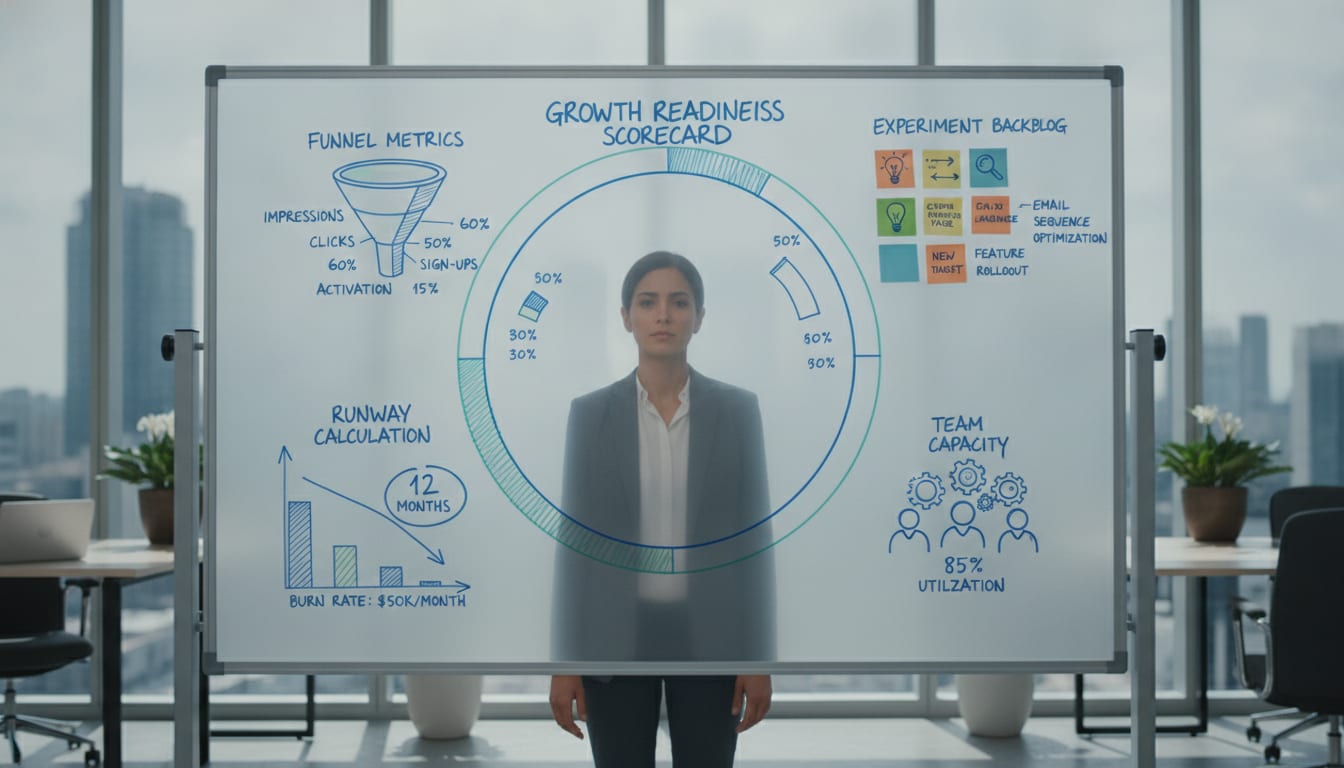
Short answer: you're ready for a growth partner when you have (1) evidence that people want what you've built, (2) enough traffic or pipeline to learn from, (3) a decision-maker who can approve changes inside a week, and (4) at least six months of runway behind the investment. Miss two or more of those and an outside pod won't accelerate you — it'll just spend your money faster.
Most founders ask "do I need a growth agency?" at exactly the wrong moment: either three months too early (still hunting for product-market fit, hoping paid ads will manufacture demand) or eighteen months too late (a growth team of five shipping nothing because nobody owns the funnel end to end). The quiz below is the diagnostic we at Growaton run informally on every inbound conversation. We're publishing it because a bad-fit engagement is worse for us than no engagement — we'd rather you self-select out in two minutes than six weeks in.
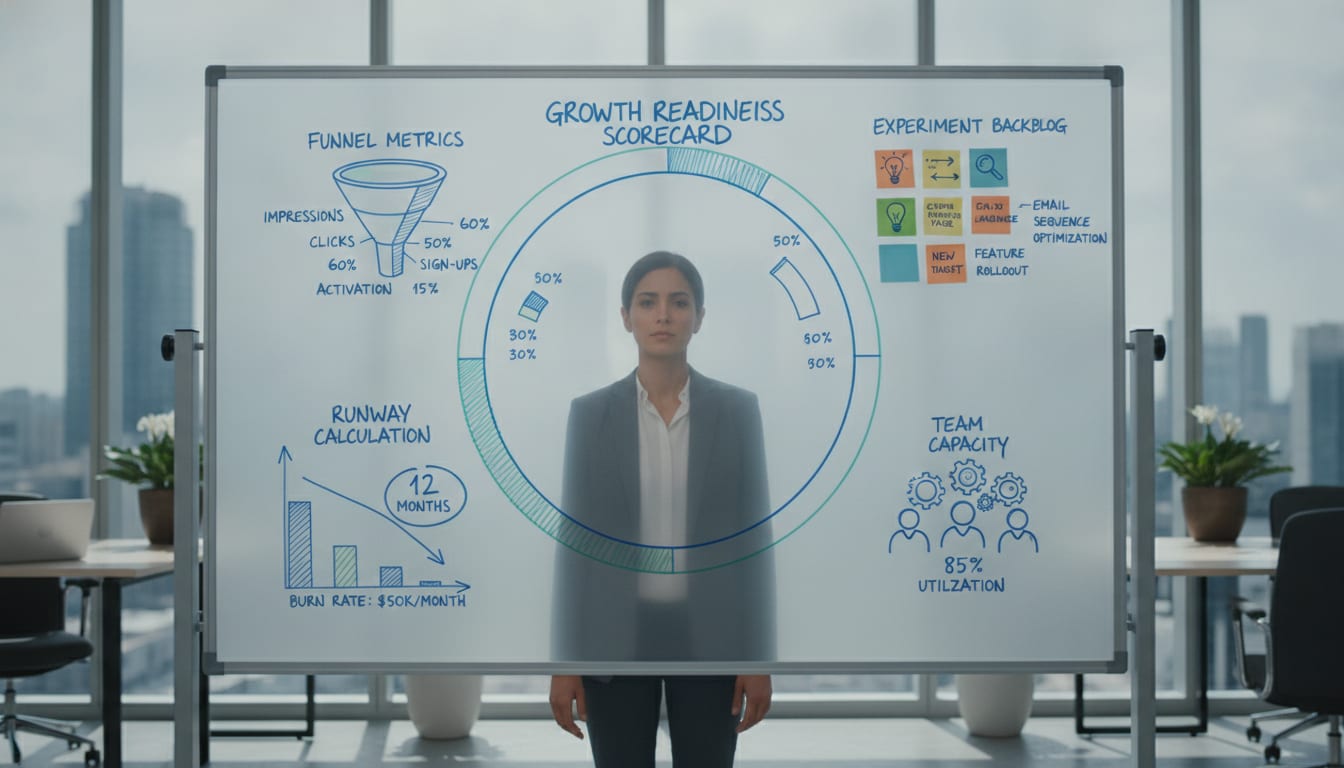
How to take the readiness quiz
Twelve questions across four dimensions. Score each 0–3 using the anchors given. Maximum score: 36. Be honest — inflating your data maturity score doesn't change your data maturity.
Keep a running tally. Scoring bands and what to do about each are at the bottom.
Dimension 1: Demand signal (are you actually post-PMF?)
This is the dimension that disqualifies the most companies, and the one founders overrate most often. A growth partner amplifies existing demand. If there's no signal to amplify, you're paying senior operators to run experiments on an audience that doesn't exist.
Q1. What's your evidence of product-market fit?
- 0 — Conviction, a waitlist, and a few design partners who haven't paid.
- 1 — Paying customers, but they came from your network and founder-led sales.
- 2 — Repeatable inbound or outbound motion producing customers you've never met.
- 3 — Repeatable motion plus quantitative retention evidence — flat-ish cohort retention curves, or 40%+ of users saying they'd be "very disappointed" without you (the Sean Ellis PMF benchmark).
Q2. What's your retention or repeat-purchase picture?
- 0 — Don't measure it, or it's a leaky bucket we're "about to fix."
- 1 — Logo churn above 4%/month (SaaS) or under 15% 90-day repeat rate (e-commerce).
- 2 — Churn is stable and roughly in line with peers for your ACV.
- 3 — Net revenue retention above 100%, or cohorts that flatten and hold.
Q3. Is there a channel you already know works, even at small scale?
- 0 — Nothing has worked consistently.
- 1 — One channel works when the founder personally runs it.
- 2 — One channel works and is documented enough for someone else to run.
- 3 — Two or more channels produce customers at defensible economics.
Why this matters: CB Insights' analysis of startup post-mortems puts "no market need" at the top of the failure list, ahead of running out of cash. Growth spend is a multiplier — and a multiplier on zero is zero. Brian Balfour's Four Fits framework makes the same point structurally: model-channel fit and product-channel fit have to exist before channel investment compounds.
Dimension 2: Measurement foundation
You don't need a perfect data stack. You need enough instrumentation that a smart outsider can tell whether last week's change helped or hurt. Without that, every engagement degrades into opinion-trading.
Q4. Can you see a full funnel from first touch to revenue in one place?
- 0 — Numbers live in four tools and nobody reconciles them.
- 1 — Top-of-funnel in analytics, revenue in the billing system, no join between them.
- 2 — Attribution is imperfect but you can trace a signup to a source and to a paid conversion.
- 3 — Warehouse or product analytics with source → activation → revenue stitched together.
Q5. Do you know your LTV:CAC and CAC payback period?
- 0 — Never calculated.
- 1 — Rough blended CAC only.
- 2 — Channel-level CAC and a defensible LTV estimate.
- 3 — Cohort-level economics with payback tracked over time.
If this one stung, run the numbers before you take a sales call — a LTV:CAC ratio calculator with payback period and cohort projections takes ten minutes and reframes the entire conversation about what a partner should be optimizing.
Q6. How many experiments did you run in the last 90 days, and do you know what you learned?
- 0 — Zero, or "we redesigned the homepage."
- 1 — A handful, results argued about rather than measured.
- 2 — 5–15 tests with recorded outcomes.
- 3 — A documented backlog, a shipping cadence, and a learning log people actually read.
Dimension 3: Capacity, ownership, and speed
This dimension predicts engagement outcomes better than budget does. The single strongest correlate we see with pod performance is how fast the client can say yes.
Q7. Who owns growth decisions internally?
- 0 — Nobody, or it's distributed across three people by default.
- 1 — The founder, in whatever hours remain after everything else.
- 2 — A named owner with authority over the funnel and budget.
- 3 — A named owner who has already scoped the problem and can brief a team in an hour.
Q8. How long does it take to get a change live on your marketing site or in-product?
- 0 — Months, or it requires an engineering sprint negotiation.
- 1 — 3–6 weeks.
- 2 — 1–2 weeks.
- 3 — Days, or we can grant a partner scoped access to ship directly.
Q9. Is engineering capacity the bottleneck on growth work?
- 0 — No — we have plenty of spare engineering capacity and just need ideas.
- 1 — Sometimes, but the roadmap is negotiable.
- 2 — Yes — good ideas die in the backlog behind product commitments.
- 3 — Yes, chronically, and we've quantified the cost of the queue.
Note the inversion: a higher score means engineering is the bottleneck. That's not a bug. If you have idle senior engineers and a clear idea backlog, you don't need an embedded pod — you need better prioritization. Growth partners earn their keep precisely where the marketing ideas outnumber the hands that can build them.
Dimension 4: Economics and commitment
Q10. How much runway do you have?
- 0 — Under 6 months.
- 1 — 6–9 months.
- 2 — 9–18 months.
- 3 — 18+ months, or default-alive.
Q11. Can you fund a partner for at least two quarters?
- 0 — We'd need results in month one to justify month two.
- 1 — One quarter, then re-evaluate hard.
- 2 — Two quarters committed.
- 3 — Two-plus quarters, budgeted, with a defined success metric agreed in advance.
Q12. Do you have a single number the engagement is accountable to?
- 0 — "Grow."
- 1 — A vague directional goal (more leads, more revenue).
- 2 — A specific metric with a target and a deadline.
- 3 — A specific metric, a target, a deadline, and agreement on how it'll be measured.
Your score: what it means and what to do next
| Score | Verdict | What we'd recommend |
|---|---|---|
| 29–36 | Ready now. You have demand, measurement, and decision speed. | Engage a full-scope embedded pod. Your constraint is execution capacity, and that's the cheapest constraint to buy your way out of. Start with a two-week diagnostic to sequence the work, then ship weekly. |
| 21–28 | Ready with a scoped start. One dimension is weak — usually measurement. | Begin with a narrow, high-leverage workstream: instrumentation plus one conversion surface. Expand scope once the data layer is trustworthy. Don't buy five workstreams you can't yet evaluate. |
| 12–20 | Not yet — fix foundations first. | Spend 60–90 days on the specific gaps below. Most of them are cheap. Then re-take this quiz. A partner hired at this stage spends the first two months doing work you could have done yourself for a tenth of the cost. |
| 0–11 | Don't hire a growth partner. You're pre-PMF or pre-revenue. | Founder-led sales, customer interviews, and product iteration. Outsourced growth cannot manufacture demand that doesn't exist. Come back when Q1–Q3 total 6 or more. |
The four instant disqualifiers
Regardless of total score, we'd decline (and you should walk away from anyone who wouldn't):
- Under 6 months of runway with no raise in motion. Growth compounding takes longer than your cash does. Cut costs or raise; don't spend.
- No paying customers. Not "free users." Paying.
- The founder wants a vendor, not a partner. If the expectation is "here's the brief, come back in a month," you want an agency, and you'll be happier with one.
- Growth is a symptom of a product problem you already know about. If churn is 8% monthly because onboarding is broken and everyone knows it, fix onboarding. No amount of top-of-funnel work outruns that math.
If you scored 12–20: the fastest foundation fixes
These are the gaps we see most, ranked by how cheaply you can close them.
- No funnel join (Q4). Two to three weeks of focused work gets source → signup → activation → revenue into one queryable place. This is the single highest-ROI pre-engagement investment, because it makes every subsequent decision falsifiable.
- No named owner (Q7). Free. Pick someone. Give them budget authority and a weekly review slot. Diffuse ownership is the most expensive free problem in startups — a theme we return to constantly in our work on building teams that actually own outcomes.
- No experiment cadence (Q6). Run six tests in six weeks, however scrappy. The point isn't the lift; it's establishing that shipping and measuring is normal behavior before an outside team arrives expecting it.
- No success metric (Q12). Also free. Pick the one number that, if it moved 30%, would change your next board meeting.
Readiness isn't the same as fit: choosing the right model
Being ready tells you when. It doesn't tell you what. Three models solve different constraints:
| Traditional agency | In-house hire | Embedded growth pod | |
|---|---|---|---|
| Best when | You need one channel executed well (paid, SEO, content) | You have a repeatable motion to scale and 12+ months of work | Growth is blocked across product, data, and marketing simultaneously |
| Time to first shipped work | 2–6 weeks | 2–5 months (search + notice period + ramp; SHRM benchmarking puts average time-to-fill in the 40-day range before ramp) | 1–2 weeks |
| Breadth | Single discipline | Single person's skill set | Product + engineering + data + marketing |
| Can ship code? | Rarely | Only if you hired a growth engineer | Yes |
| Main risk | Siloed optimization; local maxima | Wrong hire is a 6-month, six-figure mistake | Requires internal decision speed to keep up |
| Typical commitment | 6–12 months | Permanent | 2 quarters, renewable |
The honest version: if your bottleneck is genuinely one channel, hire a specialist agency and save money. Pods exist for the messier case — where the conversion problem is half copy, half onboarding flow, half missing event tracking, and no single vendor owns the whole chain. We've written a longer comparison of growth agency vs. embedded pod vs. in-house team and a breakdown of how [growth partner pricing models actually work](https://growaton.com/plans) if you're at the modeling stage.
What a well-matched engagement looks like in the first 90 days
For the readers scoring 21+, here's the benchmark to hold any partner to — including us. Our own four-phase methodology runs Diagnostics → Measurement → Conversion → Scale, and the shape looks like this:
- Weeks 1–2 (Diagnostics): funnel teardown, data audit, an ordered hypothesis backlog with estimated impact. You should end this phase knowing precisely which stage is leaking and what it's worth to fix.
- Weeks 3–5 (Measurement): instrumentation gaps closed, dashboards live, baselines locked. Unglamorous and non-negotiable. Skip it and every later result is a debate.
- Weeks 6–12 (Conversion): shipping weekly. Landing pages, onboarding flows, pricing page tests, lifecycle automation — whatever the diagnostic ranked first. Expect wins and documented losses; a partner reporting only wins is reporting selectively.
- Ongoing (Scale): double down on what worked, kill what didn't, expand into adjacent workstreams (paid, SEO, RevOps, AI automation) only where the data justifies it.
If you're twelve weeks in and still receiving strategy decks, the engagement has failed regardless of how good the decks are.
Before you sign anything
Two more things worth doing while your quiz score is fresh:
- Vet hard. Our 27-question checklist for vetting a growth partner covers the questions that surface whether a team ships or presents — seniority of the people actually doing the work, access model, how losing experiments get reported.
- Look at outcomes, not logos. Ask for the numbers, the timeline, and what didn't work. Our case study library is structured that way deliberately.
If you scored 21 or higher and want a second opinion on your sequencing, book a free growth diagnostic conversation. It's a working session, not a pitch — we'll tell you if you're better served by a specialist agency or an in-house hire, and we say that often enough that it isn't a rhetorical flourish.