Short answer: Reverse trials convert best for most self-serve B2B SaaS products — typically 2–3x the paid conversion rate of pure freemium — because they combine the low friction of a free plan with the urgency of a deadline. Free trials win when your product delivers value fast and your ACV is high enough to justify a sales assist. Pure freemium only wins when you have a viral loop, network effects, or a cost-to-serve near zero.
But "which converts best" is the wrong question if you stop there. Conversion rate is a ratio, and you can improve a ratio by making your funnel worse (fewer, more-qualified signups). What you actually care about is revenue per 1,000 signups and payback period. We at Growaton have watched founders switch to freemium, celebrate a 4x jump in signups, and then discover 9 months later that their sales team is drowning in unqualified free users while net new ARR is flat.
This article breaks down all three PLG monetization models — how they actually perform, when each one wins, and how to run the switch without torching your funnel.
The Three Models, Defined Precisely
Most confusion here comes from sloppy definitions. Let's fix that.
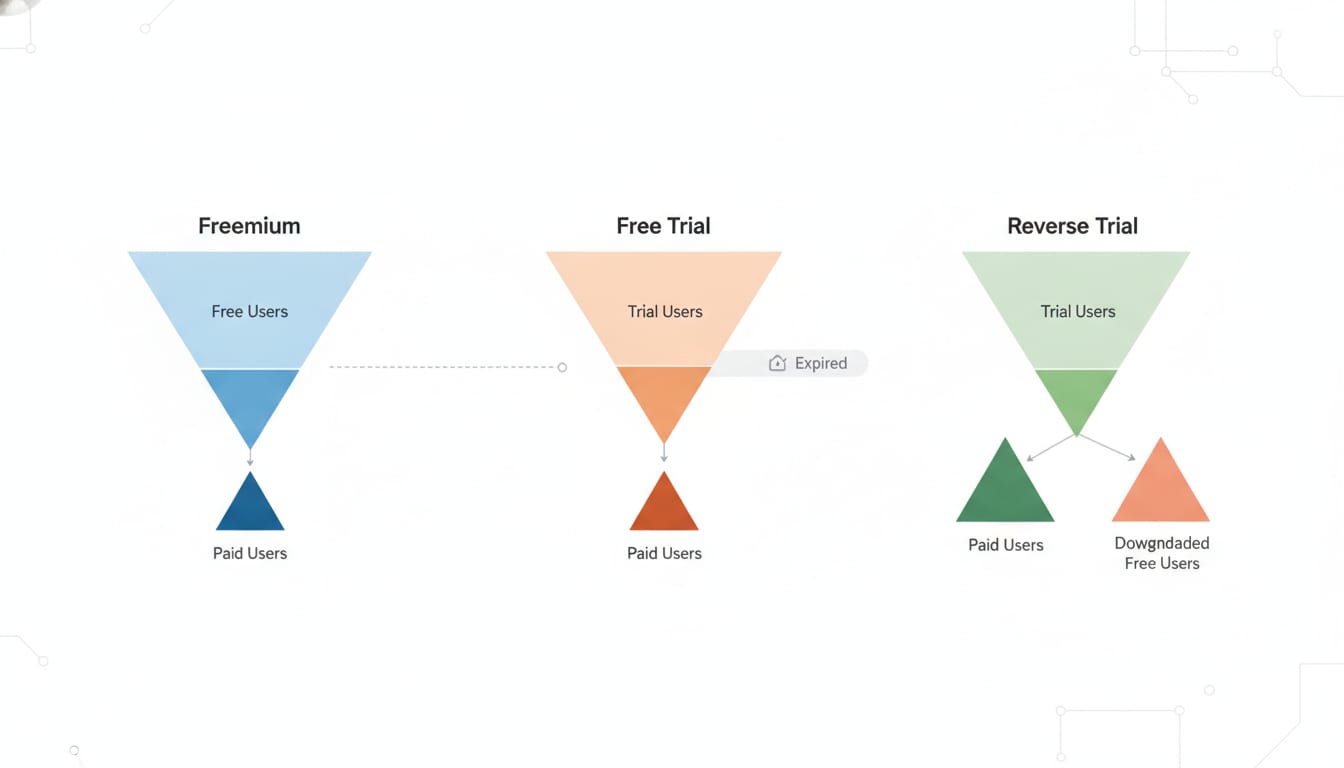
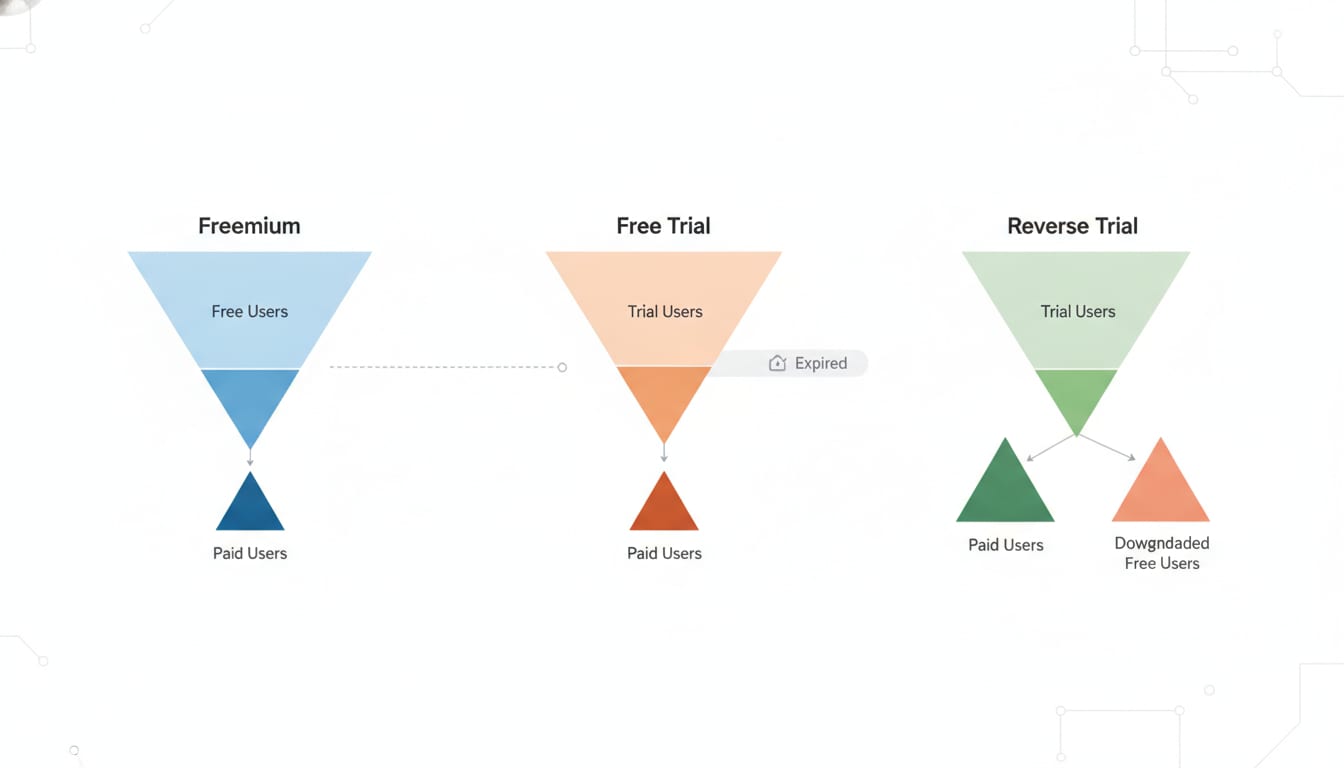
| Model | What the user gets | What happens at the end | Credit card upfront? |
|---|---|---|---|
| Freemium | A permanently free plan with limited features, seats, or usage | Nothing — they stay free forever until they hit a limit | No |
| Free trial | Full (or near-full) product access for a fixed window, typically 7–30 days | Access ends; user must pay or churn out | Sometimes (opt-out trials) |
| Reverse trial | Full premium access for a fixed window (usually 14 days), then automatic downgrade to a free plan | User keeps a limited free account indefinitely | No |
The reverse trial — a term popularized by Kyle Poyar of Growth Unhinged — is the newest of the three and the most under-adopted relative to how well it works. Notion, Canva, Slack, Loom, and Miro all run variants of it. Users experience the full-power version of the product first, form a habit, then feel the loss when premium features go away. Loss aversion does the selling for you.
There's a fourth pattern worth naming: usage-based free tiers (Twilio, Vercel, OpenAI credits). Technically freemium, but conversion is driven by consumption crossing a threshold rather than a feature paywall. Different mechanics, different playbook — we'll touch on it below.
What the Benchmark Data Actually Says
Here's where most comparison articles hand-wave. Let's use real numbers, with the caveat that benchmarks vary enormously by vertical, ACV, and how the company defines "signup."
| Model | Typical signup-to-paid conversion | Source context |
|---|---|---|
| Freemium (median) | 2–5% | OpenView / Kyle Poyar PLG benchmarks; top-quartile freemium reaches 6–8% |
| Free trial, no credit card | 8–15% | Userpilot SaaS trial benchmarks |
| Free trial, credit card required | 30–50%+ of trial starts — but 60–75% fewer starts | Opt-out trial mechanics; net revenue often similar |
| Reverse trial | ~2–3x freemium baseline, commonly 8–12% | Poyar's reverse trial research and vendor-reported case data |
Two things jump out.
First, credit-card-required trials are a filter, not a conversion strategy. A 45% trial-to-paid rate looks glorious on a dashboard and often produces the same or less revenue than a 12% no-card trial with 4x the volume — plus higher refund and chargeback rates. Always compare on revenue per 1,000 top-of-funnel visitors, not on conversion rate.
Second, freemium's low conversion rate isn't necessarily a failure. Dropbox and Slack built enormous businesses at low single-digit conversion because free users did work for them — they invited colleagues, shared files externally, generated inbound demand. If your free users generate zero distribution and cost you real money in infrastructure and support, a 3% conversion rate is just an expensive marketing channel.
The metric that actually matters
We push every client toward one number:
Revenue per 1,000 signups (R/1K) over a fixed 90-day window, segmented by acquisition channel.
R/1K collapses conversion rate, ACV, and time-to-paid into a single comparable figure. When a fintech client of ours ran freemium and free trial side by side on paid traffic, freemium showed 3.1% conversion and the trial showed 11.4% — but freemium's R/1K was actually 18% higher because trial signups skewed toward tire-kickers who'd been baited by "free full access" ads. The conversion rate lied. R/1K didn't.
If you don't have the instrumentation to calculate R/1K by channel and cohort, that's the actual bottleneck — not your monetization model. Our 4-Phase Growth Framework puts Measurement before Conversion for exactly this reason: you cannot optimize a funnel you can't see.
When Each Model Wins
Choose freemium when…
- Your product has a viral or network loop. Free users invite other users (Slack, Figma, Calendly) or expose your brand externally (Loom, Typeform, Canva).
- Marginal cost to serve a free user is near zero. No expensive inference, no per-seat vendor cost, no human onboarding.
- The value proposition needs time to compound. Note-taking, CRM, project management — products where the switching cost you're building takes months to accumulate.
- You're competing against "good enough free." If three competitors offer free plans, a trial-only funnel loses top-of-funnel share.
- Your ACV is low ($10–50/mo) and sales-assist is uneconomic.
The trap: freemium requires a genuinely well-designed gap. If your free plan solves the whole problem, nobody upgrades. If it solves nothing, nobody activates. Getting that boundary right is a design problem, not a pricing problem — and it takes several iterations.
Choose a free trial when…
- Time-to-value is under 24 hours. The user can plausibly experience the "aha" inside the window.
- ACV is $5K+ and a sales assist pays for itself. Trials create natural urgency for an SDR or AE to intervene.
- Your product requires data or setup to be valuable. Integrations, imports, and configuration mean you want the user fully committed, not dabbling in a crippled free tier.
- You need clean intent signals. A trial start is a much stronger buying signal than a free-plan signup, which makes lead scoring and RevOps routing far simpler.
The trap: trial-length dogma. Most teams default to 14 or 30 days with no evidence. Look at your activation-to-paid time distribution — if 80% of converters convert in the first 5 days, a 30-day trial just delays revenue and lets momentum die. Shorten it and add an extension offer as a sales lever.
Choose a reverse trial when…
- You're B2B self-serve with $50–2,000/mo pricing. This is the sweet spot.
- Your premium features are habit-forming but not immediately obvious. Advanced analytics, automations, permissions, integrations — things users won't discover if they're paywalled from day one.
- You want the top-of-funnel volume of freemium without the "free forever" ceiling.
- You can technically support tiered entitlements and automated downgrades. This is real engineering work. Feature flags, entitlement checks, downgrade-state UX, and billing logic all have to behave.
The reverse trial's advantage is psychological and structural at once. Structurally, you keep the free plan as a retention net — users who don't convert don't disappear, they stay in your ecosystem and can convert 6 months later when their team grows. Psychologically, you exploit the endowment effect: people value what they've already had. Removing a feature someone uses daily hits far harder than offering to sell it to them.
The trap: users feel bait-and-switched if you don't telegraph the downgrade clearly. Show a persistent, honest countdown. Name exactly which features they'll lose. Then, on downgrade day, show the specific artifacts they created with premium features that are now locked. Specificity converts; generic "upgrade now" banners don't.
A Decision Framework You Can Run in 30 Minutes
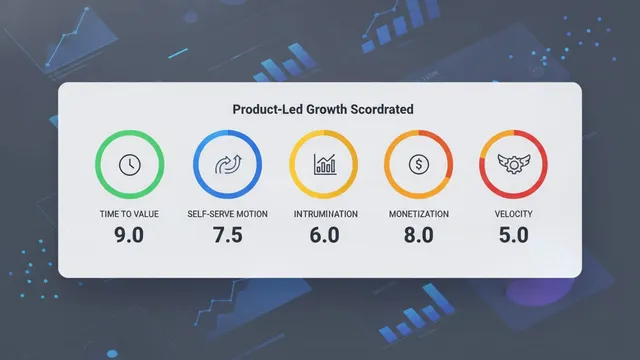
Score your product on five dimensions. Be honest.
- Time-to-value — Hours (3 pts) / Days (2) / Weeks (1)
- Viral or network loop — Strong (3) / Weak (2) / None (1)
- Marginal cost per free user — Near zero (3) / Moderate (2) / High (1)
- ACV — Under $600/yr (3) / $600–20K (2) / Over $20K (1)
- Feature depth beyond core use case — Deep (3) / Moderate (2) / Thin (1)
How to read it:
- High on viral loop + near-zero cost + low ACV → freemium. Your free tier is a distribution channel.
- High on ACV + slow time-to-value + high cost per user → free trial, with sales assist and probably a demo path in parallel.
- Everything in the middle (which is most B2B SaaS) → reverse trial. Particularly if you scored 3 on feature depth: you have premium capability worth showcasing that users would never find on their own.
- High cost per free user + high feature depth + mid ACV → reverse trial with a usage-capped free tier, not a feature-capped one. Cap the expensive thing (API calls, AI credits, storage) and leave features open.
This last pattern is increasingly common in AI-heavy products, where inference cost makes generous free tiers financially dangerous. If your COGS scale with usage, feature-gating is the wrong lever — meter the expensive resource instead. We covered the economics of this in more detail in our work on proving AI and LLM spend actually pays back.
How to Actually Migrate Models Without Wrecking Your Funnel
Switching monetization models is one of the highest-leverage and highest-risk experiments a PLG company can run. Most teams do it as a big-bang launch, then can't attribute the outcome to anything. Here's the sequence we run instead.
1. Instrument before you touch anything
You need clean event tracking on: signup → activation (defined as a specific action, not "logged in twice") → premium feature usage → paywall encounter → upgrade → 90-day retention. Segment by channel, company size, and geography. If you can't currently produce a cohort chart of signup-to-paid by week, stop and fix that first. Two weeks of instrumentation work saves you a quarter of ambiguity.
2. Run it as a holdout, not a launch
Route 50% of new signups to the new model, 50% to the existing one. Yes, running two entitlement models simultaneously is annoying. Do it anyway. Measure for a full sales cycle plus 30 days — for most self-serve B2B that's 60–90 days minimum.
3. Watch the leading indicators, not just conversion
- Activation rate should hold or improve. If it drops, your new model is confusing people.
- Premium feature adoption during the trial window is the single best predictor of reverse-trial conversion. Track breadth (how many premium features touched) and depth (frequency).
- Downgrade-day session rate — do downgraded users come back? If they never return, your free tier is too thin to serve as a retention net.
- Support ticket volume per 100 signups. A spike means your entitlement UX is broken.
4. Expect the reverse-trial-specific work
The reverse trial has more moving parts than either alternative:
- Entitlement service that can grant, expire, and revoke feature access reliably
- In-app countdown and pre-downgrade communication sequence (we typically ship day 7, day 11, day 13, and day 14 touchpoints)
- Post-downgrade state that's genuinely usable, not a nag screen
- A "reactivate premium" path that's one click, not a sales form
- Billing logic that handles mid-trial upgrades, prorations, and win-backs
This is why reverse trials are underused: they're a product-and-engineering project, not a pricing-page change. Teams that only have marketers on growth can't ship them. It's exactly the kind of cross-functional work an embedded growth pod exists to handle — product, engineering, analytics, and lifecycle in one team shipping weekly rather than three vendors negotiating scope.
5. Don't forget the pricing page
Whichever model you pick, the pricing page carries disproportionate weight. Common wins we see: naming the free tier something that doesn't feel like failure, showing the premium features as currently active during a reverse trial (with an expiry date), and putting annual/monthly toggles below the fold so the initial comparison isn't cluttered.
Hybrid Models: What the Best PLG Companies Actually Run
Almost nobody at scale runs a pure model. The mature pattern is layered:
- Reverse trial as the default self-serve path — full access for 14 days, then free tier
- Freemium tier as the long-tail net — captures users who aren't ready, keeps them in-ecosystem, supplies word-of-mouth
- Sales-assisted trial extension for high-fit accounts — when firmographic or usage signals flag an account as enterprise-shaped, an AE offers a 30-day extended trial with onboarding support
- Usage metering on expensive resources across all tiers
Slack, Notion, and Figma all operate versions of this. The model isn't a single choice — it's a routing decision made per-user based on fit signals. Getting there requires product-led sales infrastructure: PQL scoring, enrichment, routing rules, and a CRM that reflects product usage. That's RevOps work, and it's usually where the real conversion gains hide once the model itself is settled.
The Honest Verdict
If we had to give one recommendation to a seed-to-Series B B2B SaaS company with self-serve pricing between $50 and $2,000/month, it's this: run a reverse trial with a deliberately thin but genuinely useful free tier, and instrument revenue-per-1,000-signups before you launch it.
That combination gets you freemium's top-of-funnel volume, a trial's urgency, and a retention net that keeps non-converters reachable. It costs more engineering effort than either alternative — which is precisely why it's still an edge rather than table stakes.
But the model is maybe 30% of the outcome. The other 70% is activation design, paywall placement, lifecycle messaging, and whether you can measure any of it accurately. We've seen a well-instrumented freemium funnel outperform a sloppy reverse trial by 2x. The mechanics of the model matter less than the rigor with which you run it.
If you want a second pair of eyes on which model fits your product — and where your current funnel is leaking revenue — book a free growth diagnostic. We'll look at your activation data, paywall placement, and unit economics and tell you plainly whether a model change is the highest-leverage move or a distraction from something more basic. Sometimes the answer is "your pricing page is fine, your onboarding email sequence is the problem." We'd rather tell you that than sell you a rebuild.