
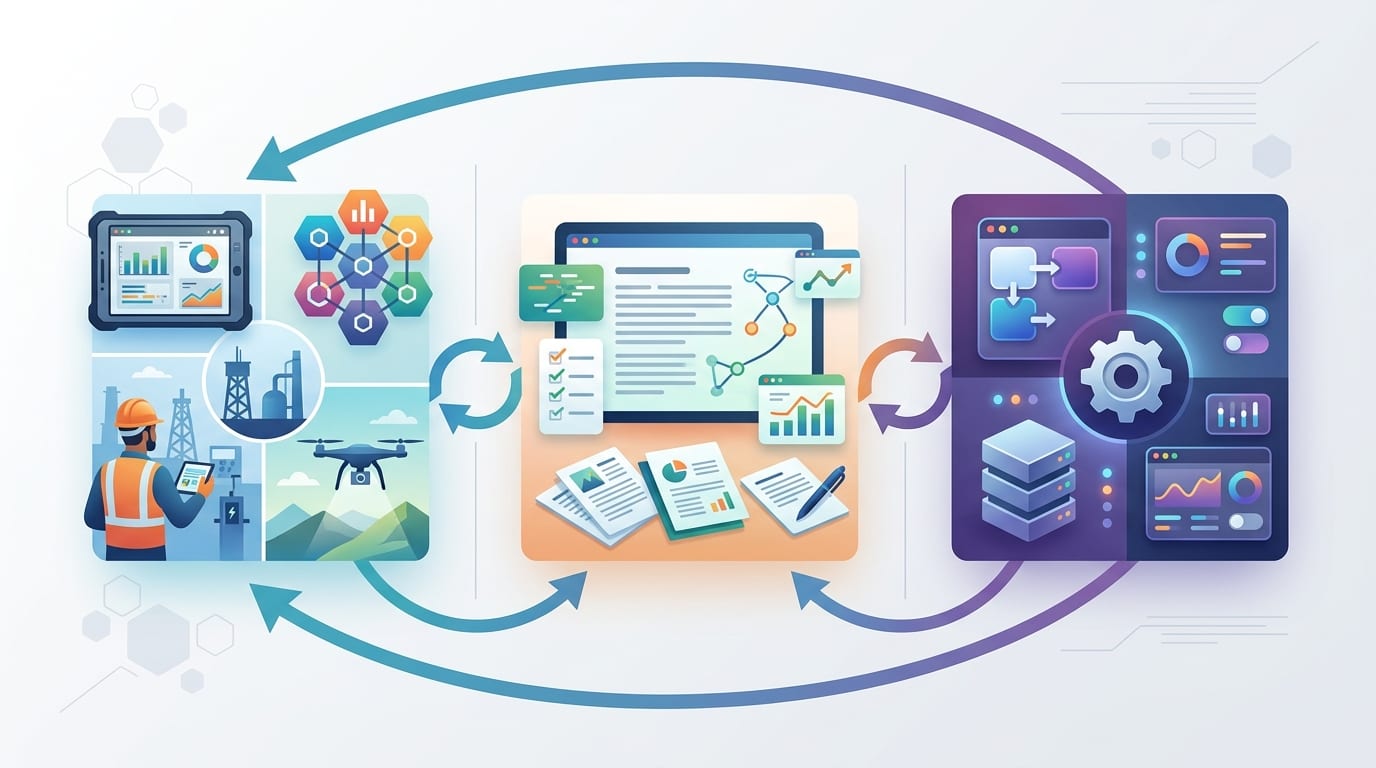
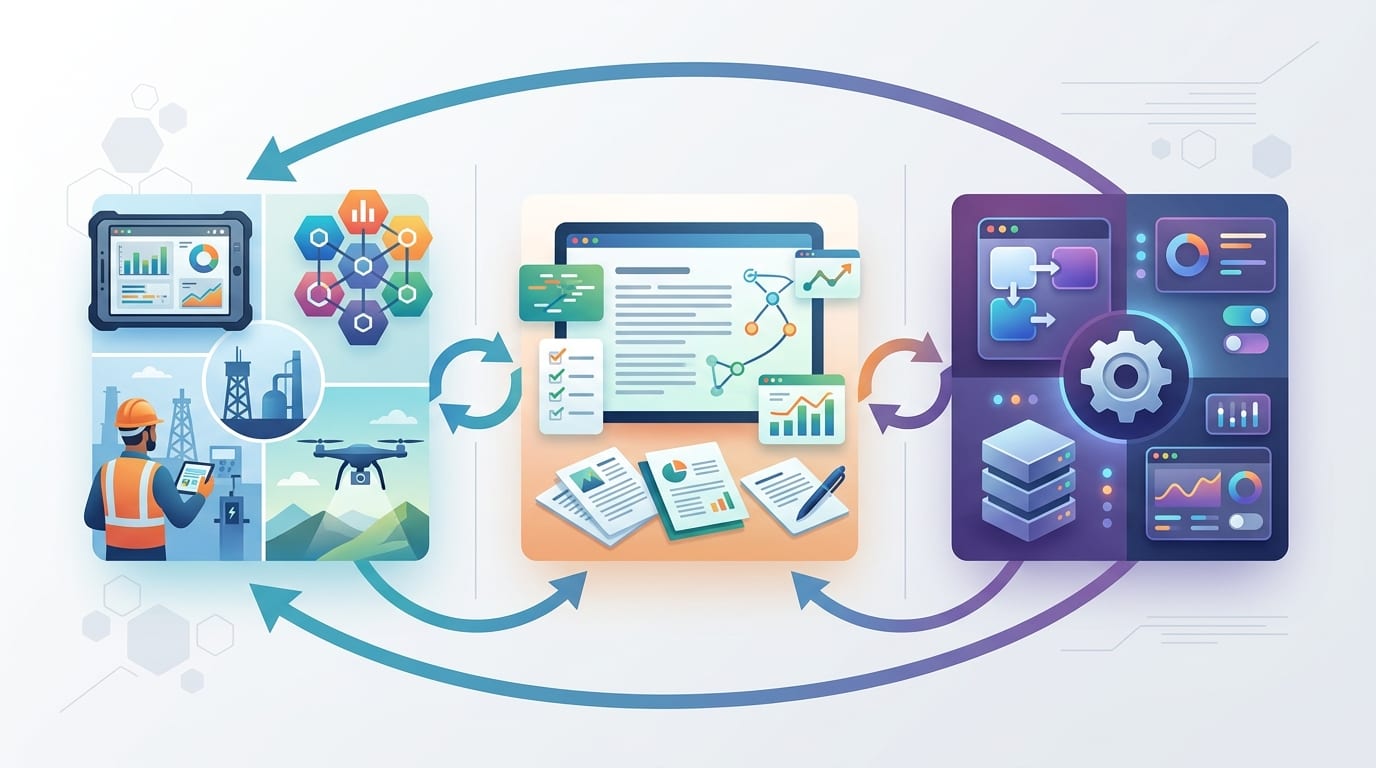
The Forward Deployed Engineer only works as a model if what the FDE learns in the client's systems ends up in your core product. If it doesn't, you built a professional services arm with a better job title and a worse margin story.
That's the honest version of the claim. Everything else in this article is the how-to: what gets written down, who decides what merges back, what the weekly cadence looks like, and the exit criterion that tells you a custom build should become a feature.
I'll say my bias up front. I think the FDE is mostly a rename. Product people with engineering backgrounds have been doing this work for fifteen years: sitting in the ops room, writing the SQL, drawing the process map, then going back and arguing with the roadmap. What's new is that the title gives a sharp mid-level operator permission to do it without a decade of scar tissue. Good news for them. A small rant for me. The rite of passage got shorter, and the part that used to be learned the hard way, the merge-back discipline, is the part most teams skip.
The short answer
Field work is defensible when it gets metabolized into the platform. Three things have to be true:
- Every engagement produces a written artifact that the core team can act on, not a Slack thread and a Looker dashboard nobody opens.
- Someone specific owns the merge-back decision and has the authority to say "this stays custom" or "this becomes a feature." Not a committee. Not the account lead.
- There's an exit criterion, a number that moves a custom build out of the field and into the roadmap.
Miss any of the three and you're running services. That's a legitimate business, it just isn't a product moat, and you shouldn't price or pitch it like one.
Why the loop is the model, not a nice-to-have
PostHog's engineering blog put the mechanism plainly in their FDE piece: "Those learnings then get used by core product teams, who generalize them for other customers." That one sentence is the whole architecture. The FDE isn't a delivery resource. The FDE is the sensor, and the core product team is the thing that acts on the signal.
We agree with this completely, and we'd push it further: if your core product team doesn't have a standing obligation to consume field output, the sensor is wired to nothing. Most companies hire the FDE and never build the receiving end.
Jision put the counterfactual bluntly on Medium: "Sitting with the customer was never the point. Plenty of companies embed engineers with customers. That is called professional services." Right. Proximity is table stakes. Dozens of integration consultancies have been sitting with customers since 2005. The differentiator was never the sitting.
And the failure mode is well documented. a16z, in their writing on the "Palantirization of everything", describes the end state as "thousands of bespoke deployments that are impossible to maintain or upgrade." That's what happens when you run the first half of the loop and not the second. Every deployment is a snowflake, every upgrade is a migration project, and your gross margin erodes one fork at a time. We agree, with one caveat: a16z frames this as a scaling risk. In our experience it shows up earlier than people expect, around deployment number five or six, when two clients ask for contradictory versions of the same thing and nobody has written down why either version exists.
The margin-versus-moat trade, honestly
Procurement Tidbits summarized the a16z position well: "a16z argued in 2025 that AI startups optimizing for 80% gross margins were being shortsighted, and that hands-on deployment work is what makes software hard to displace."
We partly agree. Hands-on deployment does make you hard to rip out. Switching cost is real, and a vendor who knows the customer's data model better than the customer does has leverage. But the argument gets abused. "We're trading margin for moat" is also what you say when your product doesn't work without six weeks of an engineer's time, and nobody is measuring whether that six weeks is going down.
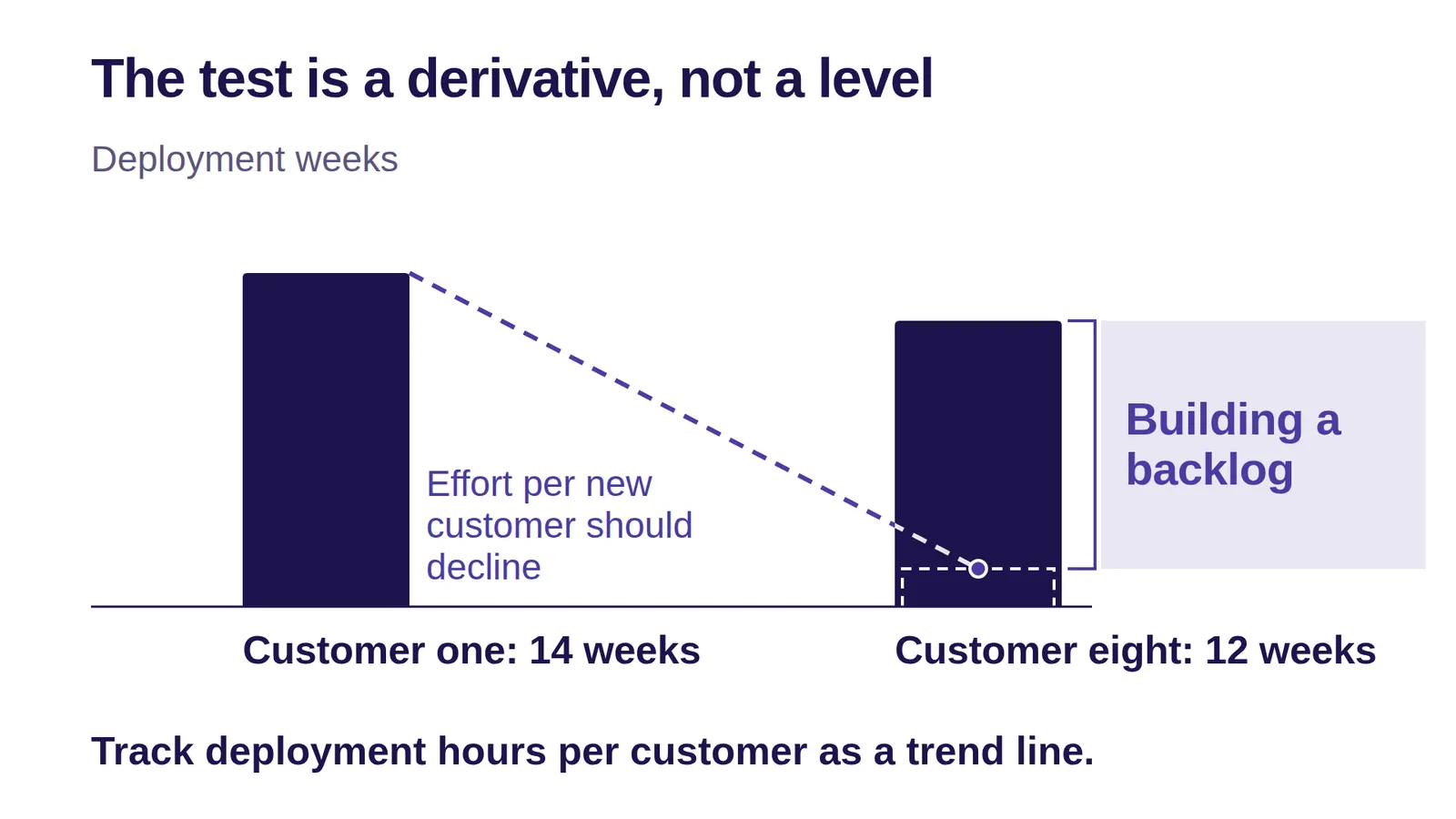
The test is a derivative, not a level. Deployment effort per new customer in the same segment should decline. If customer one took 14 weeks and customer eight still takes 12, you aren't building a moat, you're building a backlog. Trading margin for moat is a bet that the margin comes back. Write down when you expect it back, and check.
Thomas Otter is useful on the whiplash here. In his piece on the forward deployed engineer, he notes: "Two years ago or so, much of venture capital and the associated punditry insisted that all B2B products embrace product led growth, PLG." The same rooms that said touchless self-serve was the only defensible motion now say embedded humans are. Both can be partly true for different segments. What we'd resist is swallowing either as orthodoxy. PLG still works for products where the first useful action takes minutes. FDE-style motion works where the first useful action requires access to a system of record and a political negotiation about who owns it. Pick based on your activation path, not based on which fund published last.
How to build the loop
This is the part people want and nobody writes down. Here's the operating model we use at Growaton when we run an embedded pod inside a client's systems, adapted to how a product company should run its own FDEs.
1. Define the artifact before the first engagement
The output of field work is not working code. Working code is a byproduct. The output is a document, and it should be boring and standardized so the core team can read twenty of them in a sitting.
Ours has six sections:
| Section | What goes in it | Why the core team needs it |
|---|---|---|
| Job to be done | The operational outcome in the customer's language, not yours | Lets product tell a real need from a request |
| Current workaround | The spreadsheet, the Zap, the intern | Workarounds are the strongest signal of unmet demand |
| What we built | Scripts, configs, custom endpoints, with links | Prevents reinvention on deployment four |
| What's generic vs. specific | Explicit split, line by line | This is the merge-back input |
| Cost to run | Hours per month to keep alive | Converts "nice feature" into a maintenance liability you can price |
| Recurrence count | How many customers have asked for this | The exit criterion lives here |
The "cost to run" line is the one teams fight about and the one that earns its keep. A custom build that takes four engineer-hours a month to maintain is a $40k-a-year commitment at loaded senior rates across a handful of accounts. That number changes the conversation from "should we support this" to "should we support this instead of what."
2. Name a single merge-back owner
One person decides what gets generalized. In a product company that's the product lead for the platform area, not the FDE and not the account owner. The FDE has a conflict of interest: they want their customer unblocked. The account owner has a worse one.
Give the owner three verdicts and make them write the reason:
- Merge: becomes a roadmap item with an owner and a target cycle.
- Hold: real signal, not enough recurrence. Goes on a watch list with a review date.
- Stays custom: deliberately bespoke, with an expiry date and a named owner for the maintenance cost.
The third verdict is the one most teams never use, and it's the one that keeps you honest. Some things should stay custom forever. Write that down so nobody rediscovers it in nine months.
3. Run a weekly cadence, not a quarterly review
Quarterly is too slow. By the time you review, the FDE has shipped eleven things and remembers four. We at Growaton run everything on a weekly shipping cadence, and the merge-back loop rides the same rhythm.
A workable week:
- Monday, 30 minutes. FDEs post what they built last week, one paragraph each, tagged generic or specific. No meeting, written only.
- Wednesday, 45 minutes. Merge-back owner plus one core engineer go through the queue. Verdicts assigned. Recurrence counters incremented.
- Friday, 15 minutes. Anything that crossed the exit criterion gets filed as a roadmap candidate with the artifact attached.
That's 90 minutes a week to keep the loop alive. If you can't protect 90 minutes, you don't have a product strategy, you have a services pipeline with product branding.
4. Set the exit criterion in numbers
This is where most of the hand-waving happens, so be specific. A custom build should become a product feature when it hits any of these:
- Recurrence: three or more customers in the same segment have asked for it, or built the same workaround.
- Maintenance load: it consumes more than 10% of one FDE's month, or combined custom work pushes field rework above 15% of shipped output.
- Blocking a deal: it appears in two or more active sales cycles as a requirement, not a preference.
- Divergence risk: two deployments have forked the same logic and the forks disagree.
Thresholds should fit your business. The discipline is that they exist and that crossing one triggers something automatic. "We'll discuss it" is not a trigger.
5. Make the core team consume it
The receiving end needs an obligation, not an invitation. The lightest version that works: every planning cycle, the core team must either pull at least one merged item from the field queue or write one paragraph explaining why zero items qualified. The paragraph is the forcing function. Nobody wants to write it twice.
Growaton's own pods carry this as a standing rule, product, engineering, data and marketing in one group, so the person who saw the problem in the client's system is sitting in the same planning conversation as the person who owns the platform. That adjacency is most of the value. It's also why we think siloed structures, agency on one side, product team on the other, structurally cannot run this loop, no matter how good either side is.
What breaks the loop
Four failure patterns, in rough order of frequency.
The hero FDE. One person knows all nine deployments, writes nothing down, and is genuinely great. You are one resignation from a rewrite. Fix: artifacts are a delivery requirement, not documentation debt.
Merge-back by committee. Product, sales and services all get a vote, so everything becomes a hold. Fix: one owner, written verdicts, public queue.
Generalizing too early. You build the abstraction after one customer and it's wrong, so now you maintain a wrong abstraction plus two workarounds. Three customers before you generalize, as a rule of thumb, unless a single deal is large enough to carry the bet on its own, in which case say so out loud.
Counting revenue instead of learning. Field work shows green on the P&L, so nobody asks whether deployment effort is declining. Track deployment hours per customer per segment as a trend line. It's the single number that tells you which business you're in.
A note on who you send
The staffing question deserves its own treatment, and we'll get to it in this series. The short version: the person who makes this loop work is a hybrid, product thinking with enough engineering to be credible in the codebase and enough operational patience to sit through a process-mapping session. That has historically been a product manager with an engineering background. The genuine shift is that the title now lets a sharp mid-level operator do the work with clear thinking and a working understanding of systems and operations, rather than fifteen years of pattern matching.
What the shortcut doesn't cover: enterprise security review, multi-year platform bets, and the judgment calls that decide whether a fork becomes a product line. Those still escalate. Pretending otherwise is how you end up with a16z's thousands of unmaintainable deployments.
The test, in one question
At the end of every engagement, ask: what in our product is different because of this work?
If the answer is a feature, a default, a removed configuration step, or a documented decision not to build, you ran the loop. If the answer is an invoice and a happy customer, that's a fine quarter and a real business. Just call it what it is.
We run this loop inside client systems every week, and the artifact discipline is the part that separates the engagements that compound from the ones that just deliver. If you're standing up a forward deployed motion and you can't name who owns the merge-back decision, that's the conversation to have first. Book a free growth diagnostic and we'll walk through your loop, or tell you honestly that you don't have one yet.
Ship the product improvements your business needs
Growaton builds custom software, servers and infrastructure, e-commerce platforms, process automation with AI and roadmaps, deploying inside your systems every week with senior review.
product and engineering execution