
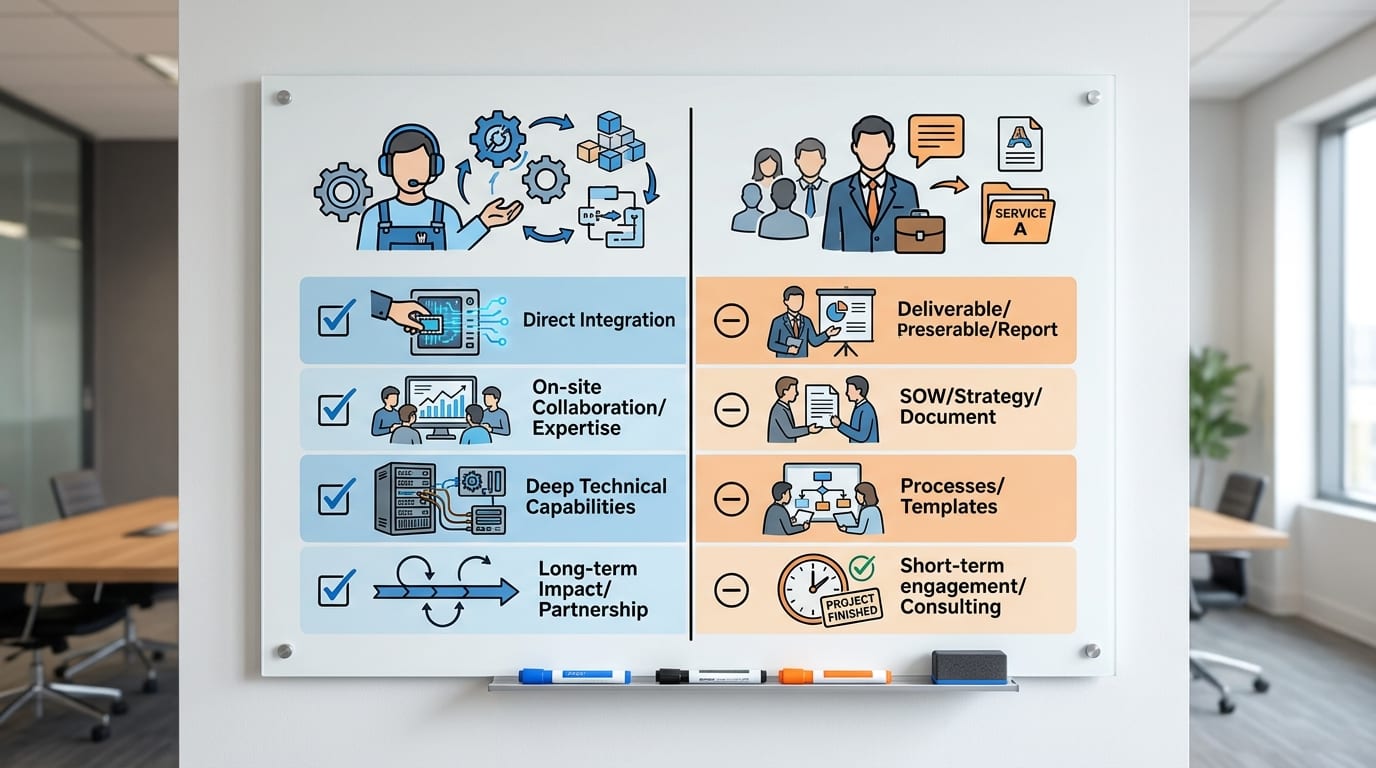
The short answer: a real forward-deployed model has a feedback loop into the product, a named person who owns a backlog, and a documented history of refusing to build things. A solutions engineer with a new business card has none of those, and bills more than the old title did.
That's the test. Everything below is how you run it during a sales cycle, before the SOW gets signed and before somebody on your team spends six months being the integration layer for a vendor who promised to be one.
Procurement Tidbits named the problem bluntly: "Analysts already warn about 'FDE washing': consulting services marketed as FDE, at premium fees, without the delivery depth to match." We agree with the diagnosis and we'd push it further. The premium fee is not the worst part. The worst part is that you buy a model you think closes a loop, and you get a model that opens tickets.
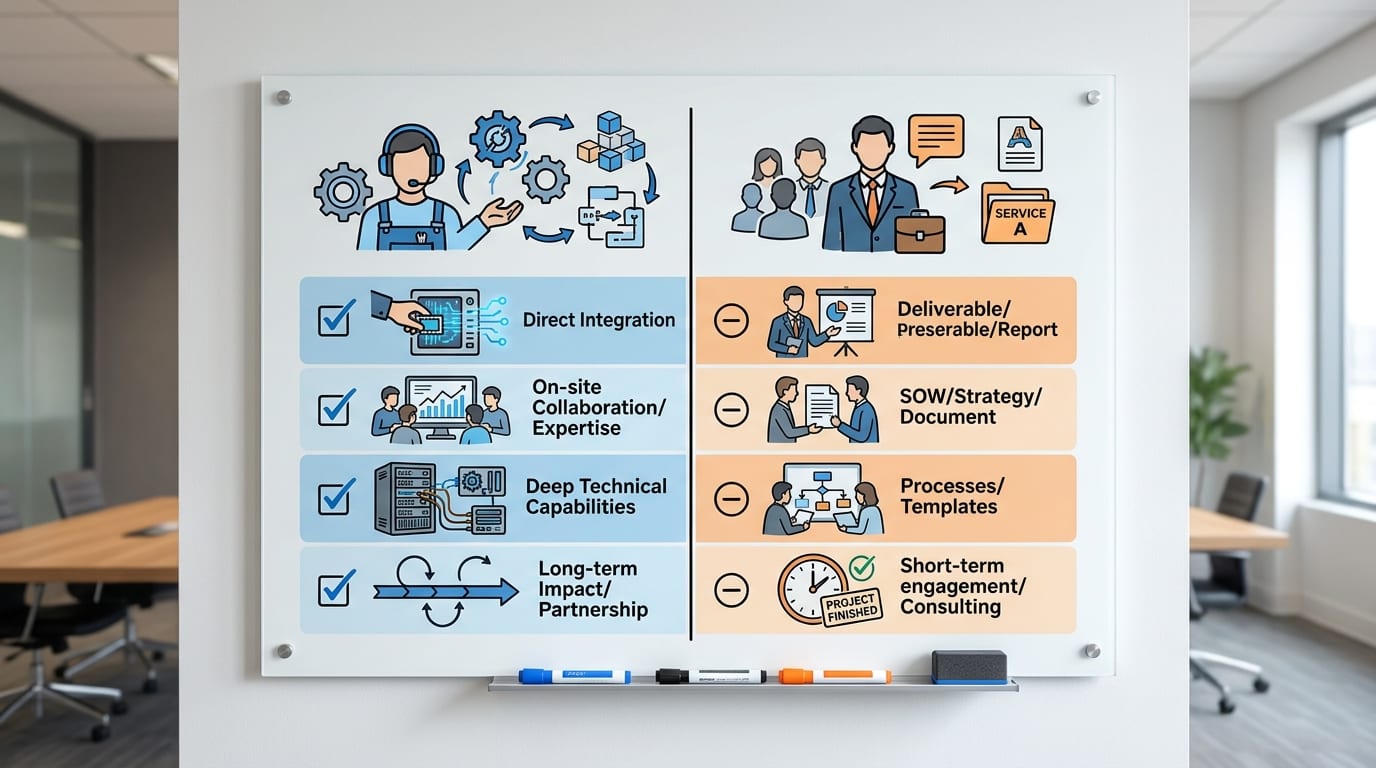
First, the honest framing: the title has outrun the definition
I've been on both sides of this. I spent over a decade at high-growth startups, from Junior Software Engineer to VP of Engineering, building an organization of 120+ people across the US, Europe and Latin America. The person who sat inside a customer's operation, learned their actual workflow, and came back with a product change nobody on the roadmap had asked for? We had those. We called them product managers with an engineering background. Some of the best work I saw shipped that way.
So when LeadDev writes that "It feels like a lot of organizations these days are just calling an FDE anybody who's customer-facing and a little bit technical," we partly agree. Partly, because the drift is real and getting worse. Partly, because the rebrand is also doing something useful: it shortens the rite of passage. You no longer need fifteen years to be dangerous in this role. You need clear thinking and a working model of systems and operations. That's good news for a lot of talented people who would have waited a decade for the title.
Jision, writing on Medium, put the gap precisely: "The title is spreading faster than the operating model behind it." And the sharper line from the same piece: "Sitting with the customer was never the point. Plenty of companies embed engineers with customers. That is called professional services."
Right. Professional services is a legitimate business. It is just not the thing you are paying an FDE premium for. The six questions below separate them.
1. Ask who owns the backlog, and get a name
Not "we work closely with product." A name, a title, and an answer to one follow-up: can that person put an item into the core product backlog without a separate business case?
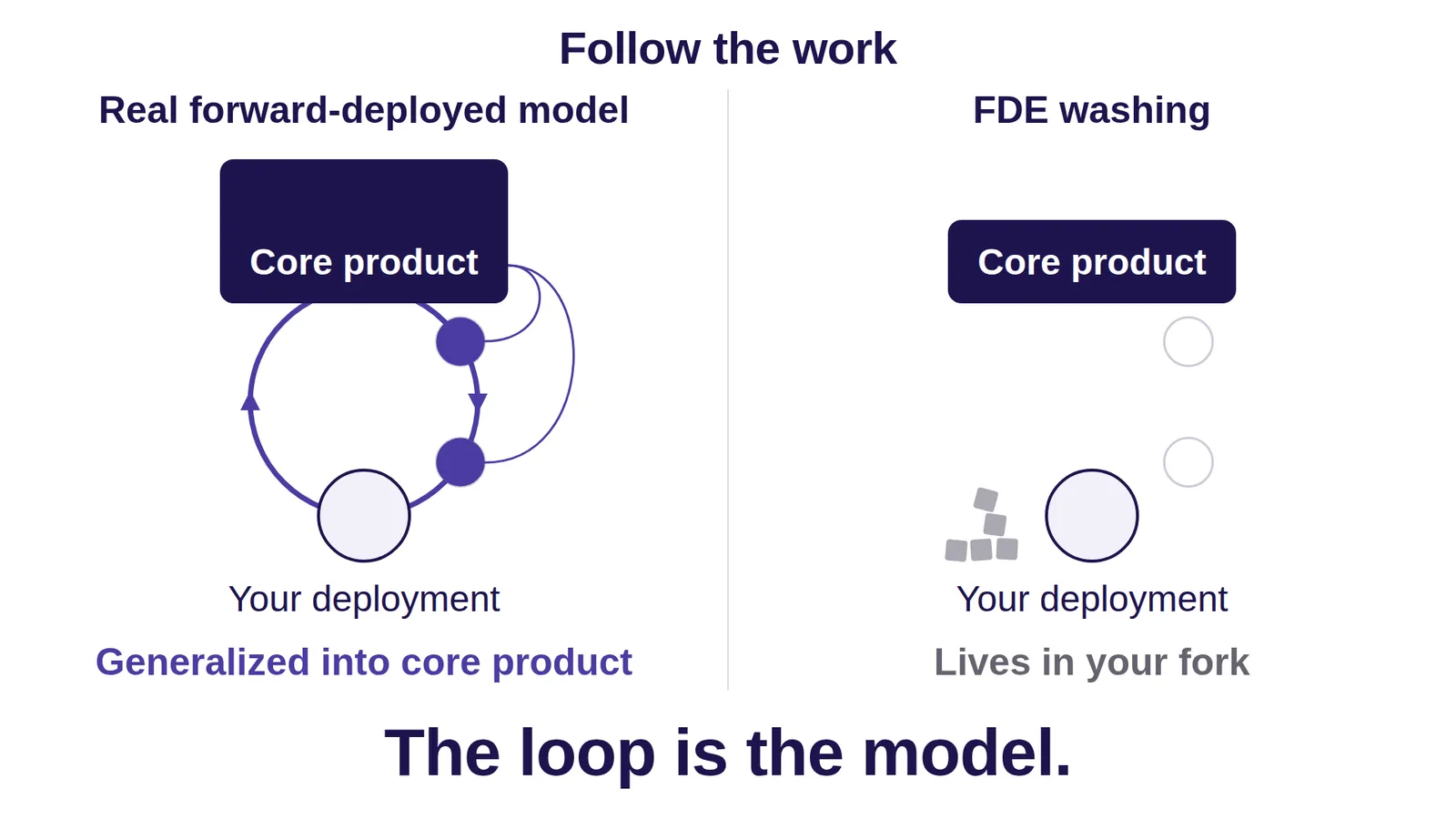
In a real forward-deployed model, the field person writes directly into the product queue. The work they do in your environment becomes an input to what the vendor builds for everyone. PostHog described the loop cleanly: "Those learnings then get used by core product teams, who generalize them for other customers."
That is the model. We agree completely, and we'd say the loop is the model. Strip it out and you have a staffing arrangement.
What a washed answer sounds like: "Our FDEs file feature requests through customer success, which get reviewed quarterly."
What a real answer sounds like: "Mariana owns the deployment backlog for your account and has commit access to the integrations repo. Anything she generalizes goes into our Q2 planning doc directly. Here are three items from last quarter that came from a customer deployment."
Ask for those three items. If they can't produce them in a week, the loop doesn't exist.
2. Ask whether their work ships into the product, or only into your instance
This is question one's harder twin. A vendor can have a backlog owner and still ship nothing but one-offs.
a16z, in its piece on what it calls the Palantirization of everything, flagged the failure mode: "thousands of bespoke deployments that are impossible to maintain or upgrade." That's the ceiling on the washed version. Every deployment is a new snowflake, maintained by whoever was in the room, and the vendor's margin degrades until they either raise prices or quietly stop maintaining your instance.
The concrete test: ask what percentage of code written during deployments ends up merged into the main product versus living in a customer-specific fork. Vendors running the real model have a number. It is rarely above 40%, and anyone claiming 90% is either lying or doing very little customization. Vendors running the washed model have never computed it.
Second test: ask what happens to your customizations when they ship a major version. "We'll handle the migration as part of your support agreement" is a bill. "Your workflow became a configuration option in v4" is a product.
3. Ask what they have refused to build
This is the one that separates judgment from headcount, and it's the question most vendors have never been asked.
Igor at Productics made the argument that most of the industry got the staffing wrong: "Every company racing to copy Palantir sent the engineer. Almost none of them sent the person with the mandate to say no." We agree, and it's the point we keep coming back to in this series. The differentiating skill is not the ability to write an integration under pressure. It is product judgment: the willingness to interrogate the solution the client has already decided on.
LeadDev described the behavior well: "If a client says X is the solution, an FDE will really interrogate whether that's really the case and vocally propose alternatives backed with data and evidence."
Igor also named who typically gets sent instead: "disproportionately, engineers early in their careers who have never had to tell a client no." Here's where we'd partly disagree with him, or at least complicate it. Seniority is not the variable. I've watched engineers four years in push back on a bad request harder and more clearly than people with fifteen years of title, because they'd been trained to ask what the request was actually for. The variable is whether the organization gives the person the mandate and backs them when they use it.
So ask for the story. "Tell me about a time your deployed engineer told a customer no, and what happened to that account." A vendor with a real model has a slightly uncomfortable story and will tell it. A washed vendor will tell you they've never had to say no, which means they've said yes to everything, which means the bespoke-deployment pile from question two is already enormous.
4. Ask how many customers that person carries
Load is the quietest signal and the hardest to argue with.
Somebody covering eight accounts is not embedded. They are a technical account manager with a calendar. Somebody covering one or two accounts has the room to learn an operation well enough to tell you something you didn't know about your own workflow, which is the whole reason you'd pay for this.
| Question | Real forward-deployed model | FDE washing |
|---|---|---|
| Accounts per person | 1-3 | 6-12, "flexible" |
| Backlog ownership | Named person, direct commit to product queue | Requests routed through CS |
| Work destination | Generalized into core product | Lives in your fork |
| Refusals | Has documented examples | "We make it work" |
| Pricing shape | Partly product, partly deployment | Pure T&M or day rate |
| Exit plan | Documented handover, your team runs it | Renewal conversation |
Ask for the ratio in writing. Ask who else is on the roster. Then ask what happens when two of those accounts have an incident in the same week, because that answer tells you whether anyone has thought about sustainability or whether the role is being run at 100% utilization because it bills.
5. Ask how they price it, and look for product in the number
Pricing shape leaks the operating model. If the whole engagement is time and materials at a day rate, you are buying consulting, and you should negotiate it as consulting. That is not an insult; it's just a different purchase with different leverage.
A real forward-deployed model has a mixed shape, because the vendor expects to earn the deployment cost back in product improvement. Look for:
- A license or platform component that exists independently of the deployed person
- A deployment fee that is capped, phased, or tapers after a defined period
- Some portion of the scope defined by outcome rather than hours
And one specific red flag: a day rate that goes up for the "FDE" tier without any change in what the person is accountable for. That's the premium Procurement Tidbits warned about, charged for a business card.
6. Ask for the move-out plan before you discuss the move-in
Procurement Tidbits framed the whole engagement as a move-in that needs a planned move-out, and that's the right instinct. The question is simple: in month nine, what does my team own without you?
Make them produce:
- A handover artifact list. Runbooks, architecture notes, data contracts, test coverage. Named documents, not "documentation."
- A named person on your side who shadows from week one. If the vendor doesn't ask who that is, they are planning to be permanent.
- An exit criterion with a date. "Internal team runs the weekly reconciliation job unassisted by week 20" is a criterion. "Knowledge transfer throughout the engagement" is not.
We build engagements this way at Growaton because we think the alternative is dishonest. A partner whose model only works while they're still in the building has an incentive to keep you dependent, and you'll feel that incentive in every scoping conversation for the next two years.
What to do with the six answers
Run all six in one call. The pattern matters more than any single response, because a competent sales engineer can pass any one of them cold.
Score it roughly:
- Five or six solid answers: real model. Negotiate on scope and load, not on whether the thing exists.
- Three or four: professional services with a genuine product behind it. Fine purchase. Price it as services and build your own exit plan, because they won't.
- Two or fewer: FDE washing. Either renegotiate to a day rate you'd pay any good consultancy, or walk.
The underlying point of this series is that the forward-deployed title mostly renames work that operations-minded product people with engineering chops have been doing for fifteen years. That rename is useful: it makes the path shorter and legible for people who think clearly and understand systems. It is also a gift to anyone who wants to charge more for the same deck.
The six questions are how you tell those two apart. None of them are clever. They're just specific, and specific is what the washed version can't survive.
If you're evaluating an embedded partner right now and want a second read on the answers you got, book a free diagnostic conversation. We'll go through the scope with you. No deck.
Ship the product improvements your business needs
Growaton builds custom software, servers and infrastructure, e-commerce platforms, process automation with AI and roadmaps, deploying inside your systems every week with senior review.
product and engineering execution