
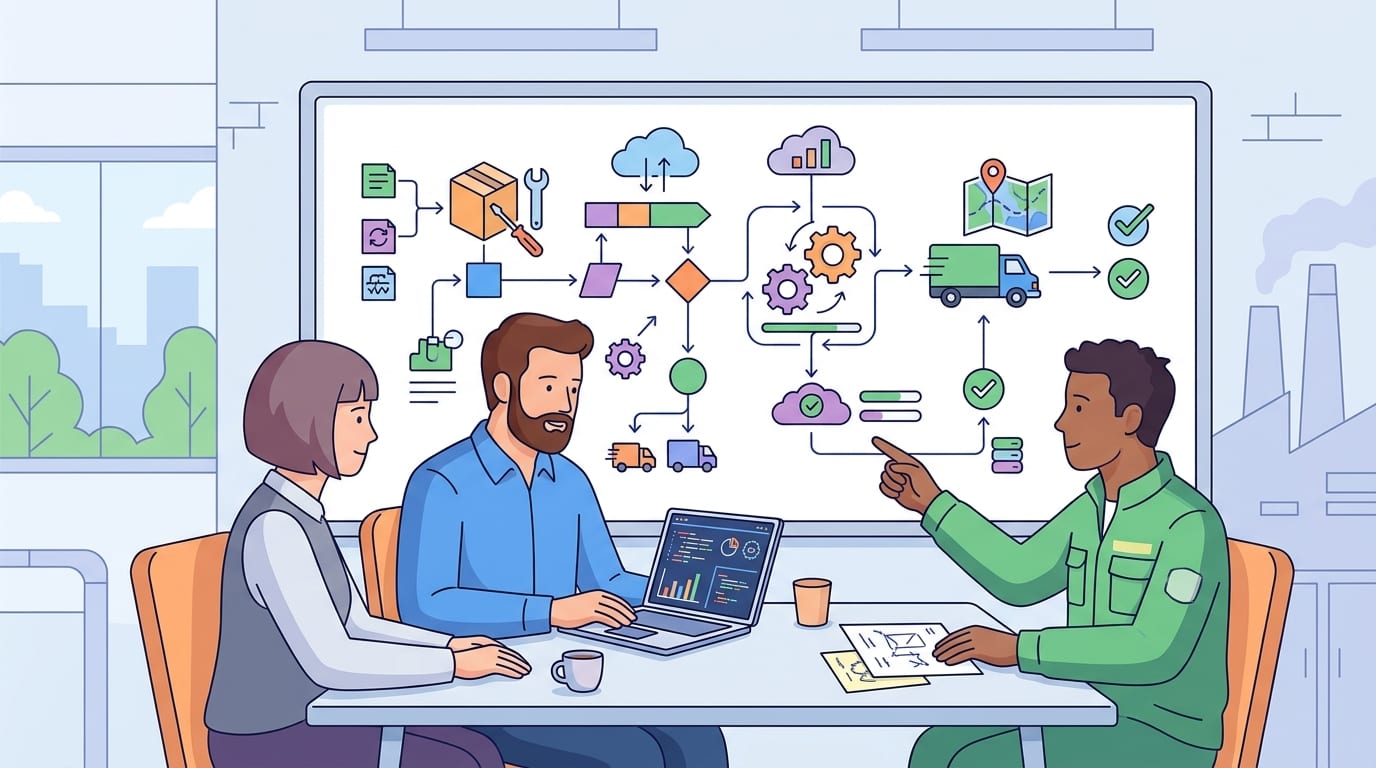
A Forward Deployed Engineer is someone your company embeds inside a customer's operation to build against that customer's reality instead of your roadmap. They sit in the customer's office or their Slack, watch how the work actually happens, and ship software that fits the mess they found. Then, if the company running the model has any discipline, what they learned goes back into the product.
That is the definition. Here is the honest part: the job is older than the title. Operations-minded product people with an engineering background have done exactly this work for a long time, usually without a name that sounded good on LinkedIn. The rename is mostly marketing. It is also, as I will argue below, genuinely useful, because it shortened a rite of passage that used to take fifteen years.
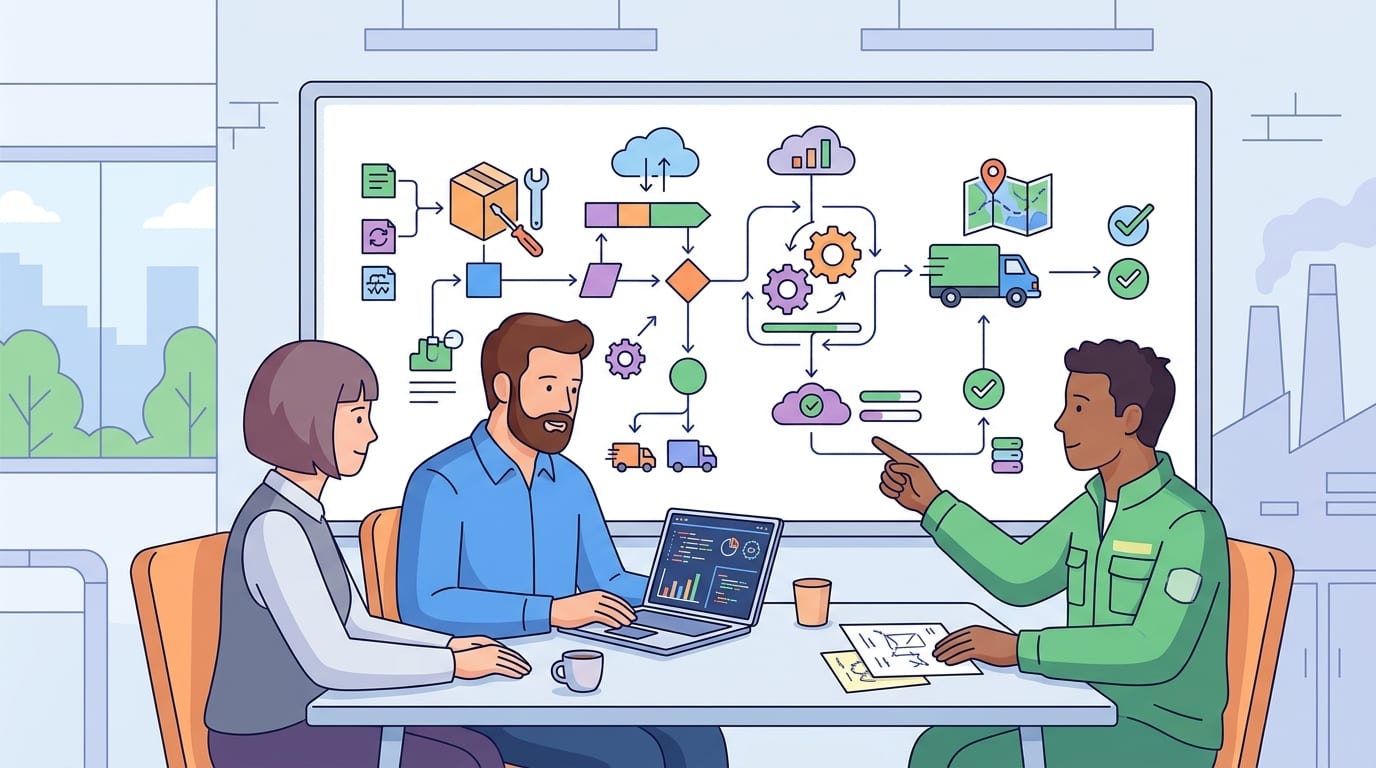
What the role actually is, in plain terms
Strip away the branding and an FDE does four things:
- Learns the customer's operation well enough to argue with them about it. Not a discovery call. Weeks of watching the work, the spreadsheets, the shadow processes, the one person who knows why the export breaks on Mondays.
- Builds in the customer's environment. Integrations, data pipelines, glue code, internal tools, configuration that is really engineering with a nicer name.
- Owns the outcome, not the ticket. The measure is whether the customer's operation got better, not whether the sprint closed.
- Carries the learning back into the core product. This is the step most companies skip, and skipping it is what turns the model into billable hours with extra travel.
The difference between an FDE and a solutions engineer is not technical depth. It is who owns the backlog. If the deployed person can decide what gets built and get it merged into the product, you have forward deployment. If they can only file requests into someone else's queue, you have a well-paid implementation consultant with a new business card.
The term is outrunning the definition
The title spread faster than any shared meaning for it, and the people closest to the work say so out loud.
LeadDev captured the complaint directly: "It feels like a lot of organizations these days are just calling an FDE anybody who's customer-facing and a little bit technical." That matches what I see in job descriptions. Half of them are field engineering. The other half are a support escalation path with a raise attached.
Writing on Medium, Jision put it more sharply: "The title is spreading faster than the operating model behind it." I agree with the diagnosis and would add the mechanism. Titles spread cheaply. Operating models require you to change who owns the roadmap, how you staff, and how you account for margin. One is a find-and-replace in a job req. The other is an org redesign.
On the buy side, Procurement Tidbits flagged the commercial consequence: "Analysts already warn about 'FDE washing': consulting services marketed as FDE, at premium fees, without the delivery depth to match." If you are a founder buying this from a vendor, that is the line to keep in your head during the pitch. Premium pricing is being attached to a label, and the label currently guarantees nothing.
Where I only partly agree with the critics: the vagueness is not purely a scam. New categories are vague for a while because practitioners are still arguing about boundaries. The problem is that right now the vagueness is doing commercial work, and it is doing it in the vendor's favor.
The older name for it
Here is the lineage, and it is not flattering to anyone's branding deck.
Wikipedia's entry on the role notes that "Venture capital firm Andreessen Horowitz described the title 'forward-deployed engineer' as 'title arbitrage'." That is a VC firm describing the thing it is also promoting as an arbitrage on prestige. Credit for the candor.
Procurement Tidbits said the quiet part plainly: "Vendor engineers sitting at the customer, configuring, integrating and fixing things until the system works? We used to call them implementation consultants." Tom White, writing in White Noise under the title "Sexy Titles, Unsexy Work," makes a compatible argument about how attractive labels get attached to work that has always been unglamorous.
I agree with both, with one correction to the lineage. The best version of this role was never an implementation consultant. It was a product manager with an engineering background who refused to stay in the building.
I have worked with a handful of those people over a decade of building engineering organizations across the US, Europe and Latin America. They were a mash of operations, engineering and product, and none of those three disciplines fully claimed them. They would spend two weeks inside a customer's warehouse or a bank's back office, come back with a model of how the work actually flowed, tell you that three of the five requested features were solving a symptom, and then write the migration script themselves because waiting for a sprint slot would have cost another month. Nobody called them Forward Deployed Engineers. They were usually called "the PM who actually knows the system," which is a sentence, not a title.
So: mostly a rebrand. Partly a rebrand of the wrong ancestor.
| Older name | What it actually meant | How it maps to FDE |
|---|---|---|
| Implementation consultant | Configure and integrate until the system works at the customer | Same field work, no mandate to change the product |
| Solutions engineer | Technical pre-sales, demo and scope | Customer-facing, but owns no backlog |
| Technical account manager | Relationship plus escalation routing | Owns the account, not the build |
| Embedded product manager with engineering depth | Model the operation, refuse bad requests, ship the fix | The real ancestor. Judgment plus hands. |
Why the rebrand is still useful
I spent the last two sections calling the title arbitrage. Now the argument for keeping it.
The rename shortened the rite of passage. The embedded-product-engineer hybrid used to be an emergent role. You could not apply for it. You accumulated it: five years in engineering, five in product, a few painful years in or near operations, and somewhere around year fifteen you had the pattern library to walk into someone else's business and be useful in week two. There was no title to hire for and no path to train toward, so the supply was accidental.
Naming the role creates a target. And once there is a target, you can describe the entry requirements honestly, which turn out to be lower than fifteen years:
- Clear thinking under someone else's constraints. The ability to hold a messy operation in your head and find the one bottleneck that matters.
- A working model of systems. Not mastery of a stack. Knowing what a queue is, what happens when data arrives late, where state lives, why the integration will break.
- A working model of operations. How work moves between people, where handoffs leak, what a shift actually looks like.
- The nerve to refuse a request. This is the hard one and it does not correlate with years.
A sharp person with three or four years of real building can clear that bar. I have hired and trained engineers into roles like this, and the constraint was never raw talent. It was that nobody had ever written down what the job was, so nobody could practice it deliberately.
That is the good news. The rant is attached to it. A shorter rite of passage also means a larger population of people who have the title and not the judgment, which is precisely the gap LeadDev and Jision are pointing at. Both things are true. The role got more accessible and the average holder of the title got weaker. If you are hiring, that means the title tells you nothing and your interview has to carry the whole load.
Where a16z is right, and where I part ways
a16z's piece, "Trading Margin for Moat", makes the strategic case: implementation-heavy software companies can out-build product-led darlings in hard enterprise categories, because the deployed work creates defensibility that a self-serve signup flow never will.
I think that is right. Doing the unglamorous embedded work well is a moat, and it is a moat precisely because it does not scale cheaply. Competitors can copy your pricing page in a week. They cannot copy four years of knowing how a specific industry's operation actually runs.
Where I disagree is the staffing default. The article, and most of the hiring that followed it, assumes the deployed person should be an engineer. The differentiating skill in the first four weeks on site is product judgment: interrogating the customer's stated solution, finding the request underneath the request, and refusing to build the bad one. Breadth of stack helps. It does not substitute.
My rule: send the hybrid. If you do not have a hybrid, send the product person with engineering background and give them a developer. Not the reverse. An engineer with no product judgment will build exactly what was asked for, beautifully, and you will have burned a quarter of margin producing a feature that should have been a conversation.
Staffing this by headcount instead of by judgment gets you the margin hit without the moat. That is the expensive failure mode, and it is common.
The honest open questions
Two things about this role are genuinely unsettled, and anyone telling you otherwise is selling.
Sustainability. The role combines travel, other people's fires, a rare skill mix, and a resolution clock set by someone else's quarter. The Pragmatic Engineer's breakdown of the role and the LeadDev reporting both circle this without resolving it. Most companies run these people at full utilization because field time bills and build time does not. At Growaton we split field weeks from build weeks on a fixed cadence and rotate people out of accounts on a schedule. It costs capacity. We accept the cost, because the alternative is losing the person in eighteen months and with them the entire model of the customer's operation.
Durability. A fair reading of the current FDE boom is that it is a bet on AI being immature rather than on AI being permanent. Enterprises cannot self-serve adaptive systems yet, so humans ground them. I partly agree. The humans are not going away, but the shape of the work moves from building the integration to defining what good looks like, writing the evaluation, and owning the judgment call the system cannot make. Treat the current structure as a phase, not a durable org design, and invest now in the part that survives: documented models of how your customers' operations work.
If you are buying this, test for it
Six questions, and they take about ten minutes in a vendor call:
- Who owns the backlog for the work this person does?
- Has any of their field work shipped into your core product? Name the feature.
- What has this person refused to build for a customer, and what happened?
- How many customers does one deployed person carry?
- What is the split between field weeks and build weeks?
- Who writes the model of the customer's operation down, and where does it live?
Vague answers to one and two mean you are buying implementation consulting at FDE prices. That is the washing Procurement Tidbits warned about, and the test is this cheap.
Our position, compressed
Forward Deployed Engineer is largely a rename of work that operations-minded product people with engineering depth have done for years. The rename is still worth having, because it turned an accidental role into a trainable one and dropped the entry cost from fifteen years of accumulated scar tissue to clear thinking plus working models of systems and operations.
The cost of the shortcut is that the title now travels faster than the skill. Interview for judgment, not for the words on the résumé. Send the hybrid. Keep the backlog with the deployed person. Split field weeks from build weeks and pay for it.
We at Growaton run embedded senior pods on this logic: product, engineering, data and growth in one unit, shipping into the customer's reality on a weekly cadence, with the learning going back into the product rather than into a billable hours report. If you want a candid read on whether an embedded model fits your stage, book a free diagnostic conversation. If you would rather read first, the rest of our writing on growth systems covers the operating model in more detail.
Ship the product improvements your business needs
Growaton builds custom software, servers and infrastructure, e-commerce platforms, process automation with AI and roadmaps, deploying inside your systems every week with senior review.
product and engineering execution