Performance drops, someone pulls up the billing dashboard, and three tools get cancelled by Friday. I have watched this happen more times than I can count, and I have yet to see it move CAC. The money is not lost in the subscriptions. It is lost in the handoffs between the CRM, the analytics layer, the ad platforms and whatever the sales team actually types into.
The short version: tool count is a cost problem. Disconnection is a revenue problem. They are not the same problem, and only one of them explains why your spend decisions look like guesswork.

What cutting tools actually does fix
I am not going to pretend consolidation is useless. A few real problems get solved by removing software, and if you have any of these, go ahead and cut.
| Problem | Does cutting tools fix it? |
|---|---|
| Line-item spend you cannot justify | Yes, directly |
| Four people maintaining overlapping tag managers | Yes |
| Security and data processing agreements nobody reviews | Yes |
| Seat licenses for a tool two people opened last quarter | Yes |
| Ad platform and CRM disagree on what a lead is | No |
| You cannot tell which channel produced last month's pipeline | No |
| Paid spend optimizes toward form fills that never close | No |
| Board deck and funnel report show different revenue | No |
The top half of that table is housekeeping. Do it in an afternoon. The bottom half is where the budget actually burns, and no amount of unsubscribing touches it.
The gaps are where the money goes
AI Digital put it cleanly in their piece on martech stack optimization: "The problem is not the number of tools, but the lack of connection between tools, data, and decisions." I agree, with one addition. The connection that matters most is the one back into the systems that spend money. A dashboard that knows the truth and cannot tell Google Ads about it is a very expensive wall decoration.
Here is where I usually find the leaks, in the order I find them.
No shared identity key
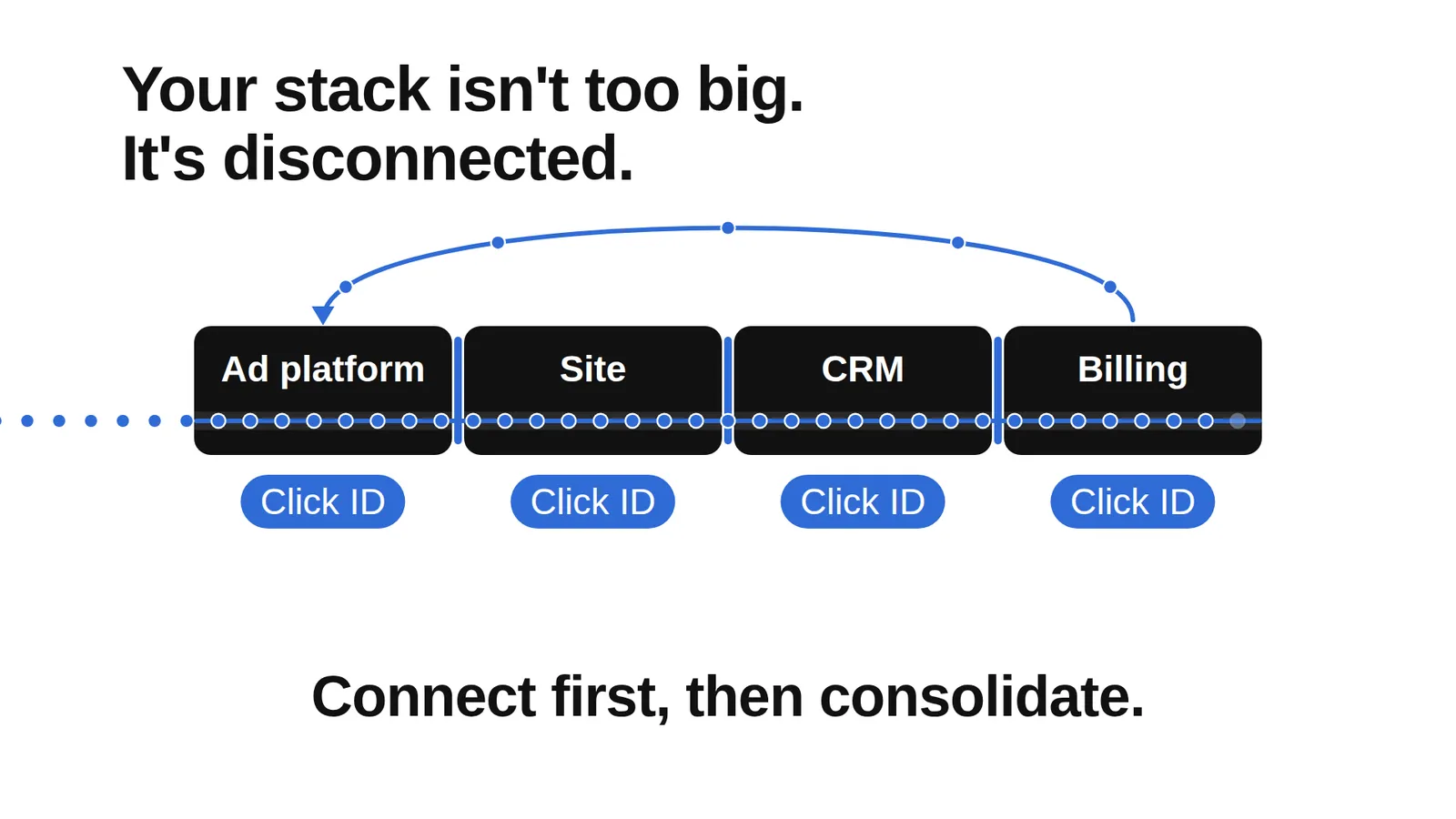
The ad platform knows a click ID. The site knows an anonymous cookie. The CRM knows an email. The billing system knows an account ID. If no single key survives the whole chain, every attribution model after that point is a reconstruction, not a measurement. You can run a perfectly rigorous A/B test and still not know which of the two variants produced revenue, because revenue lives three systems downstream of where the test ran.
Definitions that drift per team
"Lead" means a form fill in the ads account, a contact record in the CRM, and a qualified conversation in the sales pipeline. Three numbers, one word, and a weekly meeting where nobody is lying and nobody agrees. I sat with a Series A team last year whose paid report showed 1,400 leads for the month and whose sales system showed 310 worth calling. The media spend had been optimizing toward the 1,400 for eleven months.
Delay between signal and spend
Most closed-won data reaches the ad platforms late, if it reaches them at all. A 45-day sales cycle with no offline conversion upload means the bidding algorithm is optimizing on a proxy for a proxy. The platform is doing exactly what you asked. You asked for the wrong thing.
Nobody owns the seam
Each tool has an owner. The space between two tools has none. That is where integrations break quietly, a field gets renamed, and a week of data arrives null while every individual system reports green.
Stacks grow by accident, not by design
Nobody sat down in 2021 and architected this. The same source, AI Digital, names the cause: "Martech stacks usually fail because they grow without a clear data strategy." That matches what I see on the inside. A tool arrives because a campaign needed it on a Tuesday. Another arrives with a new hire who used it at their last company. A third comes bundled with an agency that left fourteen months ago, and its tracking script is still firing.
The adtech side is worse, because the pieces were never meant to be one system. The Drum describes the buy side as stacks that "were built incrementally from separate DSPs, SSPs, CDPs, ad servers and measurement tools, so interoperability remains hard in live operations." The last three words carry the weight. Interoperability demos fine in a sales call. It fails at 9am on a Monday when a feed changes shape.
MarTech.org frames the accumulated result as a structural problem rather than a spending one: "accumulating best-of-breed marketing tools can create a structural complexity wall that slows revenue operations." I would push it one step further. The wall does not only slow revenue operations down, it changes how decisions get made. When reconciling two sources takes four days, people stop reconciling and start guessing. That is where the throw-it-at-the-wall habit comes from. Not laziness. Latency.
The fix is boring: one measurement logic, written down
Shared data standards sound like a governance project. Done properly it is about a week of decisions and a few weeks of plumbing.
1. Write the contract before you touch any tool
Pick the eight to twelve objects your business actually runs on and define each one once, with an owner and a system of record. Not a glossary nobody reads. A contract that integrations are built against.
| Object | Definition that counts | System of record | Owner |
|---|---|---|---|
| Lead | Contact with email, source and consent captured | CRM | RevOps |
| Qualified lead | Passed ICP filter, booked or accepted call | CRM | Sales |
| Opportunity | Qualified lead with amount and close date | CRM | Sales |
| Closed-won revenue | Signed contract with billing start date | Billing system | Finance |
| Channel | Mapped from click ID and UTM at first touch | Data layer | Growth |
| Account | Deduplicated by domain | CRM | RevOps |
If two teams cannot agree on a row, that row is your real constraint. Stop and settle it.
2. Make one key survive the whole journey
Capture the click ID at the landing page, store it on the contact record, carry it to the opportunity, carry it to the invoice. This is unglamorous engineering. It is also the single change that turns attribution from an argument into a lookup.
3. Push the truth back into the systems that spend
Offline conversion uploads, server-side events, value-based bidding tied to actual contract value rather than form submissions. Reporting that only flows one way, from tools into a dashboard, cannot change spend. Reporting that flows back changes it every day without anybody logging into anything. Most teams get a clearer view of unit economics and tracking integrity before they get the full pipe built, which is why the reporting and KPI layer is usually the first thing worth standing up.
4. Assign the seams
Every integration gets a named owner, a freshness check and an alert when row counts drop below an expected floor. Silent failure is the default state of a connected stack. Design for noisy failure instead.
5. Only then consider cutting tools
Once the contract exists, overlap becomes obvious. You will find two tools writing to the same field with different rules, and the choice of which to keep stops being a budget opinion. That is the right order: connect, then consolidate. Consolidating first just gives you a smaller set of disconnected systems.
How to tell which problem you have
Ask these in a room with marketing, sales and finance present:
- What is our paid CAC for last month, and can two systems independently produce the same number?
- When a deal closes, which platforms learn about it, and how many days later?
- Which identifier connects an ad click to an invoice?
- If an integration broke on Monday, when would we find out?
- Who owns the definition of "qualified"?
Hesitation on three or more means the constraint sits in the gaps. Cancelling subscriptions will not reach it. If the answers are clean and performance is still flat, then yes, go audit spend and offer, because your measurement is fine and the problem is somewhere else entirely.
Where the missing piece is not a connector but an actual system nobody built, that usually becomes an engineering job rather than a configuration one.
The honest claim
Fixing connection does not invent demand. It does not fix a weak offer, and it will not rescue a product people do not want. What it does is make every dollar after it accountable to a number you can defend, which is the precondition for everything else: experimentation that compounds, bids that respond to revenue instead of form fills, a board deck that matches the funnel report.
That is a four to eight week build in most companies, not a replatform. If you want a second pair of eyes on where your own seams are leaking, start a conversation or read how a paid diagnostic maps the numbers, systems and handoffs before anyone proposes a tool.
Get one trusted set of numbers
Reports, analytics and KPI dashboards usually ship during the diagnostic, covering unit economics, tracking and whether the numbers can be trusted.
KPI dashboards