
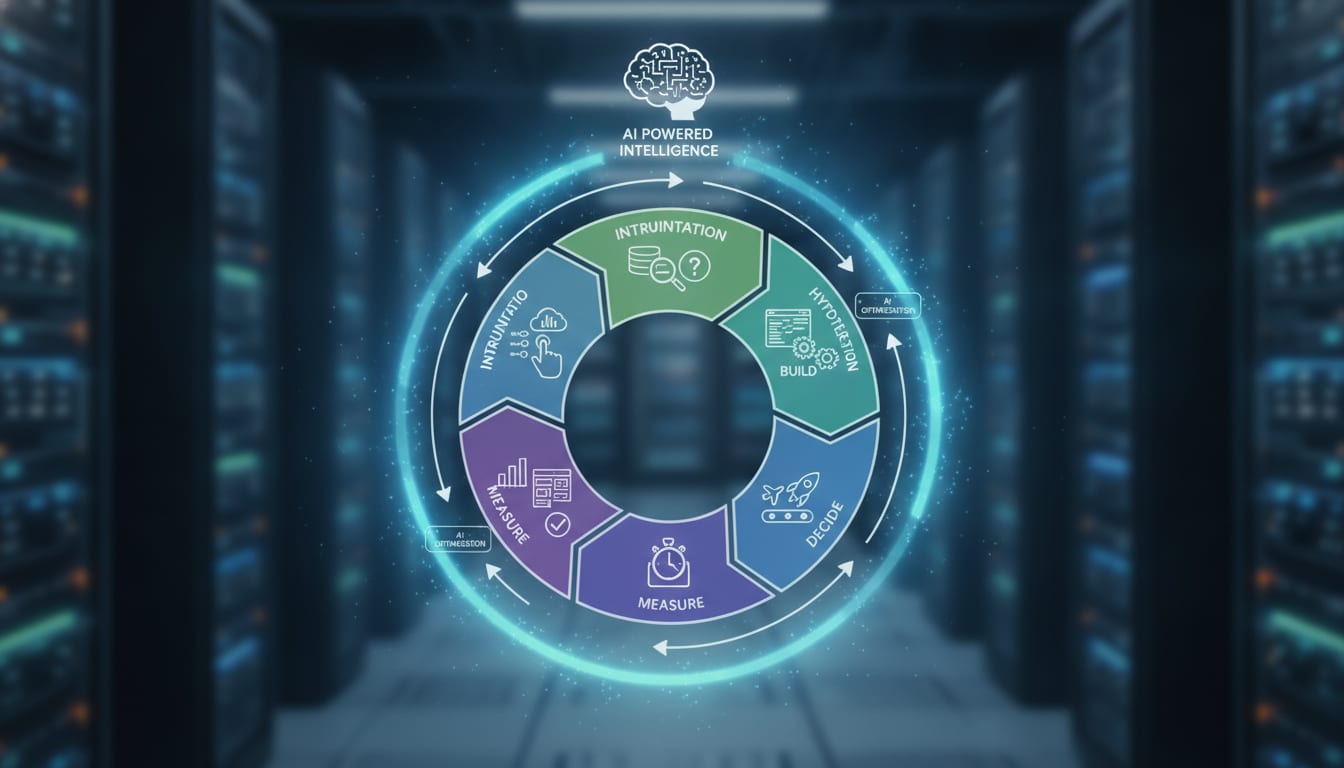
The short version: In 2026, the teams winning at growth aren't the ones with the biggest AI budget. They're the ones who have wired AI into a closed loop — instrumentation, hypothesis generation, build, ship, measure, decide — so that experiment velocity goes up without headcount going up. AI doesn't replace growth engineering. It removes the bottlenecks that made growth engineering slow: research, scaffolding, copy variants, data plumbing, and reporting. The playbook below is how we run it inside client pods, including what we've stopped doing because it didn't pay back.
What "AI Growth Engineering" Actually Means in 2026
Growth engineering is the discipline of building software specifically to move acquisition, activation, retention, and monetization metrics — onboarding flows, pricing pages, lifecycle triggers, referral loops, internal experiment tooling. It sits between product engineering and marketing, and historically it's been under-resourced at every startup we've worked with.
AI growth engineering is the same discipline with three structural changes:
- Build cost per experiment drops sharply. A variant that took a sprint now takes a day or two. That changes which experiments are worth running at all.
- Hypothesis supply increases. LLMs applied to session data, support tickets, sales call transcripts, and churn surveys surface patterns a human analyst would take a week to find.
- The system itself becomes adaptive. Lifecycle messaging, onboarding paths, and pricing presentation can respond to user signals in real time rather than through quarterly redesigns.
The trap is treating those three as separate purchases. Most teams buy an AI copywriting tool, an AI SDR, and a Copilot license, and then wonder why revenue didn't move. Integrated growth automation — where the same data layer feeds the model that feeds the experiment that feeds back into the data layer — is what produces compounding returns. Point solutions produce point results.
Research backs the gap between adoption and impact. McKinsey's 2025 State of AI survey found that while the overwhelming majority of organizations report using AI in at least one function, only a minority report meaningful enterprise-level EBIT impact — and the ones that do have redesigned workflows, not just adopted tools. That distinction is the whole playbook.
The Prerequisite Nobody Wants to Hear: Your Data Layer
We've run enough diagnostics to say this plainly: roughly two-thirds of the startups that come to us wanting "AI growth" have an event-tracking layer that can't support a clean A/B test readout. Duplicate events, inconsistent user IDs across anonymous and authenticated states, no server-side backup for client-side events blocked by ad blockers, and a definition of "activated user" that differs between the product dashboard and the board deck.
AI on top of that is a very fast way to be confidently wrong.
The minimum viable instrumentation stack
Before you automate anything, you need:
| Layer | What it must do | Common failure mode |
|---|---|---|
| Event tracking | Consistent schema, server-side where possible, identity stitching across anon → signed-in | Client-side only; 15–30% event loss from blockers |
| Warehouse | Single source of truth (BigQuery, Snowflake, Postgres) with raw events retained | Analytics tool as the only store; can't re-derive metrics |
| Metric definitions | One documented definition per core metric, version-controlled | Three teams, three definitions of "active" |
| Experiment assignment | Deterministic bucketing, exposure logging, guardrail metrics | Assignment logged in the tool but not the warehouse |
| Attribution | Multi-touch or at minimum consistent last-touch with holdouts | Channel-reported conversions summing to 140% of actual |
We rebuilt exactly this for a Series A SaaS client and cut blended CAC by 47% — not by finding a cheaper channel, but by discovering that two paid channels were claiming the same conversions and one "underperforming" channel was actually the best assisted-conversion source in the account. The full breakdown is in our case study library.
Rule of thumb: if you can't answer "what was the lift, and how confident are we?" within 30 minutes of an experiment ending, you're not ready to 10x experiment volume. Fix the readout first.
The Six-Stage AI Growth Loop
Here's the operating loop we run. Each stage has a specific AI insertion point and a specific human checkpoint. The human checkpoints are not optional — they're where the leverage actually lives.
Stage 1: Instrument and observe
AI's job: Cluster and summarize unstructured signal at volume. Feed churn survey free-text, support tickets, sales call transcripts, review-site comments, and session replay annotations into an LLM pipeline that tags themes and quantifies frequency.
Human's job: Decide which themes are actually addressable and worth money. An LLM will happily tell you 12% of churned users mentioned pricing. Only a human who knows the market can tell you whether that's a pricing problem or a value-communication problem.
Concrete play: Weekly job that pulls the last 7 days of support tickets and closed-lost CRM notes, classifies them against a fixed taxonomy (onboarding friction, missing feature, price, competitor, internal champion left), and posts a ranked delta versus the trailing 8-week average to a Slack channel. Cost: pennies per run. Replaces roughly four hours of manual reading per week.
Stage 2: Generate and prioritize hypotheses
AI's job: Draft experiment hypotheses from the observation layer, complete with proposed mechanism, target metric, and rough effect-size estimate. Also useful: having a model critique your hypothesis backlog for hypotheses that are actually the same test, or that can't produce a clean readout at current traffic.
Human's job: Score and sequence. We use a modified ICE model that adds a fourth term: learning value. A test that will teach you something structural about your users is worth running even at moderate expected lift, because it makes the next ten tests smarter.
Concrete play: Maintain a structured hypothesis backlog in a table (not a doc), with columns for: hypothesis, mechanism, primary metric, guardrail metric, minimum detectable effect, required sample, estimated build days, and status. Have an LLM pre-fill the mechanism and metric columns from a one-line idea. This is the single highest-ROI AI use we've deployed, because it removes the friction that keeps good ideas out of the backlog.
Stage 3: Build
AI's job: Scaffolding. Variant components, feature-flag wiring, test harnesses, tracking instrumentation, migration scripts, admin tooling. AI-assisted coding is genuinely transformative for the 60–70% of growth engineering work that is boilerplate around a small novel core.
The evidence here is more nuanced than the marketing suggests. Google's DORA 2024 research found that increased AI adoption correlated with higher individual throughput but also with reduced delivery stability — more change failures — when teams didn't strengthen their testing and review practices alongside. Speed without guardrails just ships bugs faster.
Human's job: Own the novel core, the review, and the guardrails. Senior engineers should be spending their time on the 30% that's hard, not typing the 70% that isn't.
Concrete play: Every AI-generated growth surface ships behind a feature flag with automated guardrail alerts on error rate, page performance, and the primary conversion metric. Non-negotiable. We've seen an AI-scaffolded pricing page variant tank Core Web Vitals badly enough to hurt organic rankings — caught in 36 hours because the alert existed.
Stage 4: Ship weekly
Cadence beats scope. A pod shipping three medium experiments a week will out-learn a team shipping one large redesign a quarter, every time, because learning compounds and redesigns don't.
We hold to a weekly shipping rhythm across every pod engagement — it's the core of our 4-Phase Growth Framework (Diagnostics → Measurement → Conversion → Scale). The weekly cadence isn't a productivity gimmick; it's a forcing function that makes scope decisions honest. If it can't ship this week, it gets cut down until it can.
Stage 5: Measure honestly
AI's job: Automated readout generation. Pull the experiment results, compute lift and confidence intervals, check guardrails, flag sample-ratio mismatch, and draft a plain-English summary.
Human's job: Resist the narrative. The most expensive failure mode in growth is a team that ships a change, sees a number go up, and declares victory without checking whether the change caused it. LLMs are extremely good at generating plausible causal stories from correlational data. Treat AI-written analysis as a first draft that needs adversarial review.
Practical guardrails we enforce:
- Pre-register the primary metric and stopping rule before launch. No exceptions.
- Report confidence intervals, not just point estimates.
- Run a periodic global holdout (typically 5%) so you can validate that your aggregate wins are showing up in aggregate revenue. They frequently don't.
- Kill "directionally positive" as a category. It's either significant, not significant, or underpowered.
Stage 6: Decide and compound
Every result goes into a searchable decision log: hypothesis, result, decision, and — critically — what it implies about the user. Over 12 months, that log becomes the most valuable asset your growth team owns, and it's also the ideal knowledge base to feed back into your hypothesis-generation prompts. This is where AI growth engineering starts compounding: the model gets better at proposing experiments because it's been trained on your actual outcomes, not generic best practices.
Where AI Pays Back — and Where It Doesn't
Not all AI applications in growth have the same return. Based on what we've deployed across SaaS, fintech, marketplace, and e-commerce pods, here's an honest ranking.
| Application | Typical payback | Why |
|---|---|---|
| Experiment scaffolding & code generation | High, fast | Directly increases experiments shipped per engineer-week |
| Unstructured feedback synthesis | High, fast | Replaces expensive manual analysis; surfaces non-obvious themes |
| Programmatic/long-tail SEO page generation | High, but fragile | Works with real underlying data and unique value; fails hard as thin content |
| Lifecycle message personalization | Medium-high | Real lift, but requires clean segmentation to work |
| Internal RevOps automation (routing, enrichment, CRM hygiene) | Medium-high | Unglamorous, reliable, compounds with sales headcount |
| AI-generated top-of-funnel blog content at volume | Low to negative | Commoditized; Google's helpful content guidance targets exactly this |
| Fully autonomous AI SDR outbound | Low | Deliverability and reputation risk usually outweigh pipeline gains |
| AI chatbot as primary support deflection without escalation design | Negative | Frustration costs exceed ticket savings |
The pattern: AI pays back when it accelerates a workflow your team already owns and measures. It fails when it replaces judgment or substitutes volume for value.
How to actually measure your AI ROI
Model spend is the easy number. The hard number is what you got. We recommend tracking three metrics per AI workflow:
- Fully loaded cost — API/tokens + tool subscriptions + the engineering time to build and maintain the workflow (this last one is usually the biggest and is almost always omitted).
- Hours reclaimed × loaded hourly cost — for automation plays.
- Attributable metric movement — for anything customer-facing, validated against a holdout.
If a workflow can't clear 3x on that math within a quarter, kill it. We go deeper on this calculation in our ROI of AI guide, which is the framework we use in client QBRs.
Team Structure: The Pod Model
You cannot run this loop with a marketing team that files tickets to an engineering team that has other priorities. The handoff cost exceeds the AI speedup. This is the single most common reason "AI growth initiatives" stall at seed and Series A.
What the loop actually requires, co-located under one owner:
- Growth engineering — builds surfaces and instrumentation
- Data/analytics — owns definitions, readouts, and the warehouse
- Product/design — owns the hypothesis quality and UX coherence
- Marketing/demand — owns traffic and message-market fit
- RevOps — owns the downstream funnel and CRM truth
At a 15-person startup, that's five hires you can't afford and don't have time to sequence. This is precisely why we built Growaton as an embedded pod rather than an agency: one senior team covering all five functions, shipping weekly, with the AI tooling already built rather than being figured out on your dime. If you're weighing that structure against alternatives, we've written a direct comparison of the agency vs. embedded pod vs. in-house tradeoffs.
The seniority point
AI amplifies whoever is holding it. Given a junior operator, AI produces more mediocre output faster. Given a senior operator, AI removes the tedium that was consuming 60% of their week and lets them spend it on judgment.
This has a direct hiring implication for 2026: the ratio of senior-to-junior on growth teams should be going up, not down. The work that used to justify a junior headcount — pulling reports, writing variants, building landing pages, cleaning data — is exactly the work AI now does at near-zero marginal cost. What's left requires taste and judgment.
A 90-Day Implementation Sequence
Don't try to build the whole loop at once. This is the sequence we run in pod engagements.
Days 1–30: Diagnose and instrument
- Audit event tracking; fix identity stitching and server-side gaps
- Document one canonical definition for each of your 6–8 core metrics
- Stand up the warehouse if it doesn't exist; get raw events flowing
- Build the automated weekly metrics readout (this alone changes team behavior)
- Ship 1–2 small, low-risk experiments purely to validate the readout pipeline works
Success criterion: you can read out an experiment result correctly, end to end.
Days 31–60: Build the loop
- Deploy the feedback synthesis pipeline (support + churn + sales calls)
- Stand up the structured hypothesis backlog with AI pre-fill
- Establish feature-flag infrastructure with automated guardrails
- Introduce AI-assisted scaffolding into the engineering workflow, with review standards
- Move to a genuine weekly ship cadence — 2–3 experiments per week
Success criterion: experiments shipped per week has at least doubled, with no increase in incidents.
Days 61–90: Compound
- Launch the decision log and start feeding it back into hypothesis generation
- Add the global holdout to validate aggregate impact
- Layer in personalization on the highest-traffic surface (onboarding or pricing)
- Run your first AI ROI review: kill the workflows below 3x, double down on the ones above
- Extend to a second workstream — usually lifecycle or paid efficiency
Success criterion: you have a documented win with a validated lift, and a documented kill with a clear reason. Both matter.
Five Failure Modes to Avoid
1. Buying tools before fixing data. Every AI tool you buy on top of broken instrumentation inherits that brokenness and adds confidence to it.
2. Optimizing local metrics into global losses. Aggressive onboarding nudges that lift day-1 activation and tank day-30 retention. Always pair a primary metric with a downstream guardrail.
3. Confusing output with outcome. "We generated 400 landing pages" is not a result. Indexed, ranking, converting pages are a result. Most programmatic AI content never gets indexed.
4. Skipping the human review checkpoint. The teams that got burned in 2025 were the ones that let AI ship directly to production surfaces. The DORA stability data isn't a warning about AI — it's a warning about removing review.
5. Treating AI as a cost-reduction play. The teams seeing real returns used AI to do more, not to do the same with fewer people. Reallocated capacity beats cut capacity, every time, at growth stage.
What Changes in 2026 Specifically
Three shifts worth planning for:
Agentic workflows move from demo to production — narrowly. Multi-step agents that can execute a full experiment cycle autonomously are still unreliable for anything customer-facing. But for internal workflows with clear success criteria and cheap failure modes — data QA, CRM hygiene, competitor monitoring, report generation — they're production-ready now. Deploy there first.
AI search becomes a real acquisition channel to instrument. With AI Overviews and assistant-driven discovery routing a growing share of queries, "traffic from ChatGPT/Perplexity/AI Overviews" needs to be a tracked segment in your analytics, not a footnote. Content strategy shifts toward being citable: clear structure, direct answers, original data, verifiable claims.
The cost curve keeps falling, which changes what's worth automating. Workflows that didn't clear the ROI bar in 2024 at frontier-model prices clear it comfortably now. Re-run your kill decisions annually — some of them are now wins.
The Honest Bottom Line
AI hasn't changed the fundamentals of growth. You still need a real product, a defined ICP, honest measurement, and the discipline to kill things that don't work. What AI has changed is the cost of iteration — and iteration cost was always the binding constraint on how fast a startup could learn.
The teams that win in 2026 will be the ones that treat AI as infrastructure inside a disciplined growth loop, not as a set of features to purchase. That means fixing your data layer before you buy tools, keeping humans at the judgment checkpoints, shipping weekly, and killing AI workflows that can't prove payback.
If you want an outside read on where your loop is broken, we run a free growth diagnostic — a working session where we audit your instrumentation, experiment velocity, and unit economics, and tell you which of the above sequences you should actually start with. No pitch deck, and you keep the findings either way.