
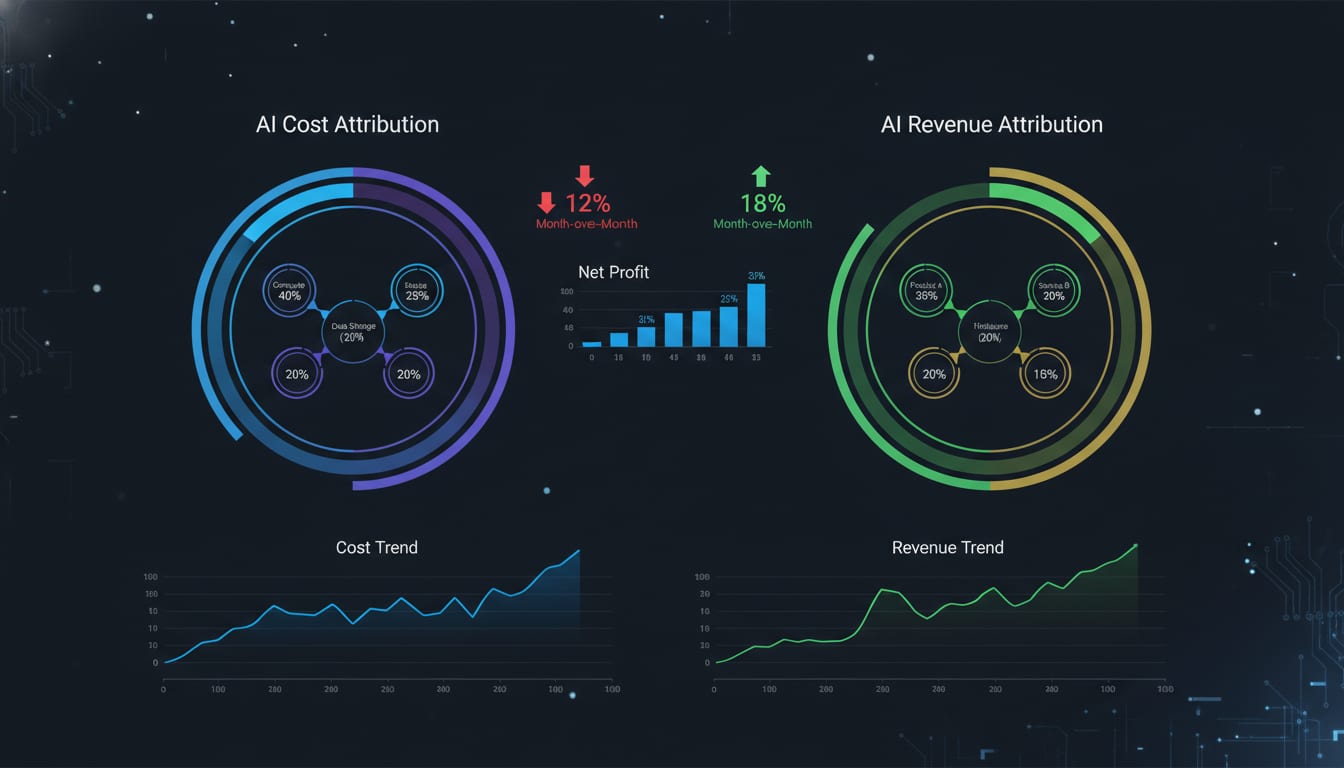
Your CFO is asking whether the $47,000 you spent on OpenAI, Anthropic, and a half-dozen AI tools last quarter actually moved the business. If you can't answer that in a single sentence with a number attached, you have a measurement problem — not an AI problem.
The honest truth: most companies deploying LLMs today are flying blind on ROI. They ship AI features, buy Copilot seats, and pipe GPT-4 into workflows without a baseline, a hypothesis, or a payback model. Then they wonder why the board isn't impressed.
This guide is how we at Growaton help startup founders and operators prove — or disprove — that their LLM spend is paying back. It covers the exact formula, the four value categories that actually matter, common measurement traps, and a 30-day framework for building an AI ROI system that survives scrutiny.
The short answer: Is AI worth it?
Yes — but only when you measure it like any other capital allocation decision. AI ROI = (incremental value generated − total cost of AI) ÷ total cost of AI. If that ratio isn't at least 3x within 6-12 months for a growth-stage startup, you're either measuring wrong or deploying wrong.
The problem isn't that AI doesn't pay back. It's that "value generated" is fuzzy, "total cost" is under-counted, and most teams never define the counterfactual (what would have happened without AI). Get those three things right and the ROI question becomes answerable.
The AI ROI formula (and why most people get it wrong)
Here's the formula in full:
AI ROI = (Incremental Revenue + Cost Savings + Productivity Gains − Total AI Cost) ÷ Total AI Cost
Simple. But every term hides landmines.
What "Total AI Cost" actually includes
Most finance teams only count the API bill. That's maybe 30% of the real cost. The full stack looks like this:
| Cost category | Typical share | What people miss |
|---|---|---|
| LLM API / inference | 25-40% | Retry costs, failed generations, long context bills |
| Tooling & subscriptions | 15-25% | Vector DBs, orchestration (LangChain, LlamaIndex), observability (Langfuse, Helicone) |
| Engineering time | 25-40% | Prompt engineering, evals, guardrails, ongoing maintenance |
| Human review / QA | 10-20% | The editor who cleans up AI content, the ops person double-checking outputs |
| Opportunity cost | Variable | What your team could have built instead |
If you're only tracking your Anthropic invoice, you're probably underestimating true cost by 2-3x.
What counts as "Incremental Value"
This is where discipline matters. Value only counts if it's incremental — meaning it wouldn't have happened without the AI investment. Four categories qualify:
- Revenue lift: New pipeline, closed deals, conversion improvements traceable to an AI-driven workflow.
- Cost avoidance: Headcount you didn't have to hire, agency retainers you cancelled, tools you consolidated.
- Time-to-value acceleration: Faster shipping = earlier revenue recognition. Real, but requires modeling.
- Quality improvements: Lower error rates, reduced churn, higher CSAT — only counts if you can tie it to a downstream metric.
Notice what's missing: "productivity" as a vague concept. "Our team saves 5 hours a week" is not ROI. Five hours multiplied by a fully-loaded hourly cost, on tasks that would have otherwise been done, applied to work that generated measurable output — that's ROI.
The four value categories, with real examples
1. Revenue-generating AI
The clearest case. AI creates output that directly drives new revenue.
Example: A B2B SaaS client of ours deployed an LLM-powered outbound personalization system that rewrote cold emails using scraped context from LinkedIn and company blogs. Cost: $2,100/mo in API calls + $8,000/mo engineering time (amortized) + one FTE reviewing samples. Result: reply rate went from 1.8% to 4.6%, generating 34 additional SQLs/month at an average deal size of $18K ACV and 22% close rate. Incremental ARR contribution: ~$1.6M annualized. ROI: ~1,200%.
Not every experiment lands here. Two out of the five AI plays we ran with that same client had zero measurable revenue impact. That's why you measure per-use-case, not in aggregate.
2. Cost-avoiding AI
Headcount or vendor spend that would have happened without AI, but didn't.
Example: A marketplace client was about to hire two content marketers at ~$180K fully-loaded to produce category landing pages at scale. Instead, we built an AI-assisted content pipeline (LLM drafting + editor review + programmatic SEO templates) that shipped 340 pages in the first quarter. Cost: $34K all-in. Cost avoided: ~$90K in Q1 alone. Payback: <2 months.
The trap: don't count "cost savings" against roles you were never going to hire.
3. Productivity augmentation
Existing employees do more, or better, in the same time. This is where measurement gets hardest, and where most companies inflate ROI.
To count it honestly, you need three things:
- A baseline (what output looked like before)
- A defined activity (not "using AI" but "producing X deliverable")
- An outcome that scales (more revenue, more customers served, more experiments shipped)
If your engineers save 30% of coding time with Copilot but ship the same number of features, the ROI is close to zero — unless you can prove the freed capacity was reinvested into something valuable. This is the framing gap McKinsey's 2024 State of AI report highlights: adoption is widespread but few organizations attribute EBIT impact to specific functions.
4. Risk & quality reduction
AI that reduces errors, prevents churn, or catches issues earlier. Hardest to quantify, most often over-claimed. Only count it when you can trace to a downstream financial metric — churn reduction, refund rate, support ticket cost.
The measurement traps that kill AI ROI credibility
We've reviewed dozens of AI ROI decks from founders trying to justify continued spend to their board. The recurring mistakes:
- No baseline: "AI saves us 10 hours/week" — compared to what? If you never measured how long it took before, you can't measure the delta.
- Ignoring the counterfactual: Revenue grew 40% while you deployed AI. How much of that was AI vs. the two new AEs you hired, or the pricing change, or the market?
- Counting gross output, not net value: You generated 400 blog posts with AI. How many drove traffic? How many drove signups? Volume ≠ value.
- Under-counting human review time: The editor spending 45 minutes fixing every AI-generated draft is a real cost.
- Ignoring quality regression: AI-generated support responses might be 3x faster, but if CSAT drops 15 points, you have a net loss.
The Boston Consulting Group's research on GenAI value found that ~70% of value capture depends on process and people changes — not the model itself. If you're not measuring the full system, you're not measuring ROI.
A 30-day framework to measure AI ROI honestly
Here's the framework we run with clients when they ask us to audit or build an AI ROI system. It's part of the broader 4-Phase Growth Framework — Diagnostics → Measurement → Conversion → Scale — applied specifically to AI investments.
Week 1: Inventory & baseline
- List every AI tool, subscription, and API in use. Include shadow spend (individual seats on personal cards).
- Categorize each into one of the four value categories above.
- For each use case, define the baseline metric it was supposed to move.
- Calculate true total cost per use case (not aggregate).
Week 2: Attribution model
- Define the counterfactual for each use case. What would have happened without this AI investment?
- Pick a measurement window: 30, 60, or 90 days depending on sales cycle.
- Instrument tracking. If you can't measure the outcome, you can't claim the ROI.
- For revenue use cases, use holdout groups or A/B tests where possible.
Week 3: Measure & rank
- Calculate ROI per use case using the formula above.
- Rank use cases: clear winners (>3x ROI), ambiguous (0.5x-3x), losers (<0.5x).
- For ambiguous cases, decide: invest more to test properly, or kill.
Week 4: Reallocate & report
- Kill or defund losers. Ruthlessly. AI spend compounds and margins on losers destroy the aggregate.
- Double down on winners with more budget or scope expansion.
- Build a one-page monthly report: cost per category, value per category, net ROI, top 3 use cases, bottom 3.
By the end of 30 days, you have an answer to "is our AI spend paying back" that survives a board conversation.
When AI isn't worth it (yet)
Not every AI use case pays back. We've told clients to not deploy AI in situations like:
- Volume is too low. If you generate 10 support tickets a week, an AI triage system will never earn back its build cost.
- The underlying process is broken. AI amplifies bad processes as effectively as good ones.
- The output requires 90%+ accuracy and current models deliver 75%. The QA burden erases the gain.
- You don't have the data infrastructure to measure whether it worked.
Being disciplined about not deploying AI is just as valuable as deploying it well.
What "AI-speed" actually means when ROI is the constraint
The Growaton thesis is that senior operators augmented with AI can ship at multiples of the pace of traditional teams — but only when every AI investment has a measurable outcome attached. That's the difference between "using AI" and building an AI-augmented growth machine.
The teams that win with AI in 2026 aren't the ones with the biggest LLM budgets. They're the ones with the tightest feedback loops between AI investment, measurement, and reallocation. A weekly shipping cadence combined with a monthly ROI review is what turns AI from a line item into a compounding advantage.
If you want a sharper answer to the question "is our AI spend paying back" — or you're building AI-augmented growth workflows and want a senior pod running the experiments and measurement — book a free growth diagnostic. We'll show you where your current AI investments are working, where they're leaking, and what to reprioritize.