
Short answer: your product is PLG-ready when a stranger can sign up, reach a real moment of value without talking to anyone, and hit a natural reason to pay — and you can prove all three with instrumented data. If any one of those breaks, product-led growth won't fix your funnel; it will just make the leak more expensive.
Most teams don't need a philosophy debate about PLG vs. sales-led. They need an honest diagnostic. So we built one: a 25-question PLG readiness quiz scored out of 100 across the five dimensions that actually predict whether a self-serve motion will compound or stall.
Take 10 minutes, score yourself honestly, and you'll walk away knowing whether to build PLG, run a hybrid sales-assist motion, or stay sales-led for another two quarters.
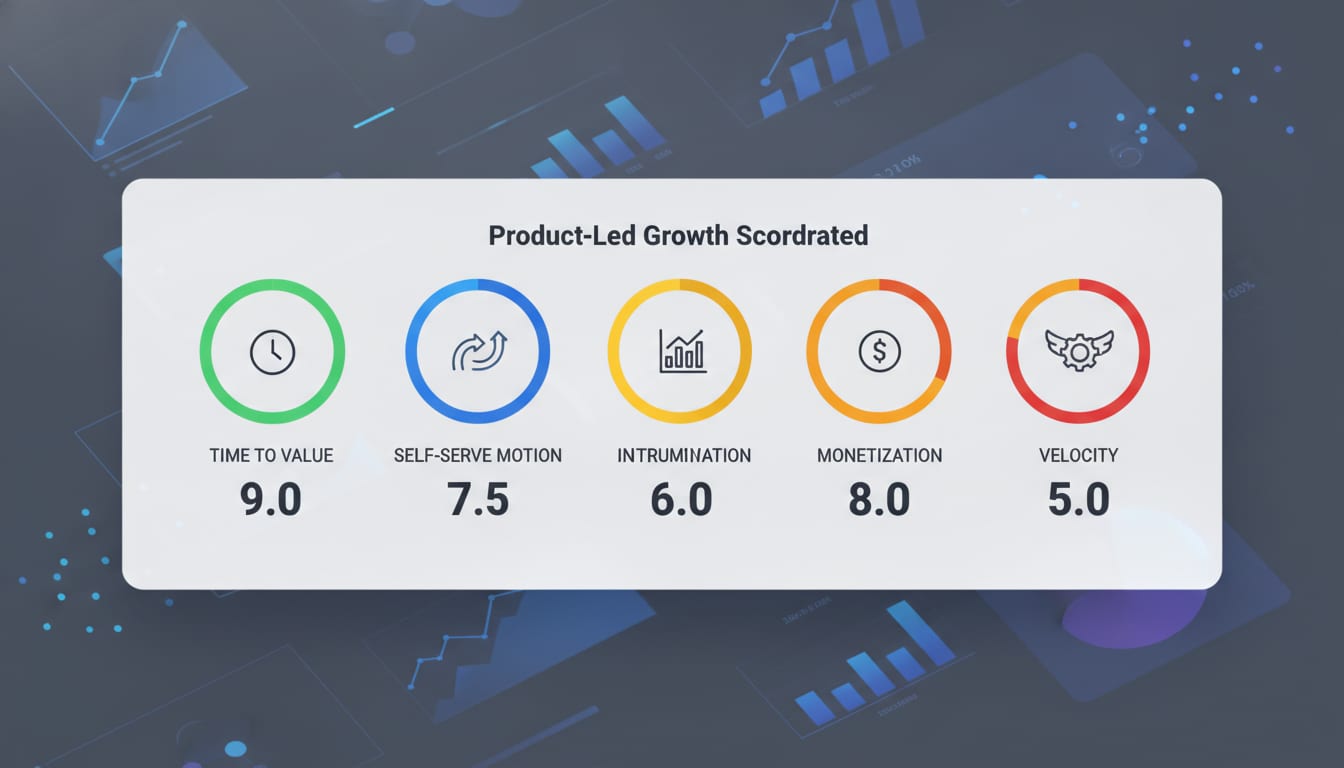
How the PLG scorecard works
Twenty-five questions, five dimensions, 20 points each.
Score each question:
| Score | Meaning |
|---|---|
| 0 | No, or we genuinely don't know |
| 2 | Partially true, or true for some segments only |
| 4 | Yes, and we have data in a dashboard that proves it |
That "we have data that proves it" bar matters. In our diagnostic engagements at Growaton, the single most common finding isn't that a product can't be product-led — it's that nobody can answer basic questions like "what percentage of signups reach activation in week one?" without a three-day SQL detour. Guessing scores a 2, not a 4.
Total your score, then read the band interpretation and the failure patterns below.
Dimension 1: Time to Value (20 points)
PLG lives or dies here. If a user can't feel the product working before their attention budget runs out, no amount of onboarding email will save you.
The questions
- Can a new user reach a meaningful "aha" outcome in under 10 minutes without a human being involved? (Not "complete onboarding" — actually get something valuable out.)
- Have you explicitly defined your activation event, in writing, with a metric attached? For example: "created a project and invited one teammate within 7 days."
- Does the product deliver value with zero or near-zero data input from the user — via templates, sample data, integrations, or AI-generated starting states?
- Is your signup-to-activation rate above the benchmark for your category? Lenny Rachitsky's survey of activation benchmarks puts "good" activation for most B2B SaaS products somewhere in the 25–40% range, with best-in-class considerably higher.
- Can a single user get value alone, before their team or their admin or their IT department joins?
Why this dominates: the products that scale product-led — Figma, Notion, Loom, Linear — all collapsed the distance between "curious" and "useful" to minutes. If your honest answer to Q1 is "about two weeks, after an implementation call," you don't have a PLG problem, you have a product architecture problem. That's a roadmap conversation, not a growth-marketing one.
Score: ___ / 20
Dimension 2: Self-Serve Motion (20 points)
Time to value gets someone to the aha. The self-serve motion turns that into revenue without a rep.
The questions
- Can a user go from landing page to paid subscription entirely on their own — pricing visible, checkout live, no "Contact Sales" gate on the entry tier?
- Is pricing published on your website with at least one tier a credit card can buy today?
- Is the user the buyer, or at least someone who can expense the entry price without a procurement cycle?
- Do you have a self-serve path for the boring blockers — SSO on lower tiers where needed, self-serve seat adds, self-serve plan upgrades and downgrades, invoice access?
- Does your product create natural collaboration or sharing surfaces — invites, shared links, comments, exported artifacts that carry your brand?
Why this dominates: we regularly find teams who call themselves "product-led" but route every trial into a demo booking because sales owns the pipeline number. That's not PLG; that's a lead magnet with a login. If a motivated user physically cannot pay you at 11pm on a Sunday, you score 0 on question 6 regardless of intent.
Score: ___ / 20
Dimension 3: Instrumentation & Data (20 points)
You cannot run product-led growth on marketing analytics. PLG is an experimentation game, and experiments need event-level truth.
The questions
- Do you have product event tracking with a documented, governed taxonomy (Amplitude, Mixpanel, PostHog, Snowplow, or a warehouse-native equivalent) — not just page views?
- Can you pull a signup-to-activation-to-paid funnel by cohort, by acquisition channel, in under an hour?
- Do you have a product-qualified lead (PQL) definition based on in-product behavior, and does it actually fire into your CRM or sales tooling?
- Can you attribute revenue back to acquisition source at the account level — not just first-touch on a form fill?
- Do you run a regular experiment cadence with pre-registered hypotheses and a decision log — at least two live tests per month?
Why this dominates: PLG replaces a sales team's intuition with a data feedback loop. If the loop is broken, you're flying blind at speed. Our Activation Rate Benchmarks by SaaS Vertical dataset exists precisely because so many teams have no internal baseline to compare against.
Score: ___ / 20
Dimension 4: Monetization & Expansion (20 points)
Self-serve acquisition with flat pricing is a treadmill. The compounding comes from expansion.
The questions
- Does your pricing metric grow as the customer gets more value from you? (Seats, usage, records, transactions, workflows — something that scales with success.)
- Is there a clear, honest reason to upgrade — a limit users hit naturally when the product is working, not an artificial wall that feels punitive?
- Is your net dollar retention above 100%? Bessemer's State of the Cloud research has long treated ~120% NDR as a "best" benchmark for cloud businesses, with 110%+ considered good.
- Have you deliberately chosen your entry model — freemium, free trial, or reverse trial — and tested the alternative? (Worth reading our breakdown of freemium vs. free trial vs. reverse trial before you answer.)
- Is your self-serve gross margin healthy enough to fund paid acquisition — meaning CAC payback on self-serve cohorts is under 12 months?
Why this dominates: OpenView's Product Benchmarks reports consistently found median free-to-paid conversion for freemium products sitting in the low-to-mid single digits. At a 4% conversion rate, the entire economic model rests on expansion revenue and low-cost acquisition. If neither is true, PLG is a very elaborate way to lose money per user.
Score: ___ / 20
Dimension 5: Velocity, Distribution & Ownership (20 points)
PLG is not a launch. It's an operating rhythm. This dimension is where most seed-to-Series B companies quietly fail.
The questions
- Is there a named owner of the activation and conversion funnel with authority over product, not just marketing?
- Can you ship a meaningful onboarding or pricing-page change in under two weeks, end to end, without a quarterly roadmap negotiation?
- Do you have at least one scalable, non-paid acquisition channel — SEO, integrations/marketplace listings, community, template galleries, or true product virality?
- Do product, engineering, data, and marketing operate as one team on growth work — or does a handoff queue sit between each?
- Do you have sufficient top-of-funnel volume to run experiments to significance — roughly 1,000+ signups per month, or a clear plan to get there?
Why this dominates: we've watched excellent PLG strategy documents die because the engineering capacity to implement them was allocated at 5% and the funnel owner had to file a ticket. Product-led growth requires the same weekly-shipping cadence we build our growth pods around — a cross-functional group that can diagnose, build, measure, and iterate inside the same sprint. If you want to model how many tests you actually need to hit your target, our Experiment Velocity Calculator does the math.
Score: ___ / 20
Your PLG readiness score: what it means
Add up your five dimension scores.
| Score | Band | What it means | What to do next |
|---|---|---|---|
| 85–100 | PLG Engine | Self-serve works and expansion compounds. Your constraint is volume and velocity. | Pour fuel on acquisition, raise experiment throughput, add PQL-driven sales-assist on the top decile of accounts. |
| 65–84 | PLG-Capable | The motion works but one dimension is dragging the rest down. | Find your lowest-scoring dimension and treat it as a 90-day program. Usually it's instrumentation or expansion pricing. |
| 45–64 | Hybrid / Sales-Assisted | Real self-serve potential, but too much friction to remove humans yet. | Run PLG as lead generation: free trial → PQL → rep. Rebuild time to value in parallel. |
| 25–44 | Not Yet | You have a product problem masquerading as a growth problem. | Stop the PLG project. Fix time to value and shrink onboarding. Revisit in two quarters. |
| 0–24 | Sales-Led Is Correct | Complex implementation, committee buying, or no self-serve economics. | Invest in sales efficiency, outbound, and onboarding. PLG here burns cash and morale. |
A dimension score below 8/20 is a hard flag regardless of your total. A 90/100 built on 6/20 instrumentation isn't a 90 — it's an unverified guess.
Four hard disqualifiers (score doesn't matter)
Some products simply shouldn't be product-led, at least not at the core motion. Be honest if any of these apply:
- The product requires data migration or professional services to work. If value depends on someone else's historical data being loaded, a self-serve trial shows an empty room.
- The buyer is structurally not the user. Compliance, security, and infrastructure tools bought by a committee that never logs in rarely convert self-serve, no matter how good the UX.
- A single account is worth $100k+ and requires legal review. You can still use PLG for lead generation (free tools, sandboxes, open-source), but the revenue motion is sales-led.
- Regulatory or contractual gating blocks instant access. Fintech and healthcare products with KYC, underwriting, or BAA requirements need a hybrid design — not a Stripe checkout and hope.
None of these mean "no PLG forever." They mean PLG is a top-of-funnel strategy, not a monetization strategy, and you should design accordingly.
The three patterns we see most in diagnostics
Across the readiness assessments we run, the same three failure modes account for the majority of stalled PLG efforts:
1. The activation cliff nobody measured. Signups look healthy, revenue doesn't move, and no one has segmented the funnel by cohort. Nine times out of ten, activation is concentrated in one persona and collapses for everyone else. The fix is instrumentation before optimization — you can't A/B your way out of a measurement gap.
2. Pricing that punishes rather than rewards. Upgrade walls placed where users feel robbed rather than where they feel successful. Expansion revenue comes from limits that arrive because the product worked — more teammates, more usage, more workflows. Limits that arrive on day two just cap trials.
3. Growth work stuck behind the roadmap. Product owns the backlog, marketing owns the funnel, engineering owns the sprint, and the onboarding rewrite has been "next quarter" for three quarters. This is an organizational problem, and it's why we structure engagements as a single embedded pod running the Diagnostics → Measurement → Conversion → Scale sequence rather than a set of handoffs.
What to do with your score this week
Whatever band you landed in, the next move is the same shape:
- Write down your activation event and the current rate. If you can't, that's your first project.
- Pick the lowest-scoring dimension, not the most interesting one. PLG readiness is a minimum function, not an average.
- Set a 90-day target for that dimension with a weekly shipping cadence and a decision log.
- Re-take the quiz in a quarter. Movement of 15+ points per quarter is a healthy pace for a focused team.
If you want a second opinion on your score — or you scored in the 45–84 range and aren't sure which dimension to attack first — we run free growth diagnostic conversations where we pressure-test your funnel data and hand back a prioritized list. No pitch deck required. You can also browse case studies of activation and conversion work we've shipped for seed-to-Series C SaaS, fintech, and marketplace teams.