The short answer: AI-augmented growth teams don't move 10x faster — that claim is marketing fiction. Based on our engagement data across seed-to-Series C clients, the realistic delta is 2–4x more experiments shipped per quarter at roughly 55–70% of the fully-loaded cost per experiment, with the biggest gains concentrated in a narrow band of work: content production, data plumbing, QA, research synthesis, and repetitive RevOps tasks. The gains evaporate — or go negative — when teams point AI at strategy, prioritization, or anything requiring judgment about which experiment to run.
That nuance is the entire article. Below are the actual numbers, where they come from, where AI-augmented ops loses to manual work, and how to figure out which mix your team should run.
What "manual growth ops" and "AI-augmented growth" actually mean
These terms get thrown around loosely, so let's define them the way we use them internally at Growaton.
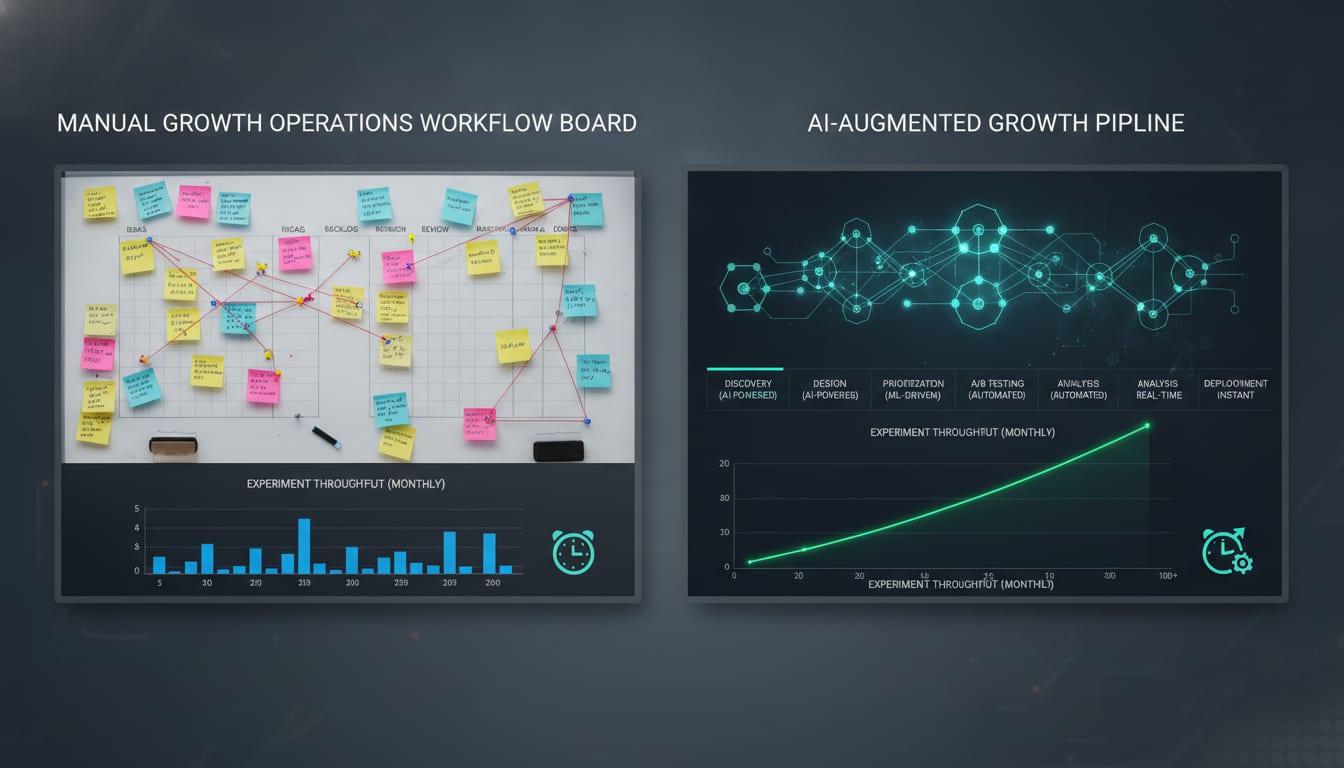
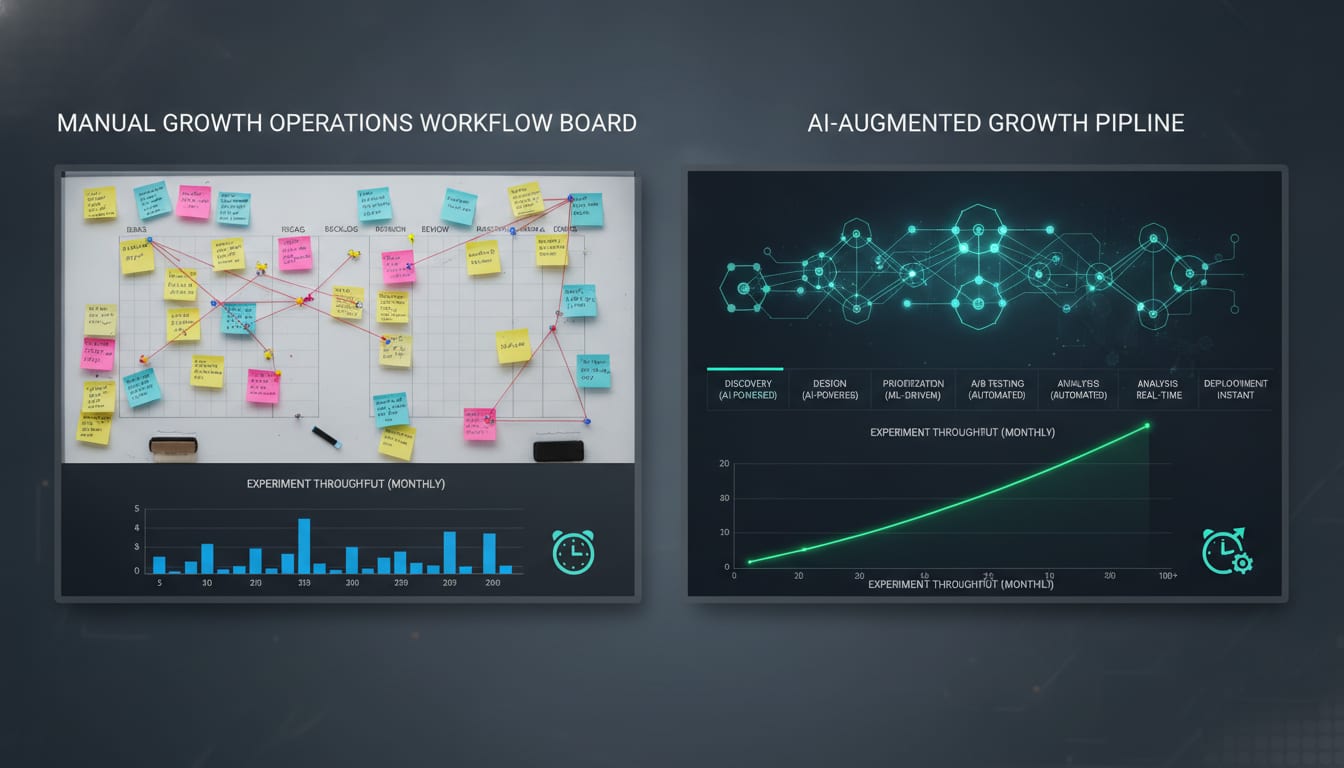
Manual growth ops is the default state of most growth teams: a human writes the brief, a human builds the landing page variant, a human pulls the data, a human writes the copy, a human QAs the tracking, a human assembles the readout. Tools are involved (Amplitude, Webflow, HubSpot, Metabase), but every artifact passes through a person start to finish. Throughput is bounded by headcount and calendar.
AI-augmented growth keeps humans on strategy, prioritization, and final judgment but delegates specific production and synthesis steps to LLMs and agentic workflows. The human writes the hypothesis and the acceptance criteria; AI drafts the five copy variants, generates the SQL, writes the test scaffolding, summarizes 40 support tickets into three themes, and pre-fills the experiment readout.
The failure mode we see most often isn't "AI vs. human." It's "AI-replaced" growth ops — teams that removed the human judgment layer and ended up with a high-volume experiment factory testing things that don't matter. More on that in the losses section.
The real numbers: throughput, cost, and quality
We tracked comparable metrics across engagements where we could observe a pre-AI baseline and a post-AI state on the same team, same product, same market. The figures below are our aggregate ranges across SaaS, fintech, and marketplace clients (n = small; treat as directional, not universal).
| Metric | Manual growth ops | AI-augmented growth | Delta |
|---|---|---|---|
| Experiments shipped / quarter (3-person pod) | 6–9 | 18–28 | 2.5–3.5x |
| Time from hypothesis to live test | 9–14 days | 3–5 days | ~65% faster |
| Fully-loaded cost per experiment | $3,200–$5,500 | $1,900–$3,200 | ~40% lower |
| Landing page variant production time | 6–10 hrs | 1.5–3 hrs | ~70% faster |
| Analytics/tracking implementation per test | 3–5 hrs | 1–2 hrs | ~60% faster |
| Experiment readout + insight write-up | 2–4 hrs | 0.5–1 hr | ~75% faster |
| Win rate (statistically significant positive result) | 22–30% | 18–26% | slightly lower |
| Rework rate (test invalidated by bad implementation) | 8–12% | 14–20% | higher |
Two lines in that table deserve more attention than the flashy throughput number.
Win rate goes down slightly. That's not a bug — it's arithmetic. When you triple the number of shots, you take lower-conviction shots. The absolute number of wins still rises sharply (roughly 2 wins/quarter manual vs. 4–6 AI-augmented), but average shot quality falls. If your team is emotionally attached to a high win rate as a vanity metric, AI-augmented ops will feel worse before it feels better.
Rework rate goes up. AI-generated tracking code, SQL, and experiment scaffolding fails in quiet, plausible-looking ways. A hand-written event definition that's wrong is usually obviously wrong. An LLM-generated one is subtly wrong — right event name, wrong dedup logic — and you don't find out until the readout makes no sense. This is the hidden cost line most AI-ROI pitches skip.
The industry data broadly agrees
Independent research lands in the same neighborhood, which is reassuring:
- A randomized controlled trial by MIT and Microsoft researchers found professionals using GPT-4 for writing tasks completed them 37% faster with higher-rated output quality — meaningful, but not order-of-magnitude.
- Microsoft/GitHub's Copilot research reported developers completed a scoped coding task 55% faster with AI assistance.
- A Harvard/BCG field experiment found consultants using AI improved output quality on suitable tasks, but performed worse than the control group on tasks outside the model's competence — the so-called "jagged technological frontier."
- McKinsey's research has repeatedly found that most organizations report cost or revenue impact from gen AI in specific functions while enterprise-level EBIT impact stays limited — a mismatch that maps almost exactly to what we see in growth teams.
The pattern across all four: large gains on well-scoped production tasks, negligible or negative gains on judgment-heavy tasks. Growth ops is a mix of both, which is why the blended delta is 2–4x and not 10x.
Where AI-augmented growth wins decisively
Content and creative production volume
This is the cleanest win. A manual team producing SEO content ships maybe 4–8 substantive pieces a month with a writer plus an editor. With a strong brief system, a house style guide encoded as prompt context, and a human editor doing structural and factual review, the same team ships 20–30 pieces at comparable quality.
The operative constraint shifts from writing capacity to editorial judgment capacity. One senior editor can meaningfully review roughly 25–30 AI-drafted pieces a month before quality visibly degrades. Push past that and you're publishing sludge — which Google's own guidance on scaled content abuse explicitly targets.
Same logic applies to ad creative. We routinely take a client from 6 creative variants per month to 40+, which matters enormously on Meta and TikTok where creative volume is the primary lever on account performance.
Data plumbing and analysis scaffolding
LLMs are excellent at the boring 80% of analytics work: writing the SQL skeleton, reshaping a dataframe, generating the dbt model stub, translating a business question into a query against a schema you've pasted in. Our data engineers report the biggest gain here isn't speed — it's that more people can ask questions. A growth marketer who couldn't write SQL can now get to a directional answer without queueing behind an analyst.
The guardrail: every AI-generated query that feeds a decision gets a human review against the semantic layer. We treat AI SQL as a draft, never as a source of truth. This is a core discipline in our 4-Phase Growth Framework — the Measurement phase exists specifically so that later velocity doesn't compound on top of broken instrumentation.
Research synthesis and qualitative-to-quantitative conversion
Manual: read 200 support tickets, 40 sales call transcripts, and 60 churn surveys. Two days of work, and one person's biased summary.
AI-augmented: structured extraction across all 300 artifacts in 90 minutes, tagged by theme, with quotes attached. Then a human spends 3 hours interrogating the output and finding what the model missed. Net: 2 days → half a day, and the coverage is more complete because nobody skimmed.
This is where we've generated the highest-conviction hypotheses in the last 18 months. Qualitative synthesis at scale is genuinely new capability, not just faster old capability.
Repetitive RevOps and lifecycle work
Lead enrichment, list hygiene, routing rules, ICP scoring, lifecycle email variants by segment, CRM field normalization. Any task that's rule-shaped but too fuzzy for a deterministic script is now cheap. We've seen teams reclaim 15–25 hours a month of an ops person's time here — and that reclaimed time is the actual ROI, not the tool spend saved.
If you want the tactical inventory, our Growth Automation Workflow Library catalogs the specific plays we deploy most.
Where manual growth ops still wins
Being honest about this is how you avoid burning six months on an AI initiative that nets zero.
Deciding what to test
AI is a terrible prioritizer. It will happily generate 50 experiment ideas, all plausible, none informed by the fact that your enterprise pipeline is stalling on a security review, your best channel just got throttled, or your CEO has committed to a specific narrative for the next board meeting. Prioritization requires context that lives in people's heads and in this quarter's politics.
Every AI-augmented team we've seen produce disappointing results had the same root cause: high experiment volume, low experiment relevance. They 3x'd throughput on tests that couldn't move the metrics that mattered.
Novel positioning and category-defining messaging
LLMs regress to the mean of their training data. That's useful for conventional copy — a pricing page, a feature description, a nurture email. It's actively harmful when you need a message nobody has written before. If your differentiation depends on a genuinely new frame, a human has to invent it. AI can then produce 30 variants of that frame for testing.
High-stakes, low-volume, compliance-sensitive work
Fintech clients in particular: regulated disclosure copy, anything touching KYC/AML flows, anything a regulator might read. The cost of one hallucinated claim exceeds the savings from 200 automated tasks. We keep humans fully in the loop here, and we're explicit with clients about it.
Anything where the feedback loop is longer than a quarter
AI's advantage is iteration speed. If the metric you care about takes 6 months to read — enterprise sales cycle conversion, annual retention cohorts — velocity buys you very little. Manual, thoughtful, low-volume work wins on the long-cycle stuff.
The cost comparison nobody publishes
Most "AI saves you money" math compares an LLM subscription to a salary. That's not the real comparison. Here's a more honest fully-loaded model for a 3-person growth pod running a quarter.
| Cost line | Manual | AI-augmented |
|---|---|---|
| People (3 senior operators, quarterly, fully loaded) | $105,000 | $105,000 |
| LLM API + AI tooling | $0 | $2,400–$6,000 |
| Experimentation / analytics stack | $4,500 | $4,500 |
| Prompt/workflow build & maintenance (setup amortized) | $0 | $8,000–$14,000 |
| QA & review overhead on AI output | $0 | $6,000–$11,000 |
| Rework from AI-induced errors | $3,800 | $7,200 |
| Total quarterly cost | $113,300 | $133,100–$147,700 |
| Experiments shipped | 7 | 22 |
| Cost per experiment | $16,186 | $6,050–$6,714 |
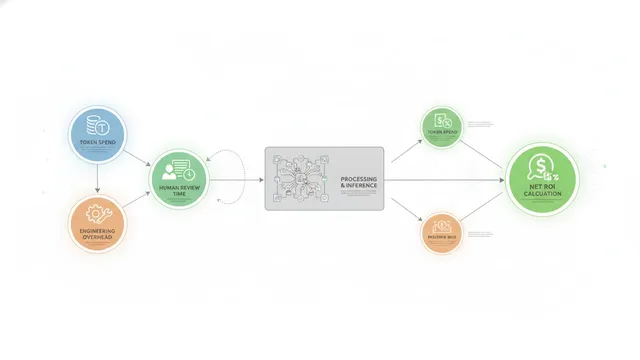
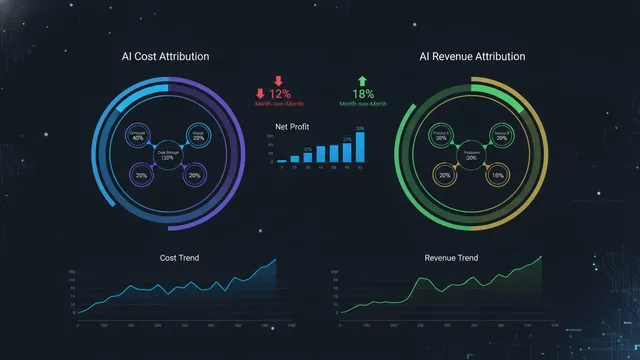
Read that carefully: AI-augmented growth costs more in absolute dollars, not less. The tooling, the workflow engineering, and the review overhead are real line items. What changes is the unit economics of learning — cost per experiment drops roughly 58–63%, and cost per validated win drops by a similar magnitude even after accounting for the lower win rate.
That's the honest framing, and it's the one that matters for a founder deciding where the next dollar goes. If you don't have enough surface area to run 20 experiments a quarter, the AI-augmented model is worse for you. Buy the cheaper manual configuration and revisit at scale. We walk through this exact calculation in The ROI of AI: How to Prove Your LLM Spend Actually Pays Back.
The setup cost is the part everyone underestimates
The $8,000–$14,000 workflow build line is the single most commonly ignored number in AI growth discussions. Getting to a reliable AI-augmented pipeline requires:
- An encoded style and brand guide the model can actually use (not a PDF — structured prompt context)
- Schema documentation and a semantic layer good enough for AI-generated SQL to be trustworthy
- Evaluation criteria per workflow so you know when output degrades
- Human review checkpoints with defined acceptance criteria
- Version control on prompts, treated like code
Teams that skip this get 6 weeks of exciting velocity followed by a quality collapse and a return to manual. We've been called in to clean up that exact pattern more than once.
A decision framework: which model fits your team right now
Score yourself. Each "yes" is a point toward AI-augmented.
- Do you have at least 20,000 monthly visitors or 2,000 monthly signups — enough traffic to power multiple concurrent tests?
- Is your event tracking trustworthy today, with a documented schema?
- Do you have one senior operator who can own AI output quality and say "no, this is bad"?
- Is a meaningful chunk of your work production-shaped (content, creative, variants, list ops) rather than judgment-shaped?
- Can you tolerate a 6–8 week ramp before velocity gains show up?
- Is your backlog of high-conviction hypotheses longer than your capacity to test them?
0–2 points: Stay manual. Fix instrumentation and hypothesis quality first. AI will amplify whatever's broken. 3–4 points: Hybrid. Automate content production and research synthesis only. Leave data and strategy manual. 5–6 points: Go AI-augmented across the board. You're leaving compounding gains on the table.
Question 6 is the one most teams fail. If your hypothesis backlog is thin, throughput isn't your constraint — insight is. Tripling execution speed against an empty backlog produces expensive noise. That's a diagnostic problem, not a tooling problem.
What we actually run at Growaton, and why
We're an embedded pod: product, engineering, data, experimentation, and marketing in one team shipping weekly. That structure is what makes AI-augmentation pay off, and it's worth explaining the mechanism.
The reason siloed agencies struggle to capture AI gains is that handoffs are the bottleneck, not production. If your content agency drafts copy in 2 hours instead of 8, but it still takes 11 days to route through your marketing lead, your dev shop, and your analytics vendor, you've optimized 6 hours out of a 264-hour cycle. Amdahl's law, applied to org charts.
Our configuration:
- AI on production, humans on judgment. Non-negotiable. Hypotheses, prioritization, and go/no-go decisions are human. Drafts, scaffolding, synthesis, and variants are AI-first with human review.
- Weekly shipping cadence as the forcing function. A weekly deadline makes quality degradation visible fast. Monthly cycles let bad AI output accumulate for a month before anyone notices.
- Instrumentation before velocity. Phase 2 of our framework is Measurement for a reason. We've declined to accelerate experiment volume for clients whose tracking couldn't support it — faster testing on broken data is just faster wrong answers.
- Prompt workflows treated as owned assets. Versioned, documented, evaluated. When an engagement ends, the client keeps the pipeline.
Net effect across our engagements: a 3-person Growaton pod typically ships what a 6–8 person conventional setup ships, at a lower cost per validated learning. Not 10x. Roughly 2–2.5x on people-equivalent output — which, compounded over four quarters of weekly shipping, is the difference between flat ARR and the kind of trajectory in our Series A case study.
The verdict
AI-augmented growth wins on cost per experiment and cost per learning — by roughly 40–60% — while costing more in absolute dollars and requiring real setup investment. It loses on strategy, novel positioning, compliance-sensitive work, and any team without enough traffic or hypothesis quality to justify the throughput.
The teams getting the worst results aren't the manual ones. They're the ones that bought the 10x narrative, removed human judgment, tripled their experiment count, and learned nothing faster than before. Velocity without direction is just expensive motion.
If you want to know which configuration your team should be running — and specifically whether your instrumentation and hypothesis backlog can support higher throughput — that's exactly what we cover in a free growth diagnostic. Thirty minutes, no deck, and you'll leave with a scored answer to the six questions above. If you'd rather see what an embedded pod engagement looks like in practice, our plans are here.