The short answer: "Fire fast" doesn't mean fire suddenly. It means decide fast, then execute with a documented, humane process that takes days — not quarters. The cruelty isn't in the termination. It's in the six months you spent hoping someone would magically become a different person while their teammates absorbed the cost.
Most founders get this exactly backward. They agonize privately for two quarters, drop hints nobody catches, then fire someone in a five-minute Zoom call that feels like an ambush. That's slow and jerky — the worst combination.
We at Growaton embed senior pods inside seed-to-Series C startups, which means we've watched dozens of founders navigate this. The pattern is consistent: the founders who handle it best aren't the ruthless ones. They're the ones who built a performance system before they had a performance problem.
This is that playbook.

Why Slow Firing Is the Most Expensive Mistake in a Growth-Stage Startup
At 12 people, one underperformer isn't 8% of your capacity. It's closer to 25% once you account for the manager time, the rework, the meetings that go in circles, and the top performers quietly updating their LinkedIn.
Here's the math founders skip:
| Cost category | What it actually looks like at a 15-person startup |
|---|---|
| Direct comp | $130K salary + ~20% loaded cost = ~$156K/year |
| Manager drag | 4–6 hrs/week of a senior lead's time on coaching, rework, damage control |
| Team compensation | 1–2 teammates absorbing 20–30% of the role's output |
| Velocity loss | Missed experiment cycles, slipped launches, decisions deferred |
| Culture tax | Your best people learn that standards are negotiable |
| Replacement cost | 6–9 months of ramp for the eventual backfill, starting later |
The culture tax is the one that compounds. Gallup research consistently finds that managers account for roughly 70% of the variance in team engagement — and nothing erodes a manager's credibility faster than visible, tolerated underperformance. Your A-players didn't join to carry someone. They joined to ship.
There's a second-order effect too. Every month you delay, the eventual conversation gets harder, because the person has more tenure, more relationships, and a longer record of you not saying anything — which they will reasonably interpret as approval.
The asymmetry nobody talks about
If you fire someone at week 8 who might have turned it around, you lose one hire and some goodwill. If you keep someone for month 10 who was never going to make it, you lose a hire, a manager's year, two adjacent teammates' patience, and possibly one great person who leaves out of frustration.
The downside distribution isn't symmetric. Act accordingly.
The Real Question: Is This a Fit Problem, a Clarity Problem, or a Capability Problem?
Before you touch the firing playbook, diagnose. Most "performance problems" at growth-stage companies aren't performance problems at all. We use a three-bucket triage — the same diagnostic instinct that drives Phase 1 of our 4-Phase Growth Framework, because you don't fix what you haven't measured.
Bucket 1: Clarity problem (your fault, fixable in a week)
The person doesn't know what "good" looks like. No written scope, no definition of done, priorities that shift weekly, three people giving contradictory direction.
Tell: When you ask them what their top three priorities are, their answer doesn't match yours.
Fix: Write the role scorecard. Three to five outcomes, each with a measurable definition. Give it 3–4 weeks. Roughly a third of "bad hires" we've seen were actually undefined roles.
Bucket 2: Fit problem (nobody's fault, fixable in a month)
The person is genuinely capable — just not at this company, this stage, or this role. The enterprise marketer who needs a brand budget and lands at a scrappy seed company. The specialist hired into a job that requires generalist range. The senior IC pushed into management they never wanted.
Tell: They're competent in some dimensions and visibly starved in others. Energy drops in the parts of the job that matter most.
Fix: Try a role reshape once, if a real role exists. If not, move to a respectful exit. Fit problems produce the best references and the best boomerangs — we've seen founders re-hire fit-mismatched people years later into the right seat.
Bucket 3: Capability or ownership problem (act now)
They can't do the work at the level required, or they can and won't. The second is worse. Missed commitments with no proactive flag. Blame that always lands elsewhere. Work that requires a rewrite. Feedback that gets acknowledged and then ignored.
Tell: You've given the same feedback three times in three different ways, and nothing structural changed.
Fix: Run the exit playbook. Ownership is the thing we screen hardest for in hiring for ownership — because it's the one trait that almost never develops on the job under pressure.
The 30-second decision heuristic
Two questions, borrowed from the best operators we've worked alongside:
- The re-hire test: Knowing everything you know now, would you hire this person into this role again?
- The relief test: If they resigned tomorrow, would your dominant feeling be panic or relief?
Two "no/relief" answers means the decision is already made. You're just deciding how long to postpone admitting it.
The Growth-Stage Firing Playbook: A 6-Step Process
This assumes you've done the triage above and landed in Bucket 3, or Bucket 2 with no viable reshape. Timelines assume US at-will employment — if you have employees in the EU, UK, or on non-US contracts, involve counsel early, because statutory notice and consultation requirements change everything.
Step 1: Write the evidence memo (before you talk to anyone)
One page, for your eyes only. Three sections:
- Expected: What the role requires, in outcomes.
- Observed: Specific, dated instances. Not "bad attitude" — "on March 4, committed to shipping the onboarding test by Friday; delivered the following Wednesday with no advance notice, third occurrence this quarter."
- Interventions: What feedback you gave, when, and what changed.
If you can't fill out section three, stop. You have a management failure, not a performance failure. Go give feedback for four weeks, then revisit.
This memo does three jobs: it forces you to test whether your gut is actually supported, it becomes your legal record, and it's the script for the conversation.
Step 2: Have the "this isn't working" conversation
This is the step almost everyone skips, and it's the difference between fast and jerky. The person should never be surprised by a termination. They should be surprised by nothing.
Say the words plainly: "I want to be direct with you, because you deserve to know where you stand. Right now, in this role, you're not meeting the bar. Here's specifically what I mean, and here's what changing would look like."
Then be quiet and listen. Sometimes you learn something that changes the diagnosis — a blocker you created, a health issue, a manager conflict you didn't see. That information is worth the meeting on its own.
Step 3: Set a real, short window — and mean it
For a growth-stage startup, 30 days is usually right. Sixty if the role has long feedback cycles (enterprise sales, SEO, long-cycle engineering). Anything past 90 days is you avoiding a decision.
A useful window has:
- 2–4 specific, observable outcomes — not "improve communication," but "run the weekly experiment review with a written recap in the channel by EOD Friday, four weeks running."
- A defined check-in cadence — weekly, 20 minutes, written notes.
- An explicit statement of stakes — "If these aren't met by [date], we'll transition you out of the role." Say it out loud. Ambiguity here is what makes the eventual exit feel like betrayal.
Be honest with yourself about intent. If you've already decided, don't run a theatrical improvement plan — that's dishonest and it wastes the person's job-search runway. In that case, skip to a straightforward, generous exit.
Step 4: Decide on the date, not "eventually"
Put the decision date in your calendar the day you set the window. When it arrives, decide against the written criteria — not against how nice the last conversation felt.
Genuine improvement looks structural: new habits, proactive flagging, work that stops needing rework. A good two weeks after a scary conversation isn't improvement. It's compliance. The tell is whether they've started anticipating problems instead of reacting to them.
Step 5: Run the exit conversation in 10 minutes or less
The termination conversation is not a debate, a performance review, or a therapy session. It's an announcement plus logistics. Structure:
- Lead with the decision (first 30 seconds). "I've made the decision to end your employment here, effective today. I want to walk you through what happens next."
- Give the reason once, briefly. Reference the window and criteria. Don't relitigate the evidence memo line by line.
- Move to logistics. Final pay, severance, benefits/COBRA continuation, equity vesting and exercise window, laptop return, account access, what you'll tell the team.
- Offer the human piece. Reference letter, intro help, a warm note in your network if you can honestly give one.
- Let them react without arguing. Anger, tears, bargaining — all normal. Absorb it. Don't defend.
Do it early in the week, early in the day, over video with camera on if remote (never over Slack, never on a Friday afternoon). Have a second person present if you have HR or a co-founder — one for support, one for the record.
Step 6: Handle the team within 24 hours
Silence breeds worse stories than the truth. Tell the team fast, keep it short, protect the person's dignence and privacy:
"[Name] is no longer with the company as of today. This was my decision, and it was about role fit against what we need in this seat. I'm not going to share details out of respect for their privacy. Here's how we're covering the work for the next two weeks. My door's open if you want to talk."
Then answer the question everyone is silently asking: am I next? If they're safe, say so directly. If your standards are changing, say that too — and say what the new bar is.
Finally, redistribute the work explicitly and temporarily. Unassigned work quietly lands on your most conscientious person, and that's how you turn one departure into two.
Severance: The Cheapest Reputation Insurance You'll Ever Buy
Founders under-index on severance because it feels like paying for nothing. It's actually paying for goodwill, a clean break, a signed release, and a candidate pipeline that doesn't get poisoned on Glassdoor and in founder Slack groups.
Practical benchmarks we see across seed-to-Series C companies (not legal advice — talk to an employment attorney in your jurisdiction):
| Tenure | Typical severance | Notes |
|---|---|---|
| Under 6 months | 2–4 weeks | Often paired with a "we got this wrong" framing |
| 6–18 months | 4–8 weeks | Add COBRA/benefits coverage for the period |
| 18 months+ | 8–12 weeks | Consider accelerated vesting for early team members |
| Senior/exec | 3–6 months | Usually contractual; negotiate at offer, not exit |
Two things worth more than money to a departing employee: a genuinely useful reference and honest framing they can use in interviews. Agree on the story together. "The role scope changed as the company grew and we mutually decided it wasn't the right fit" is often both true and usable.
Also: check your obligations. In the US, layoffs above certain thresholds trigger WARN Act notice requirements, and state rules on final-pay timing vary widely. Individual performance terminations usually sit outside WARN, but if you're cutting several people at once, get advice first.
Building the System That Makes Firing Rare
The best firing playbook is one you rarely open. Three systems do most of the work — and they're the same rituals that show up in what we call the ownership operating system.
Written role scorecards from day one
Every role gets a one-pager: mission, 3–5 measurable outcomes, and the competencies required. Written before the job post goes live, reviewed with the hire in week one, revisited quarterly. You cannot manage performance against an expectation you never wrote down.
A 90-day gate that actually gates
Structure the first 90 days with checkpoints at 14, 30, 60, and 90 days, each with explicit deliverables. At 90 days you make a real decision: confirmed, needs a specific correction, or exit now.
This is where speed is nearly free. Exiting a mis-hire at day 75 costs you a quarter. Exiting them at day 400 costs you a year, a manager, and a teammate. Data from SHRM and others repeatedly puts the cost of a bad hire at anywhere from one-third to multiple times annual salary — and virtually all of that cost accrues after the point you first suspected it wasn't working.
A weekly rhythm that surfaces problems in days, not quarters
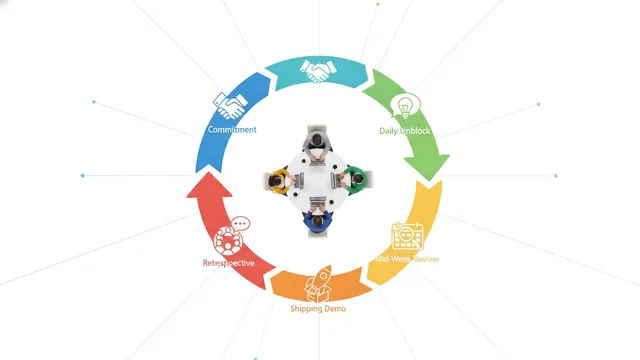
Our pods run a weekly shipping cadence: every person commits publicly to what they'll ship, then reports on what actually shipped. It's a growth practice first — velocity is the input that compounds — but it's also the single best performance-management tool we've found. Three consecutive weeks of missed commitments with no proactive flag is a signal you get in 21 days instead of two quarters.
The mechanism is simple: make work visible, make commitments explicit, make reporting public. Underperformance can't hide in a system like that, and neither can excellence. You end up promoting faster too.
Coach before you conclude
Some people labeled "underperformers" are actually under-trained. We've taken operators from junior to genuinely senior in about six months using structured player-coach pairing, real ownership of live workstreams, and weekly feedback loops. That approach doesn't rescue an ownership problem — nothing does — but it rescues a capability problem more often than founders expect. The distinction is whether they're hungry for the feedback or hiding from it.
What "Not Being a Jerk" Actually Means
It doesn't mean being soft. Being soft is the jerk move — it steals someone's runway to find a job they'd be good at while they slowly lose confidence in a role that was never going to work.
Not being a jerk means:
- They knew. No surprises. The gap was named out loud, more than once, in specific terms.
- They had a real shot. A defined window with observable criteria, and honest feedback during it.
- You were straight about the stakes. Nobody had to read your mind.
- The exit was dignified. Private, brief, well-prepared, fairly compensated.
- You told the truth to the team without humiliating the person.
- You owned your part. Most bad hires are also hiring-process failures or onboarding failures. Say that out loud — to the person and to your team.
The founders who do this well end up with something counterintuitive: people they fired who still refer candidates to them. That's the actual bar.
The 30-Day Founder Checklist
If you're reading this because there's someone specific on your mind:
- Day 1: Write the evidence memo. Run the re-hire and relief tests.
- Day 2: Triage — clarity, fit, or capability/ownership problem?
- Day 3: If clarity, write the scorecard and reset. Stop here for 30 days.
- Day 4: If fit or capability, hold the "this isn't working" conversation. Name the gap and the stakes.
- Days 5–30: Weekly 20-minute check-ins with written notes. Track against the criteria, not the vibe.
- Day 31: Decide against the written criteria. Confirm, extend once with new criteria, or exit.
- If exiting: Prep severance, logistics, and team comms before the conversation. Run it in 10 minutes. Brief the team within 24 hours.
- Week after: Post-mortem your hiring loop. What signal did you miss? What screen do you add?
Team performance and growth performance run on the same operating system: clear outcomes, short feedback loops, visible work, weekly shipping. When founders tell us their growth has stalled, we often find the root cause isn't the channel mix or the funnel — it's that nobody knows who owns what, or what "good" looks like.
If that sounds familiar, book a free growth diagnostic and we'll pressure-test your growth system — including the operating rhythm behind it. Or see how embedded senior pods compare to agencies and in-house builds in our breakdown of growth pod models and engagement structures.