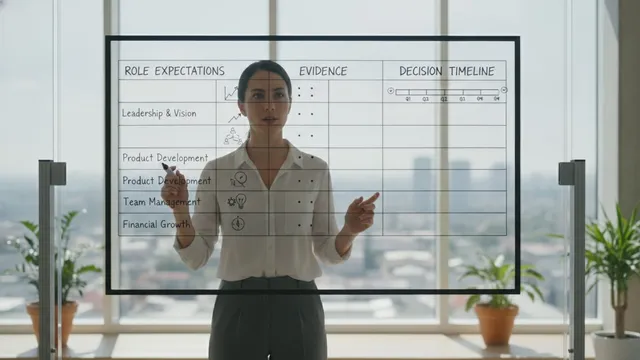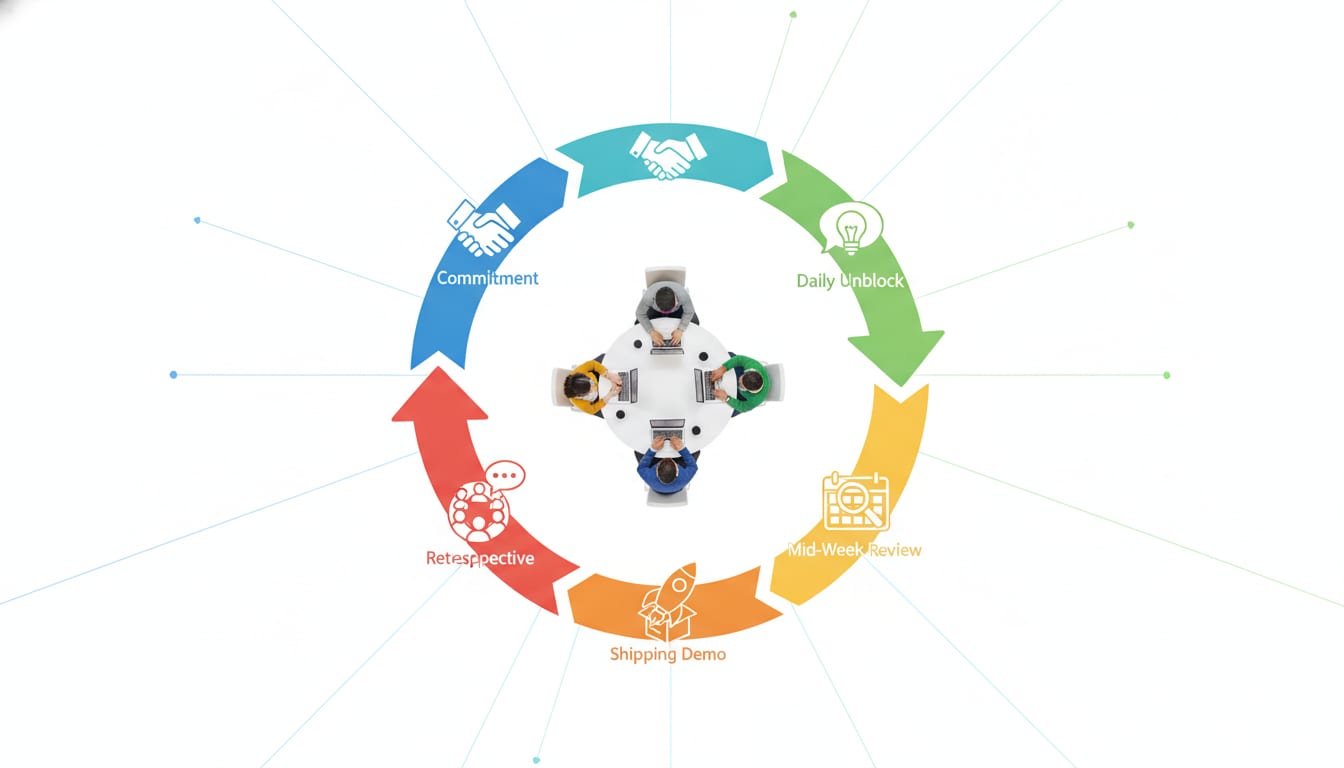
The short answer: accountability in a small team isn't a personality trait you hire for and hope survives contact with reality. It's an operating system — a small set of recurring rituals that make commitments visible, make progress reviewable, and make consequences (good and bad) land on named humans. Get the rituals right and average teams behave like great ones. Get them wrong and even your best operators drift into busy, unaccountable motion.
We at Growaton run embedded growth pods of four to six senior people inside seed-to-Series C startups. Our pods ship every week, in someone else's codebase, against someone else's revenue targets, usually without a manager in the room. That only works because we've stripped the operating system down to five rituals and killed everything else. This guide is that system — what each ritual is, how long it takes, what it produces, and how it fails.
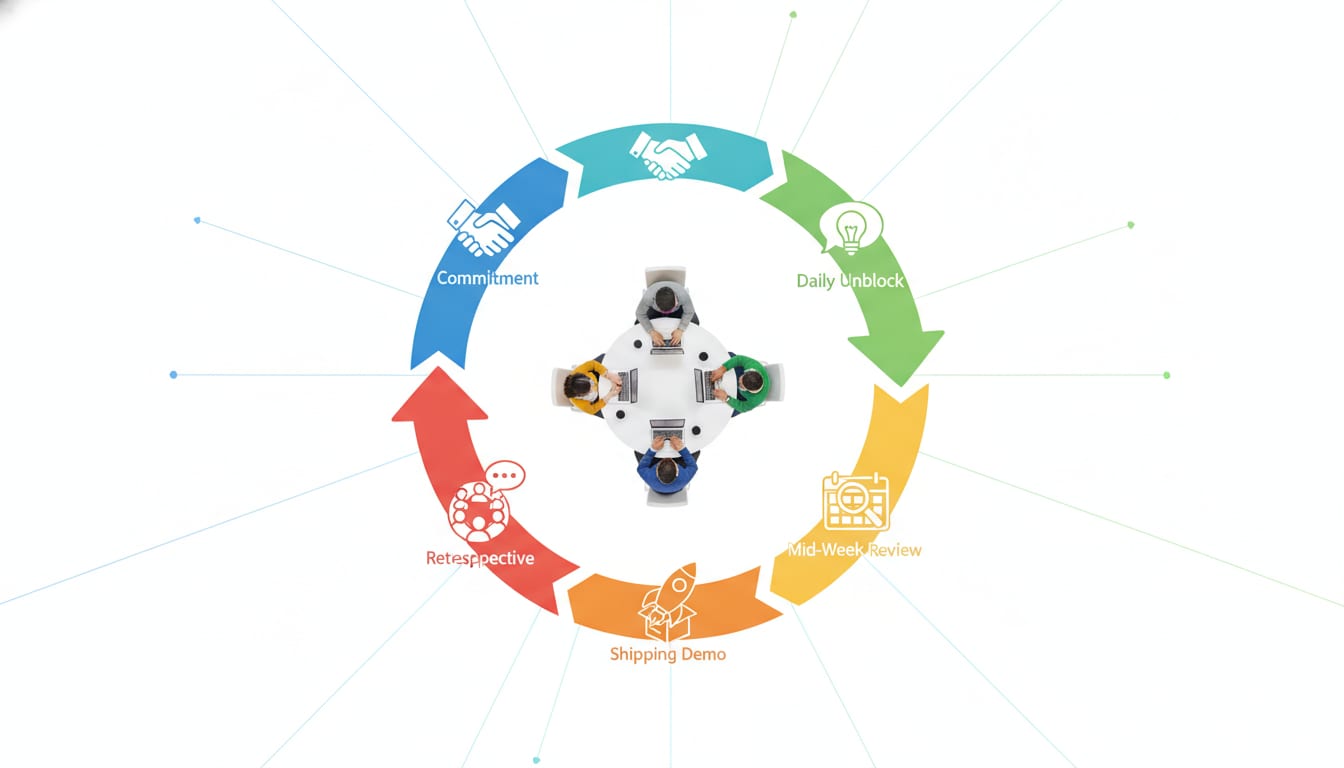
What an "ownership operating system" actually is
An ownership operating system is the minimum set of recurring practices that convert intent into owned, dated, measurable commitments — and then surface the results publicly enough that nobody has to chase anyone.
Three components, all required:
- Named single owners. Every meaningful outcome has exactly one name attached. Not a team, not two co-leads, not "product and eng."
- Short, forced loops. Commitments are made and reviewed on a cadence tight enough that drift is caught in days, not quarters.
- Visible truth. Progress and results are written down where everyone can see them, including the ugly ones.
Remove any one and the system collapses. Named owners without short loops produce heroic quarterly surprises. Short loops without named owners produce meeting theater. Both without visible truth produce a team that privately knows things are broken and publicly reports green.
This is not new thinking, and that's the point. Research on team effectiveness at Google's Project Aristotle found that the strongest predictors of high-performing teams were psychological safety, dependability, structure and clarity, meaning, and impact — four of the five are direct outputs of the rituals below, not of who you hired (re:Work, Google). Structure isn't the enemy of ownership. Structure is what makes ownership possible in teams too small to have slack.
Ownership vs. accountability vs. responsibility
These get used interchangeably and it costs teams real money. Precise definitions:
| Term | Definition | Failure mode when confused |
|---|---|---|
| Responsibility | You are assigned tasks and expected to complete them | Team completes tasks, outcome doesn't move, nobody feels wrong |
| Accountability | You answer for the result publicly, on a known cadence | Owner discovers the miss at the same time as everyone else |
| Ownership | You decide what to do to hit the outcome, and you carry the consequence | Owner waits for instructions, calls it "blocked" |
Small teams need ownership, not responsibility. A responsible engineer ships the A/B test you specified. An owner tells you the test is underpowered at your traffic volume and proposes a different measurement approach before wasting three weeks. Hiring for that difference is its own discipline — see our take on hiring operators who give a damn — but rituals determine whether that instinct survives month three.
The five rituals
We run these inside every pod. Total meeting overhead: roughly 3.5 hours per person per week for a five-person team. That's the budget. Anything that doesn't fit inside it gets cut.
Ritual 1: The Monday Commitment (45 minutes, whole team)
Not a status meeting. A commitment meeting. Each person states, out loud, in front of peers:
- The one outcome they own this week
- The metric or artifact that proves it happened
- What they need from whom, by when
Then it goes in writing. One line per person, in one shared doc or channel, phrased as a falsifiable claim.
Bad commitment: "Work on onboarding improvements." Good commitment: "Ship the new three-step activation flow to 50% of new signups by Thursday; report day-7 activation delta in Friday's demo."
The magic is the public, verbal act. Behavioral research on commitment and consistency is unambiguous — people follow through on things they've stated publicly at far higher rates than things they've merely been assigned. In our pods, moving from assigned tickets to spoken weekly commitments cut mid-week scope drift more than any project management tool ever did.
Rules that keep it honest:
- Maximum two commitments per person. Three is a lie.
- No commitment may depend on more than one other person's unfinished work. If it does, sequence it or shrink it.
- Anyone can challenge a commitment as too vague. That's not rude; that's the job.
Ritual 2: The Daily Unblock (10 minutes, async or standing)
Standups die because they become status theater — everyone recites yesterday's activity to an audience that doesn't need it. Replace the format with two questions only:
- Am I still on track for my Monday commitment? (yes/no)
- If no, what's the specific blocker and who owns removing it?
That's it. No activity logs. No "worked on the thing, continuing today." A yes takes four seconds. A no triggers a named side conversation with a name and a deadline attached, out of the main meeting.
We run this async in Slack for distributed pods, with a hard rule: a "no" that appears two days in a row escalates automatically to the pod lead. Not as punishment — as a signal that the commitment was wrong, the estimate was wrong, or the person needs help they're not asking for. All three are fixable in day three. None are fixable on Friday.
Ritual 3: The Mid-Week Reality Check (20 minutes, pod lead + individual)
Wednesday. One-on-one, or a quick threaded review. The question isn't "how's it going." It's: "If you had to ship Friday, what would you cut?"
This single question does three jobs. It forces the owner to distinguish core from nice-to-have. It surfaces silent scope creep. And it gives the owner explicit permission to reduce scope rather than blow the deadline — which is what turns deadlines from fiction into instruments.
The most common outcome of a good reality check is a rewritten commitment, in writing, with the change and reason noted. A changed commitment is not a failure. An unchanged commitment that silently misses is.
Ritual 4: The Friday Ship Demo (45 minutes, whole team + stakeholders)
The load-bearing ritual. Everything upstream exists to feed it.
Every person shows the thing. Working software, a live dashboard, a published page, a decision doc, a completed experiment readout. Not slides describing the thing. The thing.
Format we use:
- 5 minutes per person, hard stop
- Open with the Monday commitment as written, verbatim
- Show the artifact
- State the outcome: shipped / shipped partial / didn't ship, and the number if one exists
- One sentence on what you learned
Reading your own commitment aloud before showing the result is deliberately uncomfortable, and that discomfort is the entire mechanism. It removes the gap between what you said and what you did, which is where accountability actually lives.
Clients are invited. Our pods demo to founders every Friday, which is the enforcement function behind our weekly-shipping promise — the 4-phase growth framework we run (diagnostics → measurement → conversion → scale) only holds together because every phase produces a Friday artifact somebody has to stand behind.
What a healthy demo culture looks like: roughly 70–85% of commitments shipped as stated. Below 60% and your commitments are fantasy — fix estimation. Above 95% consistently and your team is sandbagging — raise the bar.
Ritual 5: The Bi-Weekly Retro on the System, Not the People (60 minutes)
Every two weeks, review the operating system itself. Three questions:
- Which commitments missed, and was the cause estimation, dependency, or priority churn?
- What decision did we make slowly that we should have made fast?
- What ritual is now theater and should be killed or changed?
Note the framing. This is a retro on process, not performance. Individual performance conversations happen privately, on a different cadence, with the pod lead. Mixing them makes people defensive and kills the honest reporting you spent four rituals building.
Track one number over time: commitment hit rate (commitments shipped as stated ÷ commitments made). It's the single best health metric for an ownership system, and it's more useful than velocity because it measures the accuracy of your promises, not the volume of your motion.
The scoreboard: making ownership legible
Rituals without a scoreboard degrade into ritual. Keep one page — genuinely one page — with four things:
| Element | What it shows | Update cadence |
|---|---|---|
| Outcome owners | Each key metric or workstream and the single name accountable | On change only |
| This week's commitments | One line per person, verbatim from Monday | Weekly |
| Commitment hit rate | Rolling 8-week trend | Weekly |
| Open decisions | Decision needed, owner, deadline | Continuous |
The "open decisions" row is the sleeper. In most small teams the biggest accountability leak isn't lazy execution — it's decisions sitting unmade for weeks because no one owns making them. Amazon's well-documented distinction between reversible "two-way door" and irreversible "one-way door" decisions exists precisely to stop teams from applying heavyweight process to cheap, reversible calls (Amazon 2015 shareholder letter). Put a name and a date on every open decision and classify it: two-way doors get decided by the owner alone, this week.
Why small teams need this more than big ones
Counterintuitive but consistent in our experience: the smaller the team, the more explicit the operating system needs to be.
Large organizations have structural redundancy. If one person drifts for three weeks, a manager, a program manager, or a dependent team notices. A five-person pod has no redundancy. One person quietly stuck for two weeks is 20% of total capacity, and there's no one whose job is to notice.
Small teams also have a specific failure pattern: everyone is generally helpful, so nobody is specifically accountable. Three people all "supporting" activation means activation has no owner. The work looks collaborative and feels good, and the metric doesn't move for a quarter. The fix is unglamorous — assign one name, let the others be explicitly consulted rather than accountable.
This is also why we build pods with deliberately non-overlapping ownership. Each role inside a high-ownership growth pod owns a distinct surface: acquisition, conversion surfaces, data/instrumentation, or engineering throughput. Overlap creates comfort. Comfort creates drift.
Common ways this system breaks
Commitments become sandbagged
If missing a commitment is punished harshly, people commit to things they've already finished. The tell: hit rate near 100% and flat business metrics. Fix: explicitly reward changed commitments and honest misses in the retro, and set a target hit rate of 80%, not 100%. Perfect execution against unambitious goals is the worst outcome available to you.
The demo becomes a slide deck
The slow slide from "show the thing" to "describe the thing" is how accountability quietly exits a company. Enforce it mechanically: no screen-share of the working artifact, no demo slot. Someone senior needs to say this out loud the first two times it happens.
Rituals accumulate
Teams add rituals and never remove them. Six months in you're at eleven hours of recurring meetings and nobody remembers why. The bi-weekly retro's third question — what ritual is now theater? — exists solely to prevent this. Kill something every quarter.
Ownership without authority
The fastest way to destroy ownership culture is to hold someone accountable for an outcome while retaining veto power over their decisions. If the person who owns activation can't ship a change to the signup flow without three approvals, they don't own activation — you do, and they'll correctly behave as if they don't. Ownership requires a real decision budget: what they can change unilaterally, what needs a heads-up, what needs a genuine yes.
The persistent underperformer
Rituals make performance problems visible fast — usually within three to four weeks. That's a feature, and it creates an obligation. A team that watches someone miss commitments for two quarters with no consequence learns that the system is decorative. This is where firing fast without being a jerk becomes an accountability practice rather than an HR event: clear signal, direct conversation, real support, and a bounded window.
A 30-day rollout
Don't install all five rituals at once. Sequence:
Week 1 — Assign owners. List every outcome that matters. Put exactly one name on each. Publish it. Expect the argument; have it now rather than in month three.
Week 2 — Start Monday Commitment + Friday Demo. These two alone produce 70% of the value. Run them for a full two weeks before adding anything.
Week 3 — Add the Daily Unblock and Mid-Week Reality Check. By now you'll know where commitments actually break, and these will feel useful rather than imposed.
Week 4 — First system retro. Compute your baseline commitment hit rate. It will be low — ours started around 55% in early pods. Publish it anyway. The number matters less than the fact that you're now measuring promises.
Then hold it for a full quarter before judging. The system's compounding effect comes from repetition; four weeks tells you whether people tolerate it, twelve tells you whether it works.
Where AI changes the equation (and where it doesn't)
AI has compressed execution time dramatically — a senior builder with good tooling ships in days what took weeks two years ago. That makes the ritual layer more important, not less. When execution is fast, the bottleneck moves entirely to decision quality and commitment clarity. A team that can build five things a week but can't decide which one matters is worse off than before.
Practically, we use AI to reduce ritual overhead, not replace judgment: auto-summarizing async unblock threads, drafting experiment readouts from raw analytics, generating first-pass retro themes from a fortnight of Slack. That reclaims maybe 90 minutes per person per week. What it never does is make the commitment for you or stand in front of the team on Friday. If you're weighing where AI actually pays back versus where it's theater, that's a measurement problem worth its own rigor — our writing on proving LLM spend pays back covers the framework.
The uncomfortable conclusion
Most founders diagnose accountability problems as people problems and respond by hiring differently. Sometimes that's right. Far more often, the team is full of capable people operating in an environment where commitments are vague, loops are long, and nothing is visible until it's late.
Rituals are cheap. Rehiring is not. Install the operating system first, run it honestly for a quarter, and then decide who can't operate inside it. You'll usually find the answer is fewer people than you feared.
If you're scaling a growth team and suspect the problem is your operating rhythm rather than your roster, that's exactly the kind of thing we pull apart in a free growth diagnostic conversation — no pitch required. You can also see how the weekly cadence plays out in practice across real engagements in our case study library.