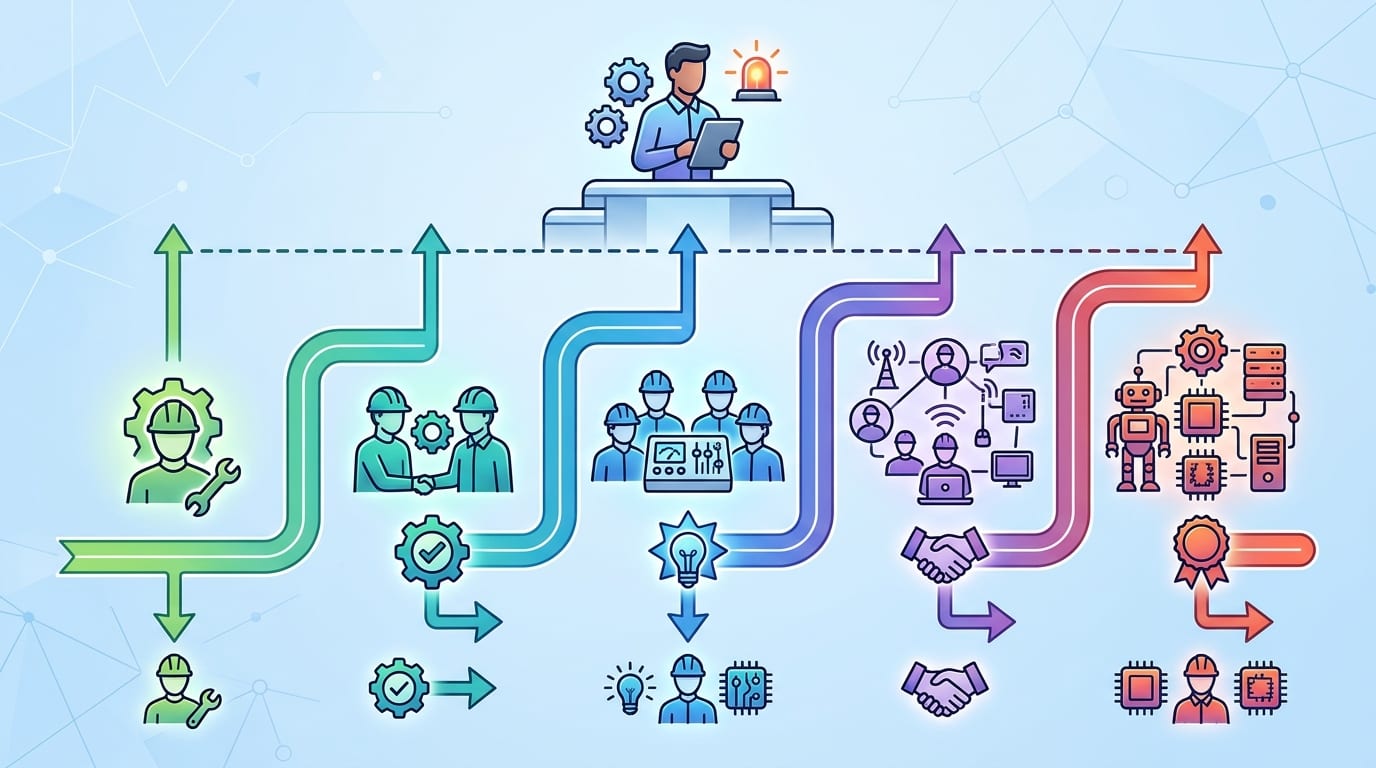
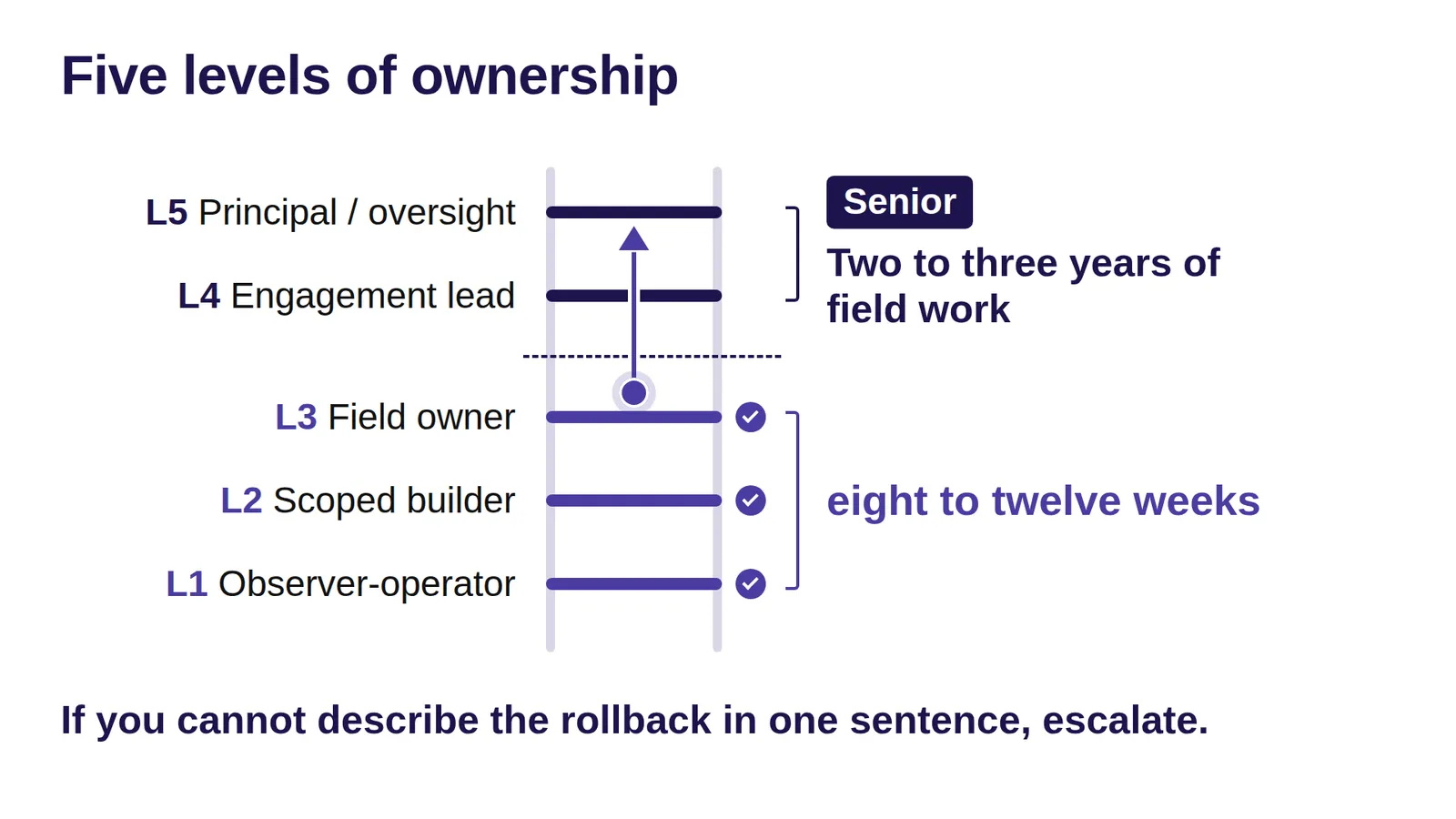
The short answer: you don't hire for fifteen years of judgment, you build a ladder that replaces most of it with structure, and you keep a senior person on the three or four decisions that structure can't cover.
That's the whole method. Five levels of ownership, each with written exit criteria. A mid-level operator with clear thinking and a working model of systems and operations can carry Levels 1 through 3 inside a client's stack in eight to twelve weeks. Levels 4 and 5 stay with someone who has actually been burned before. Enterprise security review, multi-year platform bets, and the "do we tell the client their roadmap is wrong" conversation do not get delegated down a ladder. They get escalated up one.
I've built this twice: once running a 120-person engineering org across the US, Europe and Latin America, and again at Growaton, where the whole business is embedded pods doing product, engineering, data and growth inside someone else's company. The ladder is what makes it work without a bench of principals.
First, the honest version of the role
The Forward Deployed Engineer title is mostly a rename. Procurement Tidbits put it bluntly in their piece on vendor FDEs: "Vendor engineers sitting at the customer, configuring, integrating and fixing things until the system works? We used to call them implementation consultants." Andreessen Horowitz, per Wikipedia's entry on the role, called the title "title arbitrage."
We partly agree. The work isn't new. Outstanding product managers with engineering backgrounds have been doing exactly this for twenty years: sitting in the client's operations, reading their data, writing the spec and then writing some of the code. What is new is that the rebrand loosened the entry requirement. You no longer need to have survived three product cycles at a scale-up to be trusted in front of a customer. That's the good news. It's also my rant: the rite of passage got shorter, and most companies shortened it by lowering the bar instead of building the scaffolding.
The Forbes Technology Council described the role as "part technologist, part operator, part strategist" and called it one of the most compelling career paths available. Fine. Compelling career paths still need a definition of done at each rung, or you've just given a 27-year-old a customer and a prayer.
Why business context beats stack breadth
Here is the part that makes a short ladder possible.
LeadDev, in "The reality of being a forward-deployed engineer (FDE)", writes that beyond coding "there are other elements of the role that matter just as much: business communication, relationship building, requirements gathering, and understanding the industry you work in." They also note that "effective forward deployed engineers (FDEs) know who to ask when a problem falls outside their own expertise."
We agree, and we'd go further. Those four skills are the job, and three of them are learnable in weeks, not years, if the pod is structured to teach them. Requirements gathering is a procedure. Industry context is reading plus twenty conversations. Knowing who to ask is a routing table you can literally write down. What takes fifteen years is pattern recognition on irreversible decisions, and that's exactly the slice we keep senior.
So we hire for clear thinking, a working mental model of systems and operations, and the willingness to ask a stupid question in front of a client's VP. Then we hand them a ladder.
The five levels of ownership
Each level has a scope, exit criteria, and a named thing it is not allowed to touch. The exit criteria are the point. Without them, "mid-level" becomes a feeling instead of a boundary.
| Level | Owns | Exit criteria to move up | Escalates |
|---|---|---|---|
| L1: Observer-operator | Runs existing playbooks in the client's systems. Pulls data, reproduces bugs, documents the current workflow. | Can describe the client's core business metric and the three systems that produce it, unprompted, in a client meeting. Two weeks of clean documentation. | Everything outside the playbook |
| L2: Scoped builder | One bounded workstream with a reversible blast radius: a report, a script, an automation, a landing experiment. | Shipped three changes with no rollback. Wrote the spec before the code for all three. Can name the owner on the client side for each system they touched. | Anything touching production writes on client data |
| L3: Field owner | A whole surface inside the client: an integration, a funnel, an internal tool. Runs their own client meetings. Writes requirements that other people build. | Four weeks of running the weekly cadence without a senior in the room. Caught at least one requirement the client stated wrong and corrected it before build. Merge-back notes filed on every custom build. | Security review, architecture that outlives the engagement, pricing and scope renegotiation |
| L4: Engagement lead | The whole pod's scope, the roadmap conversation, the "your roadmap is wrong" conversation. | Has taken a scope through a renegotiation and a failed experiment without losing the account. Usually two to three years of field work minimum. | Multi-year platform bets, legal, anything that changes the client's cost structure |
| L5: Principal / oversight | Irreversible calls. Enterprise security review. Platform bets measured in years. Staffing the ladder itself. | n/a | n/a |
A sharp mid-level person can reach L3 in eight to twelve weeks on a well-documented client. That is the shortcut, and it's real. L4 is not a twelve-week thing, and anyone selling you that is selling you a disappointment.
What the ladder does not cover
Say this out loud to the client in week one, because they will otherwise assume the person embedded with them is senior by virtue of being there.
- Enterprise security review. Threat models, data residency, SOC 2 evidence, pen test remediation. This needs someone who has been through an audit and knows which auditor questions are theater and which are not. Never an L2 or L3.
- Multi-year platform bets. Choosing a database, committing to an event bus, deciding to build versus buy a billing system. The cost of being wrong lands after the engagement ends, which is exactly why the person in the field is the wrong person to decide it.
- Judgment on irreversibility. The real senior skill is not knowing the answer. It's recognizing within ninety seconds that a decision cannot be undone cheaply, and stopping. We train L2s and L3s on one trigger: if you cannot describe the rollback in one sentence, escalate.
- Telling the client something they don't want to hear about their own business. That's L4. It requires a relationship that survives the sentence.
How to actually run it, week by week
Weeks 0-1: context before code
No one writes production code in week one. The L1/L2 work is mapping: which systems produce the number the client cares about, who owns each one, where the data lies to you. We require a one-page systems map and a named human per system before any build ticket opens. This is the single highest-leverage thing we do, and it's also the thing clients push back on, because it looks like we're not shipping.
Weeks 2-4: reversible shipping only
Everything shipped in this window must be revertible in under an hour. Scripts, reports, experiments, internal tools. The goal is not impact, it's calibration: we're finding out how fast this person learns the client's domain and whether they ask for help before or after breaking something. LeadDev's point about knowing who to ask gets tested here, deliberately, by assigning at least one problem outside the person's expertise.
Weeks 4-12: surface ownership and merge-back
L3 takes a surface. From here the weekly cadence is fixed: one client-facing review, one internal build review, and a merge-back note. The merge-back note is one paragraph answering a single question: does this custom build belong in the core product? If the same note appears for three different clients, you have a feature, not a custom build. If the field work never comes back into the product, you sold consulting with a premium name on it, and the ladder was just a staffing convenience.
Ongoing: the pairing rule
Every L2 and L3 is paired with an L4 or L5 who reviews, not approves. Review means the senior person reads the spec and the merge-back note weekly and intervenes on scope and irreversibility, not on code style. One senior can hold four or five field people this way. That ratio is the economics of the whole model, and it breaks if the senior is also carrying their own full engagement.
The sustainability problem, which we have not solved
LeadDev wrote in "The rise of the forward-deployed engineer (FDE)" that "sustainability is shaky: rare skills, heavy travel, and real burnout risk." PostHog's engineering blog on the role says FDEs "do a ton of meetings and customer-facing work and are often required to travel 20-50% of the time." Wikipedia notes that "some software engineers consider the role to be undesirable because of the travel requirements and pressure to solve customer problems within relatively short amounts of time."
We partly agree, with one correction. The travel is a symptom. The actual load is that the resolution clock is set by someone else's quarter and the person in the field absorbs every mismatch between the client's expectations and the product's reality. A shorter ladder makes this worse, not better, because you've put someone with less scar tissue in front of the pressure.
What we do about it, honestly and incompletely:
- A hard split between field weeks and build weeks. Roughly three field weeks to one build week. The build week is not slack, it's merge-back and internal work with no client calls.
- Rotation windows. No one stays on the same client surface indefinitely. Nine to twelve months, then rotate, which costs continuity and we accept that cost.
- The pairing rule doubles as a pressure valve. The L4 takes the escalations that would otherwise land as 11pm anxiety on an L2.
None of this runs at 100% utilization. Most companies run the role at full utilization because it bills, and then wonder why their FDEs leave in eighteen months. We price the gap in. It's a real cost, not a clever trick.
Product manager or engineer: who you send
Our position, stated in the series and worth repeating here: send the hybrid. A product person with an engineering background catches the requirement that's stated wrong, which is the failure mode that actually kills engagements. An engineer catches the integration that won't scale, which is usually recoverable.
If you don't have a hybrid, send the product person and give them a developer. Not the reverse. The ladder above is written for that shape: L1 through L3 are mostly about reading a business correctly and writing specs that survive contact with a codebase, which is product work with engineering literacy attached.
What good looks like after a quarter
- The client can name what the pod owns and what still escalates.
- At least one requirement was corrected before build, not after.
- Merge-back notes exist for every custom build, and at least one has been promoted into the core product.
- No L2 or L3 made an irreversible call alone.
- The field-to-build ratio held. If it didn't, the pod is being run at billing utilization and will degrade.
That's the honest claim. A structured ladder lets a sharp mid-level operator be genuinely dangerous inside a client's systems in about three months. It does not manufacture principal-level judgment, and if you need that, you still need to pay for a principal.
If you're building an embedded pod and trying to work out which levels you can actually staff from your current team, that's roughly the conversation we have in a free growth diagnostic. We've written more on how the pod model compares to agencies and in-house teams on the Growaton blog.
Ship the product improvements your business needs
Growaton builds custom software, servers and infrastructure, e-commerce platforms, process automation with AI and roadmaps, deploying inside your systems every week with senior review.
product and engineering execution