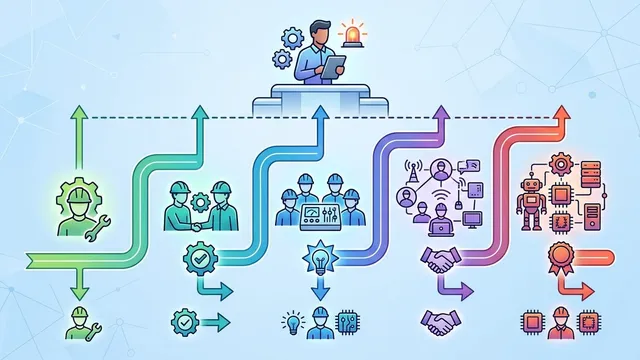
The short answer: send the hybrid. A product person with a working engineering background, who can read a schema, write a spec that survives contact with the customer's ops team, and say no out loud. Send them with a developer either way, because the hybrid alone under-builds. The pairing is part of the answer, not a consolation prize. Do not send a strong engineer and hope they absorb the product instinct on site. That substitution fails in a predictable way, and it fails in week three.
That's the whole position. The rest of this is why, what each profile actually catches in the first four weeks, and how to staff it when nobody on your bench has fifteen years of scar tissue.

The role you're staffing is older than the title
Before arguing about who to send, be clear about what the job is. The Forward Deployed Engineer sits inside the customer's operation and ships against their reality instead of your roadmap. We've written about the term, the job, and the older name for it elsewhere in this series. The lineage matters here because it tells you which skills are load-bearing.
Procurement Tidbits puts it bluntly: "Vendor engineers sitting at the customer, configuring, integrating and fixing things until the system works? We used to call them implementation consultants." Wikipedia's entry notes that Andreessen Horowitz described the title "forward-deployed engineer" as "title arbitrage". We partly agree. It is a rebrand of work that operations-minded product people with an engineering background have done for decades, and we think the rebrand is still useful, because it shortened the rite of passage. You no longer need fifteen years to be dangerous in someone else's systems. You need clear thinking and a working model of systems and operations.
But a shorter rite of passage changes who you can send, not what the job requires. And what the job requires is mostly not stack breadth.
What each profile catches in the first four weeks
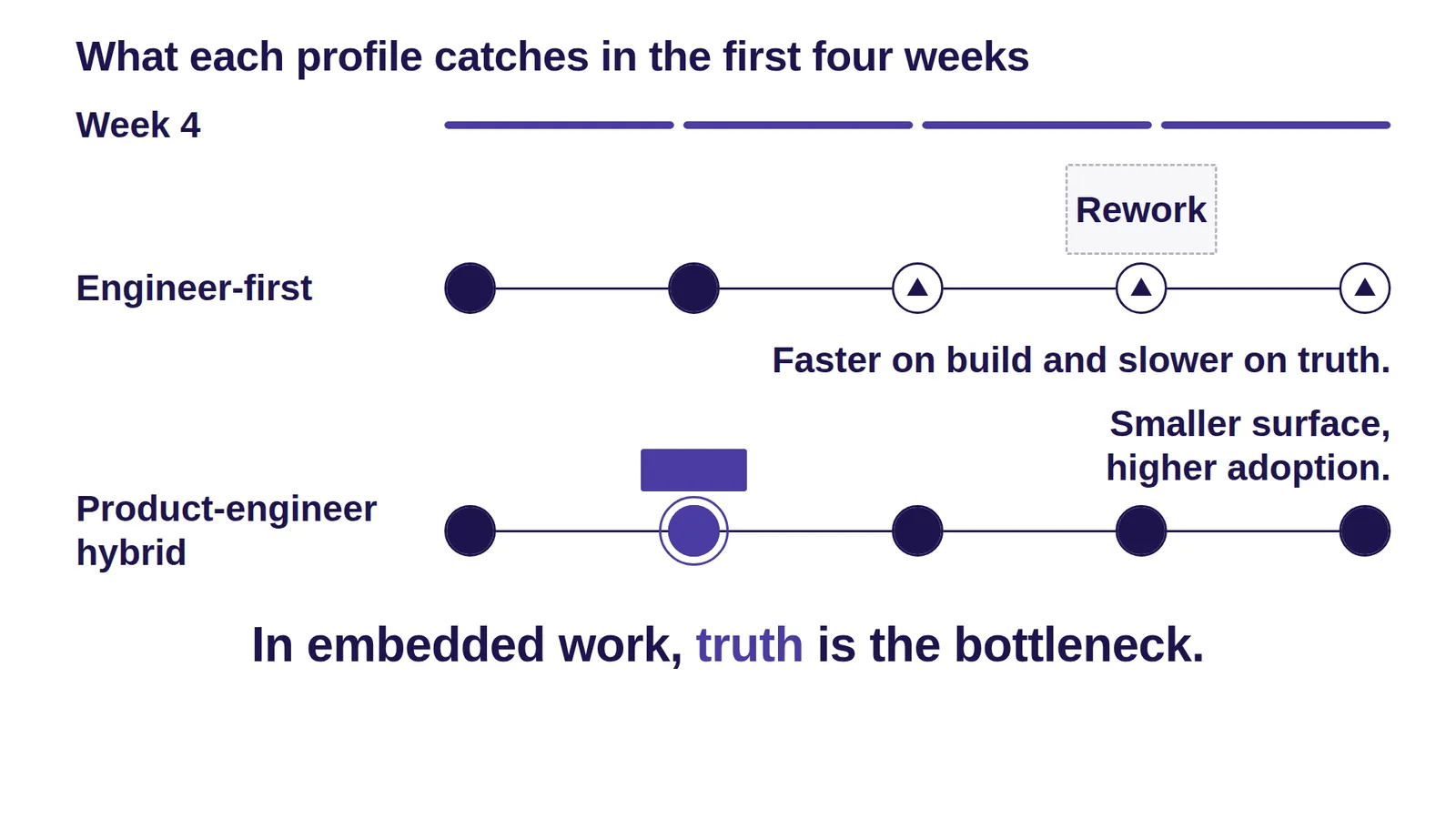
This is the comparison that actually decides the engagement. Four weeks is roughly the window where a deployment either finds the real problem or commits to the stated one.
| Week | Engineer-first deployment | Product-engineer hybrid deployment |
|---|---|---|
| 1 | Gets environment access, maps the API surface, finds three data quality problems. Accepts the customer's framing of the problem because it arrived in a ticket. | Gets environment access too, but spends half the week in the ops team's actual workflow. Finds that the stated problem is a symptom of a handoff two steps upstream. |
| 2 | Starts building the thing that was asked for. Velocity looks excellent. Stakeholders are delighted. | Writes a one-page problem statement and gets it wrong in front of the customer on purpose. Learns who the real decision maker is and who the quiet blocker is. |
| 3 | Hits the first integration surprise: an undocumented legacy system, a compliance constraint, a team that was never told about the project. Escalates late because it feels like a personal failure. | Already knew about the legacy system because they asked the person nobody invited to the kickoff. Scope has been renegotiated once, in writing. |
| 4 | Demo lands. Half the room is happy. The ops lead says "this isn't how we actually do it." Rework begins. | Demo lands against the corrected problem. Smaller surface, higher adoption. A merge-back candidate has already been flagged for the core product. |
The engineer-first path is not incompetent. It's faster on build and slower on truth. In embedded work, truth is the bottleneck, not build throughput.
What practitioners say, and where we agree
LeadDev's piece on the reality of the role names the skill mix directly: "there are other elements of the role that matter just as much: business communication, relationship building, requirements gathering, and understanding the industry you work in." We agree, with one sharpening. Those are not soft complements to the engineering. In the first four weeks, they are the job. The code is the artifact that proves you understood.
The same article makes a point most hiring loops don't test for: "Effective forward deployed engineers (FDEs) know who to ask when a problem falls outside their own expertise." Knowing who to ask is a network and a social read, not a technical skill. It is also the single highest-leverage habit on site, because an embedded person's expertise will fall short constantly by design. You were sent into a domain you don't know.
LeadDev's companion piece on the rise of the role adds the behavior that separates a deployment from an order-taking exercise: "If a client says X is the solution, an FDE will really interrogate whether that's really the case and vocally propose alternatives backed with data and evidence." Agreed, and note what "vocally" is doing in that sentence. Interrogating privately and building what was asked for anyway is the common failure. It looks like diligence and produces the same outcome as compliance.
Igor at Productics is the sharpest on the staffing error: "Every company racing to copy Palantir sent the engineer. Almost none of them sent the person with the mandate to say no." He also identifies who got sent: "disproportionately, engineers early in their careers who have never had to tell a client no." We agree with both, and we'd add that this is a management failure more than a talent one. A mid-level engineer with no mandate and no cover will say yes. That's rational behavior. The mandate has to be granted explicitly, in the statement of work and in the first customer meeting, or it does not exist.
Thomas Otter has written about the enterprise software history this sits inside, and it's worth reading alongside the newer takes, because the services-versus-product tension he describes is the same tension every FDE program rediscovers.
Where we partly disagree is with the enthusiasm in Forbes Technology Council's framing: "Part technologist, part operator, part strategist, this role is becoming one of the most compelling career paths." Compelling, yes. Also the fastest way to produce a person who is billable, well-liked by one customer, and invisible to their own product org. The career path is real. The career trap next to it is real too, and nobody is marketing that part.
Why business context beats breadth of stack
Here is the practical argument. Breadth of stack is a lookup problem. Industry context is a time problem.
An engineer who has never touched the customer's database can be useful on it within a few days, faster now with decent tooling. A person who does not understand why claims adjusters batch work on Thursdays, or why the warehouse team ignores the system between 6am and 9am, cannot derive that from documentation. They have to be told, and they only get told if they built the relationship to be told.
That asymmetry is why we weight the profile the way we do. You can staff missing technical depth with a second person next week. You cannot staff missing judgment with a second person at all, because judgment doesn't parallelize. Two people with no mandate to say no produce twice as much of the wrong thing.
The staffing decision, as a table
| Dimension | Send the engineer | Send the product-engineer hybrid |
|---|---|---|
| Finds the real problem | Sometimes, late | Usually, early |
| Says no to the customer | Rarely without explicit cover | Expected, it's the job description |
| Technical depth on day one | High | Adequate, extended by a paired developer |
| Requirements gathering | Treated as input collection | Treated as the primary deliverable of week one |
| Knows who to ask | Learns it by accident | Maps the org chart deliberately |
| Risk of building the stated problem beautifully | High | Moderate |
| Risk of under-building and over-talking | Low | Real, and the reason you pair them with a developer |
That last row is the honest limit of our position. A product person without a builder next to them will produce excellent documents and a slow first demo. The pairing is not optional. One hybrid plus one strong developer beats two of either.
How to staff this when nobody has fifteen years
This is the part founders actually ask us about. The talent pool for "fifteen years of embedded product engineering" is small and expensive, and if your model requires it, your model doesn't scale.
We run it as a ladder with exit criteria instead. How we staff an embedded pod when nobody on the team has fifteen years is a longer piece in this series, but the short version:
- Shadow. Attends customer calls, writes the notes, owns nothing. Exit criterion: can summarize the customer's workflow without using the customer's words.
- Scoped build. Owns a defined ticket inside someone else's spec. Exit criterion: raised at least one scope objection that turned out to be correct.
- Scoped discovery. Owns requirements for one workflow end to end. Exit criterion: produced a written problem statement the customer corrected, and incorporated the correction without expanding scope.
- Deployment owner. Owns the engagement surface for one customer, with a senior reviewer on the weekly. Exit criterion: said no to a customer request in a meeting and the relationship got stronger.
- Merge-back owner. Decides what from the field becomes product. Exit criterion: shipped a custom build into the core platform and killed one that shouldn't have been.
What the ladder does not cover: enterprise security review, multi-year platform bets, and pricing or contract renegotiation. Those escalate to someone senior every time, and pretending otherwise is how a program with good people produces a bad quarter.
The failure mode that outlives the staffing choice
Even with the right person on site, the model breaks if the work stays on site. If the field work doesn't come back into the product, you sold consulting with a premium name. The hybrid profile helps here specifically because a product-trained person is already thinking about generalization while a pure engineer is thinking about the customer in front of them. Someone has to own the merge-back decision, write down what was learned, and define the criterion that turns a custom build into a feature. That's a product job wearing field clothes.
We at Growaton run embedded pods on a weekly cadence for exactly this reason. The deployment person is never alone, the merge-back decision has an owner, and the question "should this become product" gets asked every week instead of at renewal.
What we'd tell you to do on Monday
Look at who you have deployed right now. Ask them one question: what have you told the customer no about in the last month? If the answer is nothing, you don't have a staffing problem yet, you have a mandate problem, and it's cheaper to fix. Grant the mandate in writing, back it in the next customer meeting, and see what happens in two weeks.
If the answer is still nothing after that, you sent the wrong profile.
If you're building this function and want a second opinion on the staffing model before you hire for it, book a free growth diagnostic. We'll look at the deployment structure you have and tell you where it leaks.
Start with a paid diagnostic of your numbers
Every engagement opens with a four-week diagnostic of business economics, product and data systems, operational handoffs and market context, ending in a prioritized plan with each constraint named and sized.
paid growth diagnostic