Short answer: For most seed-to-Series C startups with product-market fit and under ~$15M ARR, an embedded growth pod wins on speed-to-impact and cost-per-experiment. Agencies win when you need a single narrow channel executed at volume. In-house teams win once you have enough recurring revenue to fund three-to-five senior specialists and the internal management capacity to keep them aligned.
The wrong answer isn't "agency" or "in-house." The wrong answer is picking a model based on price rather than on the bottleneck actually holding your growth back. We've watched founders spend $180K on a paid media agency when their real problem was a 4-day onboarding activation gap that no amount of ad spend could fix. We've also watched startups hire a VP of Growth at $220K fully loaded, then hand them no engineer and no data infrastructure — an expensive way to buy a spreadsheet.
This piece breaks down all three models on the dimensions that actually matter in 2026: execution surface area, experiment velocity, true cost, accountability, and knowledge retention.
The Three Models, Defined Properly
Terminology in this space is a mess. Everyone calls themselves a "growth partner." Let's be precise.
The Traditional Growth Agency
A vendor organization structured around channel or discipline specialization. You buy SEO, or paid social, or lifecycle email, or content. Work is scoped as deliverables, delivered by account managers coordinating junior-to-mid executors, and measured in outputs (blog posts published, ROAS on managed spend, MQLs delivered).
Key structural trait: the agency does not touch your product or your codebase. If the experiment requires shipping a pricing page variant, an onboarding change, or an event-tracking fix, it goes into your engineering backlog — where it dies.
The Embedded Growth Pod
A small, cross-functional, senior team that operates as a unit inside your company's rhythm. A pod typically includes a growth lead, a full-stack engineer, a data/analytics person, and a marketing/performance operator — sharing one roadmap and one set of metrics.
Key structural trait: the pod owns the entire path from hypothesis to shipped change to measured result. Because engineering sits inside the pod, product-side experiments (paywalls, activation flows, referral loops, self-serve upgrade paths) don't require borrowing your team. This is also sometimes called a fractional growth team, though "fractional" undersells it — the commitment is full-time attention from a part-time-priced team.
The In-House Growth Team
Full-time employees on your payroll: a growth lead, growth engineer(s), a performance marketer, a data analyst, sometimes a designer. They report internally, sit in your standups, and accumulate institutional knowledge permanently.
Key structural trait: maximum context, maximum control, highest fixed cost, slowest to assemble. Nothing beats a well-run in-house growth team at scale. Almost nothing is slower to build.
The Comparison Table Founders Actually Need
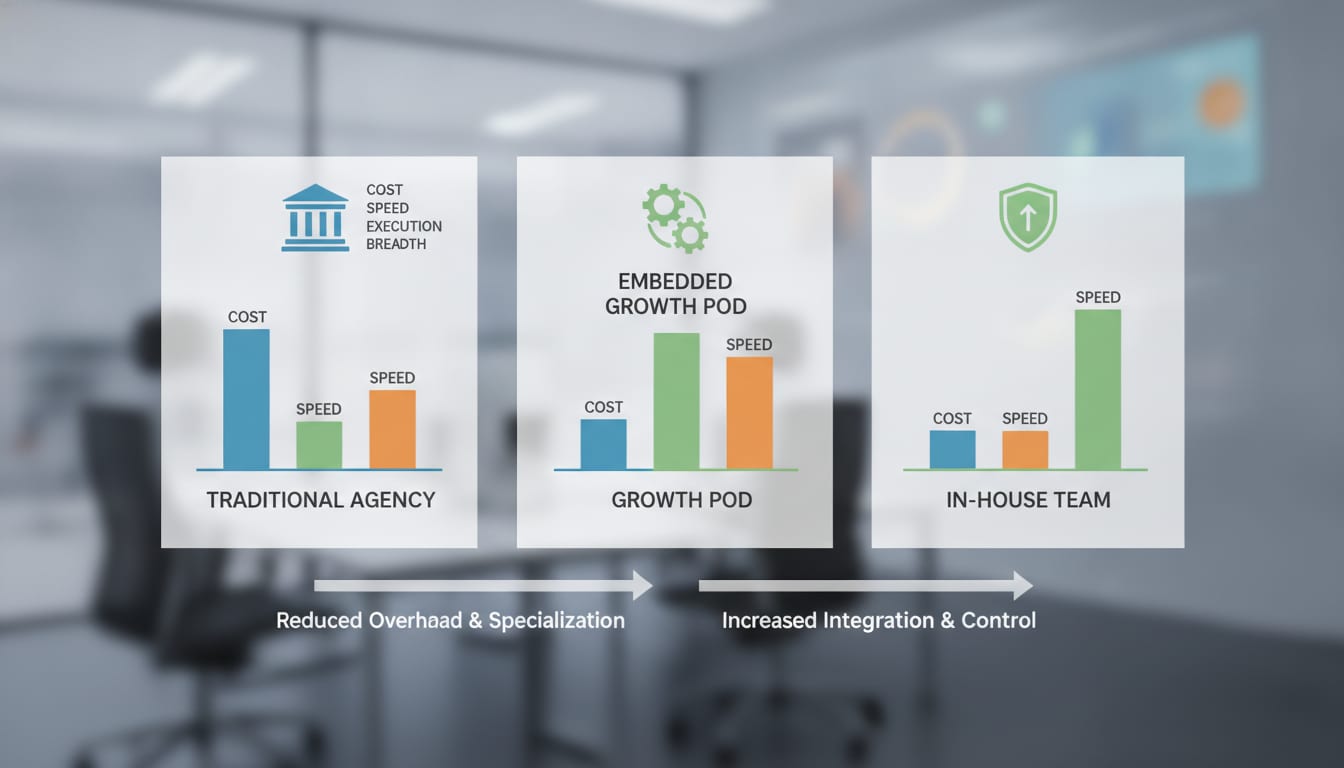
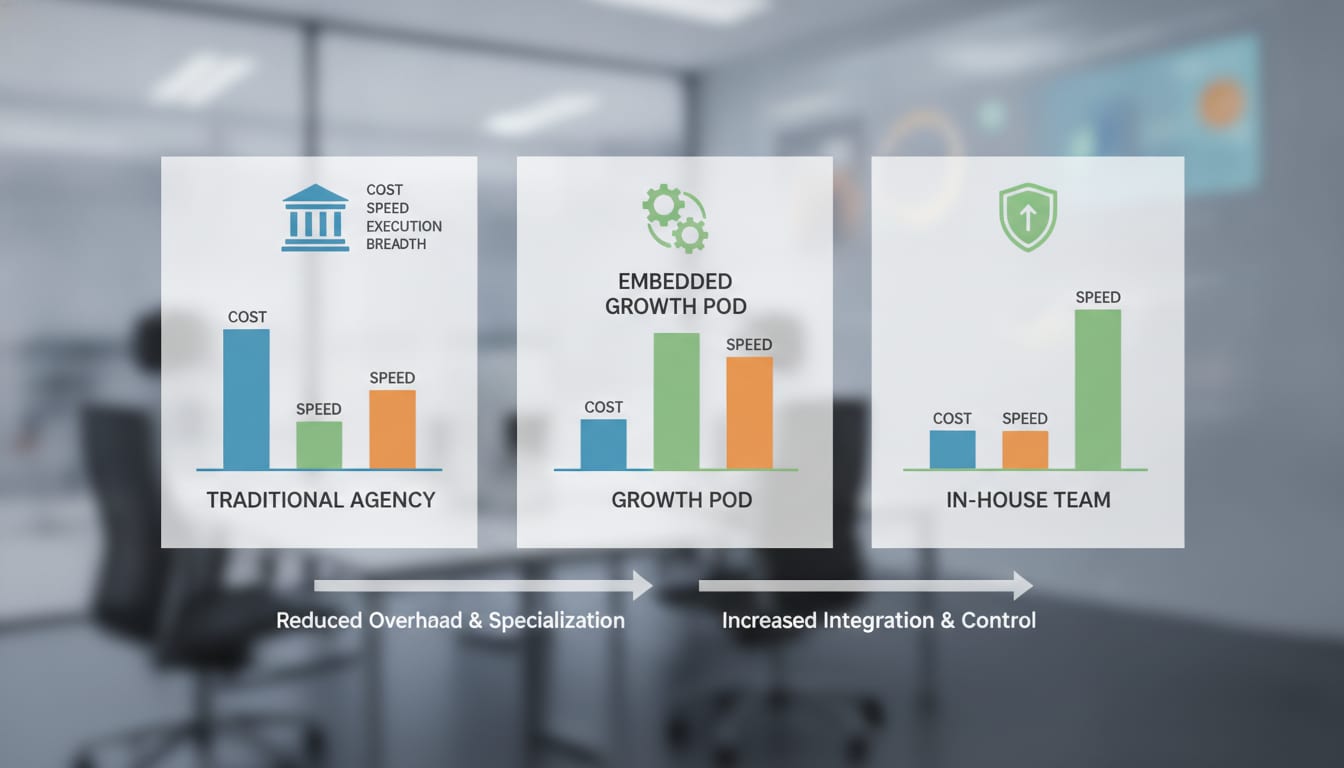
| Dimension | Growth Agency | Embedded Growth Pod | In-House Team |
|---|---|---|---|
| Time to first shipped experiment | 4–8 weeks (onboarding, brand guidelines, approvals) | 1–3 weeks | 3–7 months (hiring cycle) |
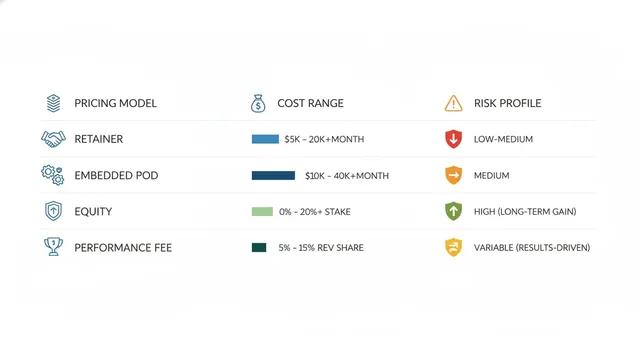
| Typical monthly cost (US market) | $8K–$40K per channel retainer | $25K–$60K for a full pod | $55K–$90K fully loaded for 4 FTEs |
| Can ship product/code changes | Rarely | Yes — core to the model | Yes, if you hired a growth engineer |
| Seniority of people doing the work | Mixed; senior on the pitch, junior on the account | Senior throughout | Whatever you can hire and retain |
| Breadth of surface area | Narrow (1–2 channels) | Broad (product, data, paid, SEO, RevOps, automation) | Broad, but only where you've hired |
| Experiment velocity | Low–medium; gated by your eng backlog | High; single backlog, weekly cadence | Medium–high once mature |
| Accountability metric | Deliverables, channel KPIs | Business metrics (activation, conversion, ARR) | Business metrics |
| Knowledge retention when they leave | Low | Medium (depends on documentation discipline) | High |
| Ramp-down flexibility | 30–90 day notice | 30–60 day notice | Layoffs, severance, morale cost |
| Best fit | Scaling one proven channel | Pre-$15M ARR, multiple unproven bottlenecks | Post-$15M ARR with a repeatable growth motion |
Cost figures reflect typical 2025–2026 US market ranges for growth-stage engagements. Fully loaded FTE costs assume ~1.25–1.4× base salary for benefits, taxes, equipment, and software, consistent with SHRM's guidance on total employment cost.
Why the Agency Model Breaks Down for Growth-Stage Startups
Agencies aren't bad. They're optimized for a different problem — executing a known playbook in a known channel at volume. When you know paid search works and you need someone to run 400 ad groups competently, an agency is efficient and often cheaper than hiring.
The breakdown happens for three structural reasons.
1. The Handoff Tax
Every growth experiment worth running eventually touches the product. Your agency finds that trial users who complete integration setup convert at 4× the rate of those who don't — great insight. Now someone has to redesign the integration step. That's engineering work. It goes into your sprint queue behind the enterprise customer's SSO request and the security audit remediation.
The insight sits idle for a quarter. Then the retainer renewal comes up and everyone wonders why the numbers didn't move.
Growaton's engagements consistently show the same pattern: the highest-leverage growth work in SaaS and marketplaces is product work, not campaign work. If your growth resource can't ship code, you've capped your upside before you started.
2. Deliverable Accountability Instead of Outcome Accountability
Agency contracts specify outputs because outputs are defensible. "12 blog posts, 4 landing pages, monthly reporting deck." Nobody signs a contract promising ARR growth, because ARR depends on your product, pricing, sales team, and market.
Fair enough. But it means the incentive structure rewards volume of work, not movement of metrics. Reid Hoffman's oft-quoted framing that startups need to prioritize speed over perfection cuts the other way here: agencies optimize for polish because polish is what shows up in the deliverable review.
3. Fragmentation Cost
The typical Series A startup we talk to has three to five vendors: an SEO agency, a paid media agency, a design contractor, maybe a content shop, maybe a dev agency. Nobody owns the funnel. Each vendor optimizes their slice and reports success while the aggregate number stays flat.
This is measurable. When four parties each need weekly syncs, alignment docs, and access provisioning, you've created a coordination job — and the person doing it is usually the founder. Research on organizational communication has documented how coordination load scales non-linearly with the number of parties involved. Every additional vendor makes the whole system slower, not just marginally more expensive.
Why In-House Is Right — Eventually, and Not Yet
We're not anti-in-house. The end state for any serious company is an owned growth function. The question is when, and the honest answer is later than most founders think.
The Assembly Math
To run a real experiment-driven growth machine, you need at minimum:
- Someone who can form and prioritize hypotheses (growth lead)
- Someone who can ship product changes fast (growth engineer)
- Someone who can instrument and trust the data (analytics engineer or analyst)
- Someone who can drive traffic and demand (performance/SEO operator)
Hiring four senior people takes, realistically, six to nine months with a competent recruiter and a compelling story. LinkedIn's Global Talent Trends data has repeatedly shown technical and specialized roles taking 40–60 days from first outreach to accepted offer — and that's per role, sequentially, assuming you don't lose a candidate at the offer stage.
Then add ramp. A growth hire is typically 60–90 days from start to first meaningful shipped result. So you're roughly 9–12 months from decision to functioning team, and you've spent $400K+ of runway getting there.
The Single-Point-of-Failure Problem
The classic seed/Series A move is to hire one "growth person" and hope they're a full-stack unicorn. They're not. They're a specialist with adjacent competence, and you've just made your entire growth function dependent on one person's particular skill shape.
If they're a paid acquisition specialist, you'll get paid acquisition. If they're a PLG product person, you'll get onboarding work. What you won't get is coverage across the actual bottleneck map — because one person can't cover product, data, paid, SEO, and RevOps.
When In-House Genuinely Wins
Go in-house when all of these are true:
- You have a repeatable growth motion you're scaling, not searching for
- Revenue supports $600K–$1M/year of fully loaded growth headcount without threatening runway
- You have a leader who can actually manage a cross-functional growth team (not a marketer managing engineers by proxy)
- Your growth work is now continuous operations, not discrete high-variance bets
That's usually somewhere north of $15M ARR, sometimes earlier in capital-rich companies.
Why the Embedded Pod Model Wins in the Middle
The embedded pod exists to solve a specific window: you have product-market fit and revenue, you don't yet have a growth machine, and you can't afford to spend a year building one.
It Collapses the Handoff Tax to Zero
The defining feature isn't cost or flexibility — it's that hypothesis, build, and measurement live in one team with one backlog. When the data says the activation gap is in step three of onboarding, the engineer who ships the fix is in the same standup as the analyst who found it. No ticket. No cross-team negotiation. No quarter-long delay.
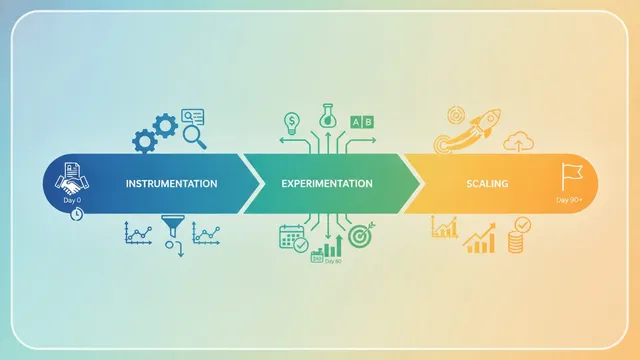
This is what makes weekly shipping cadence realistic rather than aspirational. We at Growaton structure engagements around it deliberately: every week produces a shipped change and a measurement, which forces both prioritization discipline and honest reporting. You can read how we structure it in our 4-Phase Growth Framework — Diagnostics, Measurement, Conversion, Scale.
It Buys Seniority You Couldn't Hire
A four-person pod of senior operators costs less than four senior FTEs and requires zero recruiting cycle. That trade — paying a premium per hour for people you couldn't hire at all, without the fixed-cost commitment — is the core economic argument.
It's also a hedge. If the pod's diagnosis is that your real problem is pricing and packaging rather than acquisition, a pod pivots the workstream in a week. An in-house team you hired for paid acquisition cannot pivot into pricing strategy without a reorg.
It Compounds Faster with AI Tooling
This is the 2026-specific part. The realistic output of a senior operator with strong AI tooling — code generation, automated analysis, content production pipelines, workflow automation — has changed materially in the last 24 months. McKinsey's research on generative AI's economic potential puts the largest productivity gains in exactly the functions a growth pod covers: software engineering, marketing, and sales operations.
The leverage isn't evenly distributed, though. It accrues to senior people who can direct and validate AI output, not to junior people using AI to produce plausible-looking work faster. That asymmetry favors small senior pods over large mixed-seniority agency teams — and it's why the same pod headcount produces meaningfully more shipped experiments per month than it did in 2023.
Where Pods Are the Wrong Choice
Honest limitations:
- No PMF yet. If you're still searching for product-market fit, you need founder-led discovery, not a growth system. A pod will optimize a funnel that shouldn't exist.
- You need one channel at massive volume. Managing $500K/month in paid spend across 12 markets is specialist agency work.
- You want a body, not a team. If you've already diagnosed the problem and just need execution hands on a defined spec, a contractor is cheaper.
- You won't give access. Pods need production access, analytics admin, and decision authority. Startups that can't grant that should stay with vendors.
A Decision Framework: Diagnose the Bottleneck First
Stop asking "which model?" Ask "what's actually broken?" The model follows.
Step 1: Locate Your Constraint
| Symptom | Likely Constraint | Best-Fit Model |
|---|---|---|
| Traffic is flat, conversion is fine | Demand generation | Agency (single channel) or pod |
| Signups are healthy, activation is poor | Product/onboarding | Pod or in-house growth eng |
| Activation is fine, expansion is flat | Pricing, packaging, PLG mechanics | Pod or in-house product-growth |
| Nobody trusts the numbers | Data instrumentation | Pod (analytics engineering) |
| Sales pipeline leaks between stages | RevOps / lifecycle | Pod or in-house RevOps hire |
| Everything works; you need more of it | Scale operations | In-house team |
If you can't confidently identify your constraint, that's itself the answer: you need diagnosis before execution. Buying channel execution while blind is how retainers get burned.
Step 2: Check Your Runway Math
Divide your available growth budget by 12. If the monthly number is:
- Under $10K: One specialist contractor or agency on your single highest-confidence channel. Do not fragment.
- $10K–$25K: A focused agency engagement, or a lean pod on a narrow scope. Prioritize ruthlessly.
- $25K–$60K: Pod territory. This is where cross-functional breadth beats channel depth.
- $60K+ and stable revenue: Start building in-house. Consider a pod alongside it to bridge the 9-month hiring gap and train the team you're hiring — this is where player-coach mentoring dynamics matter most.
Step 3: Audit Your Management Bandwidth
The hidden variable nobody prices in. Every model requires management, but different amounts:
- Agency: 4–8 hours/week of your time (briefs, reviews, approvals, coordination across vendors)
- Pod: 2–4 hours/week (one weekly review, async decisions — the pod self-manages)
- In-House: 8–15 hours/week initially (hiring, onboarding, 1:1s, roadmap, performance management)
Founders systematically underestimate this. If you're the CEO of a 25-person company and you're already at capacity, hiring an in-house team you don't have time to lead produces worse results than a pod you check in on weekly.
The Hybrid Model Most Successful Companies Actually Run
The cleanest real-world pattern we see between Series A and Series B isn't a single model. It's:
One in-house owner + one embedded pod + one specialist vendor.
- An in-house growth lead who owns strategy, holds context permanently, and is accountable internally
- An embedded pod providing engineering, data, and cross-channel execution capacity — the muscle
- A specialist agency for one channel at scale where depth genuinely matters (usually paid media above $150K/month spend)
This structure keeps institutional knowledge inside the company while buying execution breadth you can't hire fast enough. It also creates a natural graduation path: as the pod documents systems and the in-house team grows, pod scope narrows toward the hardest problems and eventually winds down.
We're explicit with clients that this is the goal. A growth partner that engineers permanent dependency isn't a partner. The measure of a good pod engagement is whether your internal team is more capable at the end than at the start — which is a question worth asking any partner you evaluate, alongside the rest of the vetting questions in our checklist.
What Changes in 2026
Three shifts are actively reshaping this decision:
1. The cost of building is falling faster than the cost of hiring. AI-assisted engineering means a senior full-stack engineer ships materially more per week than they did two years ago. This makes small senior teams disproportionately more valuable and makes headcount-based agency models (billing for hours of mid-level labor) structurally less competitive.
2. Search traffic distribution is shifting. With AI Overviews and LLM-based answer engines mediating more discovery, SEO is becoming less about page volume and more about entity authority, structured data, and being the source AI systems cite. That's a technical and strategic discipline — it needs engineering, not just content production.
3. Capital efficiency is non-negotiable again. The 2021 playbook of hiring ahead of revenue is gone. Boards want proof of efficient growth before they fund headcount. Variable-cost models that produce attributable results have an advantage they didn't have four years ago.
Net effect: the middle of the market — companies with revenue but not scale — has more reason than ever to buy senior cross-functional capacity rather than assemble it slowly.
The Verdict
| If you are... | Choose... |
|---|---|
| Pre-PMF, pre-revenue | Founder-led growth. No external model. |
| Seed, one clear channel to scale | Specialist agency or contractor |
| Seed–Series B, multiple unproven bottlenecks, PMF confirmed | Embedded growth pod |
| Series B+, proven motion, $60K+/mo growth budget | In-house team, pod to bridge hiring gap |
| Series C+, mature growth org | In-house team + specialist vendors for depth |
The embedded pod wins the largest slice of the growth-stage market in 2026 — not because it's fashionable, but because it's the only model that puts hypothesis, engineering, data, and distribution in one accountable unit at a price a Series A company can actually sustain.
The model that loses in every scenario is the one most startups default to: three disconnected vendors, no owner, and no ability to ship product changes.
Want a straight answer on which model fits your situation? Our Free Growth Diagnostic conversation is a 45-minute working session where we map your funnel, identify the constraint, and tell you honestly whether you need a pod, a hire, or neither. No deck. If in-house is the right call, we'll say so — and tell you who to hire first.
You can also see how pod engagements have played out in practice in our case study library, or review pod scopes and pricing directly.