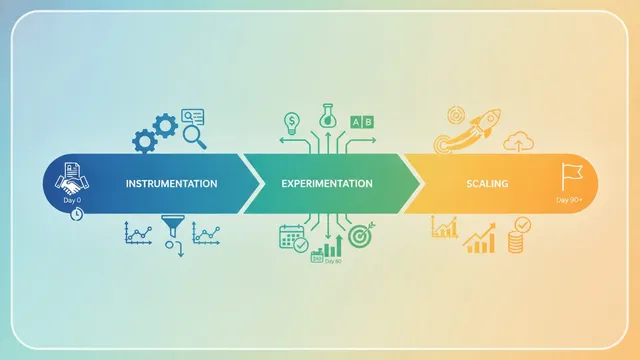
Short answer: In 2026, a credible growth partner costs somewhere between $8,000 and $60,000 per month depending on the model you choose. Traditional channel agencies sit at the low end ($5K–$20K/mo retainers), embedded growth pods sit in the middle-to-upper range ($25K–$60K/mo), fractional specialists are billed per head ($6K–$15K/mo each), and performance or equity-based deals only make sense in a narrow set of conditions that most seed-to-Series-C startups don't actually meet.
The harder question isn't "what does it cost?" It's "what am I buying per dollar — hours, deliverables, or shipped outcomes?" That's the distinction that decides whether your growth spend compounds or evaporates.
We at Growaton have priced, scoped, and re-scoped dozens of engagements with seed through Series C companies in SaaS, fintech, marketplaces, and e-commerce. This is the honest breakdown of every pricing model on the market — including the ones we don't use, and why.
The Five Pricing Models You'll Actually Encounter
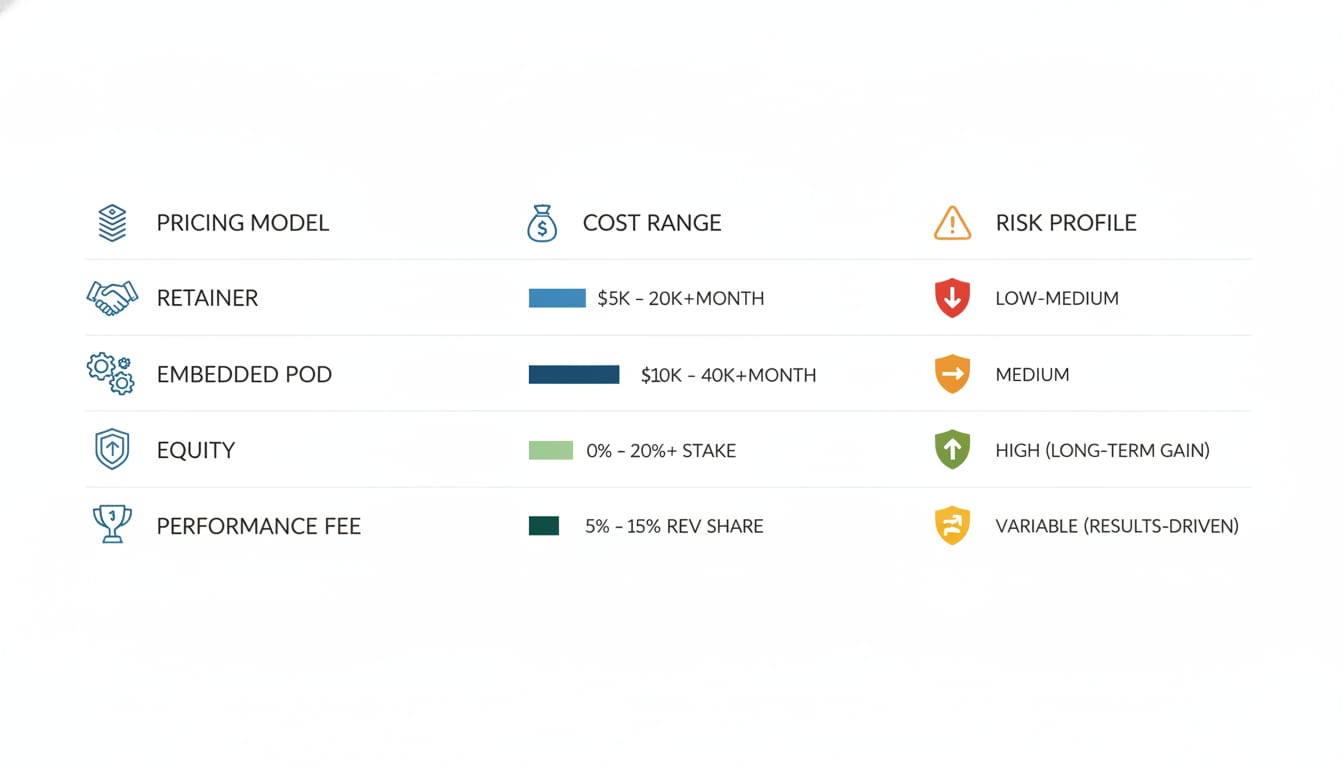
| Model | Typical Cost (2026) | What You're Buying | Best Fit | Biggest Risk |
|---|---|---|---|---|
| Channel retainer | $5K–$20K/mo | Execution in one channel (paid, SEO, lifecycle) | You know the channel works and need volume | Siloed work that can't touch product or data |
| Fractional specialist | $6K–$15K/mo per person | Senior brain, part-time hours | One specific gap (e.g. no growth lead) | Strategy with no hands to execute it |
| Embedded growth pod | $25K–$60K/mo | Cross-functional team shipping weekly | Post-PMF, multiple bottlenecks at once | Overkill pre-PMF; requires internal decision speed |
| Project / sprint | $15K–$75K one-time | A defined build or audit | Discrete scope (migration, redesign, data layer) | Nobody owns what happens after launch |
| Performance / equity | Variable + 10–25% of incremental revenue, or 0.25–2% equity | Aligned upside | Clean attribution, single-channel levers | Attribution fights, misaligned time horizons |
Everything else on the market is a variant or a blend of these five.
Model 1: The Channel Retainer
The most common structure and the easiest to understand. You pay a fixed monthly fee for a defined scope of work in a defined channel.
What it costs
| Scope | Monthly range | What's usually included |
|---|---|---|
| Single channel, junior-led | $3K–$8K | Campaign management, basic reporting, ad ops |
| Single channel, senior-led | $8K–$20K | Strategy, execution, creative iteration, weekly reporting |
| Multi-channel marketing retainer | $15K–$40K | Paid + SEO + content + lifecycle, usually with account manager layer |
Ad spend is almost always separate. Watch for percentage-of-spend pricing — commonly 10–20% of media spend — which creates an incentive to spend more, not to acquire more efficiently. If you see it, negotiate a flat fee or a hybrid with a spend cap.
When retainers work
They work when you've already validated the channel, your funnel converts, and the bottleneck is genuinely just more execution. A $12K/mo paid search retainer on a product with proven unit economics is a fine trade.
When they quietly fail
Retainers break when the real problem lives outside the retainer's scope. This is the single most common failure pattern we see in diagnostic calls: a company is paying $15K/mo for paid acquisition, traffic is up 60%, and revenue is flat — because activation is broken, the pricing page doesn't convert, or the lead routing drops 30% of demos. The agency can't fix any of that. It's not in the contract, and they don't have engineers.
You end up paying for motion instead of outcomes. And because most retainers are billed on scope-of-work rather than results, nobody in the room is contractually uncomfortable about it except you.
Model 2: Fractional Specialists
Hiring a fractional CMO, Head of Growth, or growth engineer for 10–20 hours a week. Rates typically land between $150 and $400 per hour, packaged as $6K–$15K/mo per person.
This is genuinely good value for a specific job: you need senior judgment to set direction, sequence bets, and hire the permanent team. A strong fractional growth lead at $10K/mo who prevents one bad $180K hire has already paid for a year.
The limitation is structural. A fractional leader produces strategy, roadmaps, and hiring plans. They rarely produce shipped code, instrumented events, or live experiments — because they don't have a team. If you stack a fractional CMO on top of an under-resourced in-house team, you've bought a plan your team can't execute.
Rule of thumb: fractional works when your execution capacity exceeds your strategic clarity. It fails when the reverse is true.
Model 3: The Embedded Growth Pod
This is the model we run at Growaton, so treat the following with appropriate skepticism — but here's the pricing logic honestly laid out.
An embedded pod is a single cross-functional team — typically growth engineering, product, data/analytics, and demand generation — that operates inside your company's rituals, tooling, and Slack, shipping on a weekly cadence. You're not buying a channel. You're buying the capacity to find and fix the constraint wherever it lives.
What embedded growth pod pricing looks like
| Pod configuration | Monthly investment | Typical composition |
|---|---|---|
| Diagnostic / starter | $8K–$15K | Time-boxed audit: analytics integrity, funnel teardown, unit economics, prioritized roadmap |
| Focused pod | $25K–$35K | Growth engineer + growth lead + shared data/design; 1 primary workstream |
| Full pod | $35K–$55K | Engineering + product + data + paid/SEO + RevOps across 2–3 concurrent workstreams |
| Multi-pod / scale | $55K+ | Parallel pods on separate surfaces (acquisition, activation, monetization) |
For context on how that compares: a single senior full-stack engineer in the US costs roughly $180K–$230K in base salary — call it $250K–$290K fully loaded with benefits, equipment, and payroll tax, per Levels.fyi compensation data and standard 1.25–1.4x loading multipliers. That's $21K–$24K per month for one function, before you've hired a growth lead, a data analyst, or a performance marketer. And before the 8–14 week hiring cycle.
The real cost comparison
| Line item | In-house team of 4 | Full embedded pod |
|---|---|---|
| Monthly cost | $75K–$95K fully loaded | $35K–$55K |
| Time to productive output | 3–6 months (hire + ramp) | 1–3 weeks |
| Recruiting cost | $60K–$100K in fees | $0 |
| Severance / wind-down risk | High | 30–60 day notice |
| Breadth of skill | 4 specialties | 6–8 specialties |
| Institutional knowledge retained | Permanent | Documented, transferable |
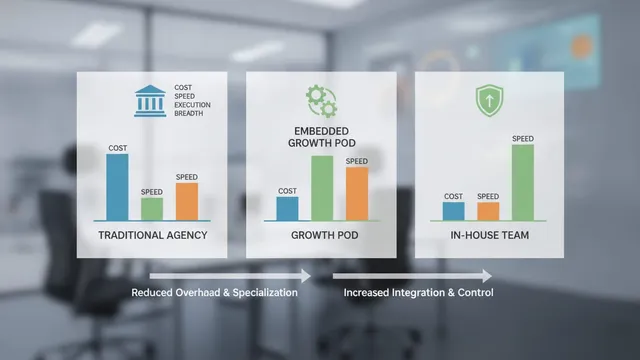
The honest trade-off: in-house teams build permanent institutional memory and cost less per head at scale. Pods buy speed, breadth, and reversibility. If you're confident about your growth motion for the next three years, hire. If you're still finding the shape of it, renting a senior team that can pivot in a week is usually cheaper than being wrong about four hires.
Where pods are the wrong answer
We turn away roughly a quarter of inbound. A pod is wrong if:
- You're pre-product-market-fit. No pricing model fixes a product nobody wants. Retention curves that don't flatten are a product problem.
- Monthly revenue is under ~$30K. A $35K/mo pod against $25K MRR is arithmetic that doesn't work.
- Nobody internally can make decisions in under a week. Weekly shipping requires weekly deciding. If every experiment needs three committees, you'll pay for velocity you can't absorb.
- You need one narrow thing. Need Google Ads managed? Hire a Google Ads specialist. Don't buy a pod.
If you're unsure which side of that line you're on, our readiness diagnostic exists to answer exactly that — including telling you not to hire us.
Model 4: Project and Sprint Pricing
Fixed-scope, fixed-fee work with a defined endpoint.
| Project type | Typical fee |
|---|---|
| Growth / funnel audit | $8K–$20K |
| Analytics & attribution rebuild | $20K–$50K |
| Marketing site or pricing page rebuild | $25K–$75K |
| Onboarding / activation redesign | $30K–$60K |
| CRM & RevOps implementation | $15K–$45K |
Projects are the right instrument when the deliverable is genuinely finite and the outcome is a working artifact — a clean data layer, a shipped checkout, a migrated CRM.
They're the wrong instrument for growth itself. Growth is a rate of learning, not a deliverable. A one-off $20K audit that produces a 40-slide deck no one implements is the most reliably wasted money in the category. If you buy a project, budget for the implementation before you buy the diagnosis.
Growaton runs paid diagnostics at $8K–$15K deliberately as a paid pilot, not a deck. It includes shipped fixes — analytics instrumentation, tracking corrections, at least one live experiment — so you leave with working infrastructure regardless of whether the relationship continues.
Model 5: Performance Fees and Equity
The model founders ask about most and buy least. Let's be precise about why.
Pure performance / revenue share
The pitch: pay us 15% of incremental revenue we generate. No risk to you.
The reality: attribution. Within 90 days, you are in a spreadsheet argument about whether a customer came from the partner's paid campaign or your founder's LinkedIn post or the podcast you did in March. Multi-touch attribution is contested even inside well-instrumented companies; between two companies with opposing financial incentives, it's unresolvable. Google's own guidance on attribution modeling exists precisely because single-source-of-truth attribution doesn't exist.
Performance-only deals are workable in a narrow band:
- Single-channel, click-attributable acquisition (paid social to a direct-response e-commerce checkout)
- Short sales cycles under 14 days
- Clean baseline data for at least 6 prior months
- Agreed incrementality methodology written into the contract before signing
Outside that band — which is to say, in almost all B2B SaaS, fintech, and marketplace businesses — it produces litigation-flavored partnerships.
Hybrid: reduced base + performance kicker
The version that actually works. Something like 60–75% of standard fee as base, plus a bonus tied to two or three pre-agreed metrics.
What makes a hybrid work:
- Metrics you both control. Activation rate, qualified pipeline, conversion rate on a specific surface — not "revenue," which depends on your sales team, your pricing, and the macro environment.
- Baselines locked in writing before work starts, using the partner's instrumentation, agreed by both parties.
- A cap. Uncapped upside sounds founder-friendly until the partner earns $400K on a lucky quarter and you resent them.
- A floor high enough to fund senior talent. If the base doesn't cover the team's cost, the partner will staff junior or quietly deprioritize you for a full-fee client. Nobody says this out loud, but it's how service businesses survive.
We'll structure hybrid deals when instrumentation is trustworthy and the metric is genuinely shared. We decline them when the baseline is unknowable — which, honestly, is most first engagements before the analytics are fixed.
Equity-for-services
Typically 0.25%–2% of equity, sometimes with a reduced cash component. It looks elegant on a whiteboard and rarely survives contact with reality.
Problems, in order of severity:
- Time-horizon mismatch. Equity pays out in 5–10 years. A services business needs to make payroll in 30 days. The partner will always prioritize cash clients — not from bad faith, but from solvency.
- Cap table drag. Series A investors ask hard questions about non-employee service equity. It's dilution without a person on the team.
- Valuation dispute. Converting $400K of services into equity at what valuation? Founders think last round; partners think next round.
- Impossible exit. Bad-fit employees can be let go. A bad-fit shareholder is permanent.
Equity can make sense in one scenario: a partner who is functionally a co-founder, contributing over a year with a vesting schedule, cliff, and clawback for underperformance. If it's a vendor relationship, keep it cash. Cash is cleaner for both sides.
How to Compare Quotes Without Getting Fooled
Sticker price is the least informative number in a proposal. Three metrics matter more.
1. Cost per shipped experiment
Divide monthly fee by experiments actually shipped and measured per month.
| Model | Fee | Experiments/mo | Cost per experiment |
|---|---|---|---|
| Channel retainer | $15K | 1–2 | $7,500–$15,000 |
| Fractional lead + in-house eng | $10K + eng | 1–3 | $3,300–$10,000 |
| Embedded pod | $40K | 8–16 | $2,500–$5,000 |
The pod's higher sticker price often produces a lower cost per learning cycle, because engineering, analytics, and marketing sit in the same standup instead of trading tickets across company boundaries. That's the entire economic argument for the model — and if a partner can't tell you their historical shipping velocity, you're being sold hours, not outcomes.
2. Seniority ratio
Ask directly: what percentage of billed hours are executed by people with 8+ years of experience? Traditional agency economics depend on senior sales, junior delivery. A $20K retainer where 80% of hours are executed by a 26-month-experience coordinator is more expensive than a $35K pod staffed entirely by senior builders. Get names, get LinkedIn profiles, get the actual staffing plan in the SOW.
3. Time to first shipped change
Not first meeting. Not first strategy deck. First change live in production affecting real users. Under 14 days is good. Over 45 days means you're funding onboarding overhead.
Contract terms that cost you money
- Long lock-ins. 12-month minimums with no out are a red flag. 3-month initial term with 30–60 day rolling notice is fair to both sides.
- Percentage-of-spend fees without a cap.
- Change-order culture. If every new idea triggers a re-scope negotiation, you'll stop having ideas.
- Vague deliverables. "Ongoing optimization" is not a deliverable. "Weekly shipped experiments with documented results in a shared dashboard" is.
- Data and IP ownership. You should own the code, the analytics, the accounts, and the documentation. Confirm this in writing.
What Each Stage Should Actually Budget
Based on patterns across our engagements and what we see in the market:
| Stage | Monthly revenue | Recommended model | Budget |
|---|---|---|---|
| Pre-seed / pre-PMF | <$20K | Founder-led growth. Buy nothing. | $0–$3K (tools) |
| Seed, early traction | $20K–$100K | Paid diagnostic → focused pod on one constraint | $8K–$30K |
| Seed / Series A, scaling | $100K–$500K | Full embedded pod, 2–3 workstreams | $30K–$55K |
| Series B | $500K–$2M | Pod + hiring in-house team it trains | $40K–$70K, declining as in-house ramps |
| Series C+ | $2M+ | In-house core + specialist pods on new surfaces | $25K–$60K per surface |
Note the arc. A good partner's fee should decline as a share of your growth budget over time, because they're building systems and training your people, not creating dependency. If year three costs more than year one for the same scope, something's wrong.
A useful sanity check: total growth partner spend should generally stay under 15–20% of gross revenue, and every engagement should have a defensible path to CAC payback inside 12 months for SaaS or 3 months for e-commerce. If the partner can't model that with you before signing, they haven't thought about your business.
The Uncomfortable Truth About Growth Pricing
Most growth spend fails for reasons that have nothing to do with the pricing model. It fails because:
- Nobody fixed the analytics first, so no one can tell what worked
- The work was scoped to a channel while the bottleneck lived in the product
- Decisions took three weeks and the shipping cadence collapsed to match
- The engagement optimized for deliverables instead of learning velocity
The pricing model you choose matters less than whether the structure lets one accountable team touch acquisition, product, and data in the same week. That's why we built Growaton as a pod rather than a channel shop — not because pods are magic, but because the alternative requires you to be the integration layer between four vendors, and founders are the most expensive project managers in any company.
If you want to pressure-test which model fits your stage and constraint, book a free growth diagnostic conversation. We'll map your funnel, name the actual bottleneck, and tell you plainly whether that's a $10K problem, a $40K problem, or a "don't hire anyone yet" problem. You can also review our pod plans and scopes, our 4-phase methodology, or case studies with the specific numbers.