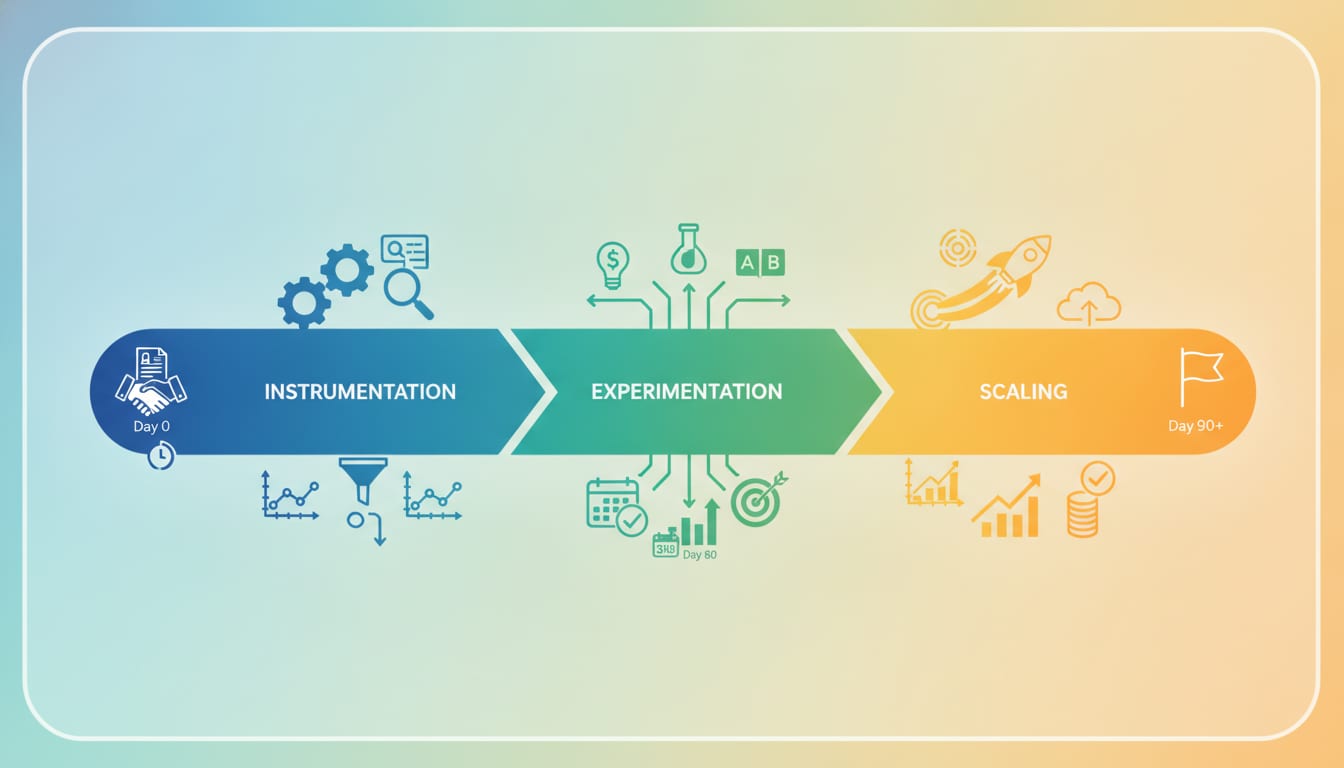
The short answer: A good growth partner engagement runs on a 3-to-6-month initial term with a 30-day rolling exit after that, a scope defined by outcomes and workstreams rather than deliverable counts, KPIs split into leading (shipping velocity, experiments live, activation lift) and lagging (pipeline, CAC, payback), and a first 90 days that follows a predictable arc: instrument in weeks 1–3, ship experiments from week 3 onward, prove a repeatable channel or conversion lift by day 90. If a prospective partner can't describe all four in a single call, that's your answer.
Below are the questions founders actually ask us at Growaton before signing — including the uncomfortable ones about lock-in, IP, and what happens when results don't show up.
Contracts and Commercial Terms
How long should the initial contract be?
Three months is the floor. Six is the honest answer for most seed-to-Series C companies.
The reason isn't vendor greed — it's math. If your sales cycle is 45 days and your activation window is 14 days, a 30-day engagement can't produce a single closed-loop result. You'd be paying for setup and leaving before the compounding starts.
Here's the realistic timeline for when different engagement types produce signal:
| Engagement focus | First credible signal | Full read |
|---|---|---|
| Paid acquisition (SMB/PLG) | 3–4 weeks | 8–10 weeks |
| Onboarding/activation CRO | 2–3 weeks | 6–8 weeks |
| SEO / content compounding | 8–12 weeks | 6–9 months |
| Outbound + RevOps rebuild | 4–6 weeks | 3–4 months |
| Enterprise sales enablement | 6–8 weeks | 2 sales cycles |
What we recommend: a 90-day initial term with a defined scope, then month-to-month or a rolling 30-day notice. Growaton structures it this way because a partner who needs a 12-month lock-in to keep you is admitting the work won't hold you.
What should I refuse to sign?
Four clauses are worth fighting over:
- Auto-renewal with a long notice window. A 12-month auto-renew requiring 90-day notice is a trap. 30-day notice on a rolling term is fair.
- IP ownership that isn't yours. Every line of code, ad account, tracking plan, dashboard, and audience segment created for you should be yours on day one — not on final payment, not "upon mutual agreement."
- Ad account or tool ownership held by the partner. If they run paid media in their Google Ads account, you lose your entire conversion history and learning phase when you leave. Non-negotiable: accounts in your name, partner gets user access.
- Vague scope with billable "out of scope" escalations. If the contract says "growth marketing services," you'll be arguing about invoices by month two.
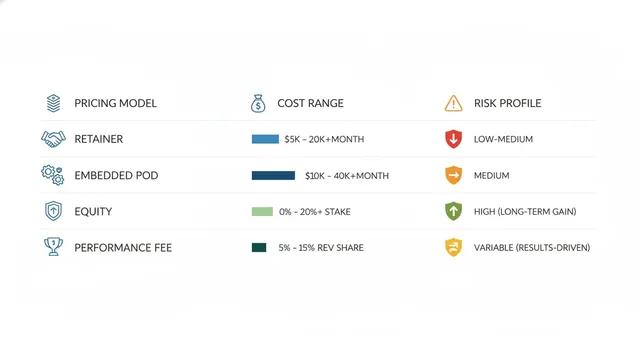
What about pricing models — retainer, pod, equity, performance fees?
Each has a failure mode:
| Model | Works when | Fails when |
|---|---|---|
| Monthly retainer | Scope is broad and cross-functional; you want senior capacity | Partner is incentivized to protect margin over shipping |
| Embedded pod (fixed capacity) | You need product + engineering + marketing working as one unit | You only need one narrow skill |
| Performance / % of revenue | Attribution is clean and single-channel | Multi-touch funnel — arguments over credit begin immediately |
| Equity or equity-blend | Early-stage, capital-constrained, long horizon | You're 18 months from a raise and the partner leaves in 6 |
| Project / fixed fee | Discrete build (migration, pricing page, analytics stack) | Ongoing experimentation, which by definition has unknown outputs |
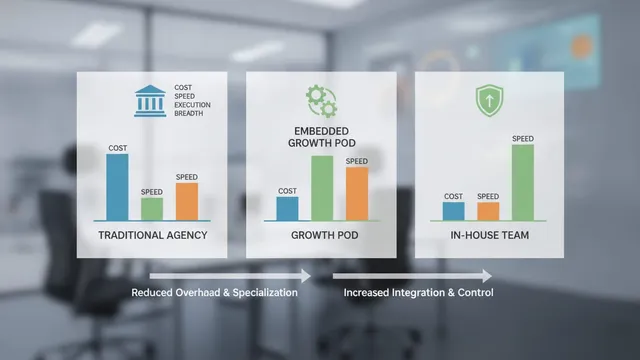
The pod model wins for most companies with product-market fit because growth problems rarely live in one discipline. Your activation problem is 40% product, 30% engineering, 20% lifecycle email, 10% pricing — and a specialist agency can only see their slice. For a deeper breakdown, see our comparison of growth agency vs. embedded growth pod vs. in-house team and the full pricing model explainer.
How much should this cost?
Ranges vary wildly by geography and seniority, but a useful sanity check: a competent embedded pod should cost less than the fully loaded cost of the equivalent in-house hires (salary + benefits + equity + recruiting fees + 3-month ramp), and should be replaced by in-house hires once you know exactly which roles you need. According to First Round's State of Startups research, hiring is consistently the top operational challenge founders cite — which is precisely why a pod is a bridge, not a permanent substitute.
If a partner's price is dramatically below market, you're getting juniors with a senior on the intro call. Ask directly: who is doing the work, and what is their utilization across other clients?
Scope: What's In, What's Out
How should scope be written?
By workstream and outcome, not by deliverable count.
Bad scope: "8 blog posts, 4 landing pages, 12 ad creatives per month." This turns your partner into a content factory optimizing for output, not results.
Good scope: "Own the self-serve signup-to-activation funnel. Target: lift 14-day activation from 22% to 32% by day 90. Includes onboarding instrumentation, in-app messaging, email sequences, pricing page tests, and required front-end engineering."
The second version makes the partner accountable for a number and gives them authority over the levers that move it. It also prevents the most common failure in agency relationships: a partner responsible for a metric they can't actually influence because engineering access was never granted.
What should a full-stack scope actually cover?
A genuinely integrated engagement touches these workstreams. You won't need all of them — but you should know which are in and which are explicitly out:
- Diagnostics & instrumentation — event tracking plan, funnel definition, warehouse/BI setup, attribution model
- Growth engineering — landing pages, in-app experiments, onboarding flows, feature flags, integrations
- Experimentation — hypothesis backlog, test design, statistical calls, learning documentation
- Paid acquisition — channel testing, creative, bidding, budget allocation
- SEO & content — technical SEO, programmatic pages, editorial that maps to intent
- Lifecycle & CRM — activation emails, expansion triggers, churn saves
- RevOps — CRM hygiene, lead routing, sales handoff, reporting
- AI automation — enrichment, content pipelines, support deflection, internal ops workflows
Who owns decisions when the partner and the internal team disagree?
Write this down before you start. Our default at Growaton: the partner owns the experiment roadmap; the client owns the product roadmap and brand guardrails. If a test conflicts with a strategic constraint (pricing, positioning, compliance), the client vetoes and we log it as a constraint rather than relitigating it weekly.
The single biggest source of stalled engagements isn't bad ideas — it's approval latency. If every landing page needs three internal sign-offs, your experiment velocity drops to near zero and no partner can save you. Agree on a pre-approved sandbox: which pages, flows, and channels can the partner ship to without review?
Does the partner get production access?
Yes, or the engagement is theater. Specifically:
- Repo access (branch + PR review, not direct-to-main)
- Analytics and warehouse read access
- CMS and ad account admin
- A staging environment
- Their own accounts, offboarded cleanly at the end
Companies in fintech and regulated categories often need to work through security review — build that into the timeline. A partner who's done it before will have a SOC 2 posture, DPAs ready, and answers about subprocessors. If procurement takes six weeks and nobody planned for it, you've burned two months of a six-month engagement.
KPIs and Accountability
What KPIs should a growth engagement be measured on?
Two tiers. Confusing them is how engagements die at month four with both sides feeling cheated.
Leading indicators (weekly, controllable):
| Metric | Healthy target |
|---|---|
| Experiments shipped per week | 2–5 depending on pod size |
| Time from hypothesis to live test | < 7 days |
| Instrumentation coverage of core funnel | 100% by week 3 |
| Test win rate | 20–30% (higher means you're not testing boldly enough) |
| Documented learnings per month | Every test, win or loss |
Lagging indicators (monthly/quarterly, the actual point):
| Metric | Why it matters |
|---|---|
| Activation rate (product-qualified, not signup) | The most common hidden bottleneck |
| CAC and blended CAC | Channel efficiency |
| CAC payback period | The number your board actually cares about |
| Qualified pipeline / MQL→SQL conversion | Sales-assisted motions |
| Net revenue retention | Whether growth compounds or leaks |
| LTV:CAC | Only credible after 2+ cohorts of data |
A partner measured only on lagging metrics will hide behind long feedback loops. A partner measured only on leading metrics will ship busywork. You need both, reviewed in the same meeting.
For definitions and benchmark ranges, our growth metrics glossary and SaaS benchmarks dataset are useful references to hand your board.
What's a fair KPI target for month one?
None, on the lagging side. Month one targets should be about infrastructure and velocity: tracking plan shipped, baseline funnel documented, first experiments live, backlog prioritized with expected-value estimates.
Setting a revenue target for month one guarantees one of two outcomes: the partner sandbags the number so low it's meaningless, or they promise something they'll miss and the relationship starts in a deficit. Growaton sets month-one commitments around shipping and month-two-and-three commitments around movement.
How do we handle attribution disputes?
Decide the attribution model before the first dollar is spent, and write it into the contract. Pick one:
- Platform-reported (fast, inflated, fine for directional optimization)
- Warehouse-native / self-reported attribution (slower, more honest, our default)
- Incrementality testing / geo-holdouts (the gold standard; requires volume)
Google's own guidance on measurement in a privacy-first world makes clear that last-click reporting increasingly understates upper-funnel contribution. That's not a reason to abandon measurement — it's a reason to agree on a shared source of truth early rather than argue about whose dashboard is right in month three.
What if the numbers don't move?
Ask this in the sales call and listen carefully. Good answers include:
- A documented kill criterion per channel or hypothesis ("if we can't get paid CAC under $X after $Y spend across 3 creative angles, we recommend killing paid and redeploying to SEO/outbound")
- A willingness to say "the problem isn't growth marketing, it's retention/pricing/positioning" — and to pivot scope
- A monthly written review with a recommendation to stop as a live option
Bad answers: more spend, more content, more channels, or a request for more time without a changed hypothesis. Sometimes the honest finding is that a company isn't ready for a growth partner yet — which is why we built a readiness diagnostic rather than selling into every conversation.
The First 90 Days
What does a good first 90 days actually look like?
This maps to the four-phase framework we run: Diagnostics → Measurement → Conversion → Scale.
Weeks 1–2: Diagnostics
- Access provisioning (start day one — it always takes longer than expected)
- Funnel mapping: every step from first touch to activated, paying, expanded
- Data audit: what's tracked, what's broken, what's silently double-counting
- Stakeholder interviews: sales, support, product, and 5–10 recent customers
- Baseline snapshot, written down and signed off by both sides
Deliverable: a diagnostic document naming the top 3 constraints, with sized upside. Not a slide deck of best practices.
Weeks 2–4: Measurement
- Tracking plan implemented; core funnel events firing correctly
- Dashboard both teams look at daily (not a monthly PDF)
- Attribution model agreed and instrumented
- Experiment backlog built and prioritized by expected value ÷ effort
- First 2–4 experiments shipped
Deliverable: working instrumentation and the first live tests. If you're at week four with no experiment running, escalate.
Weeks 4–9: Conversion
This is where the engagement earns or loses trust. Expect:
- 2–5 experiments live per week
- A weekly ship log: what went out, what we learned, what's next
- At least one meaningful conversion win — usually in onboarding, pricing page, or lead routing, because that's where the cheapest wins hide
- Fast kills on channels that clearly won't work at your CAC ceiling
Weeks 9–13: Scale
- Double down on the one or two things that worked
- Build the systems that make the win repeatable (templates, automation, playbooks)
- Hand over documentation so your team can run it
- A 90-day review with honest numbers, including what failed
What are the warning signs at day 30?
| Signal | What it means |
|---|---|
| No instrumentation shipped | They're a strategy shop, not a build shop |
| No experiment live | Velocity problem — theirs or your approval process |
| Only strategy documents delivered | You bought a deck |
| Different people on every call | You're being staffed by a bench, not a pod |
| Reporting is platform screenshots | No independent measurement |
| No documented losses | They're only telling you good news |
Any two of these at day 30 is worth a direct conversation. Four is worth using your exit clause.
What do we need to do to make it work?
The engagements that fail rarely fail because the partner was incompetent. They fail because of client-side friction. The non-negotiables on your side:
- One decision-maker with authority, available weekly for 45 minutes. Not a committee.
- Access granted in week one. Every day of delay is a day of paid ramp.
- A pre-approved sandbox so experiments don't queue behind legal review.
- Honesty about constraints — runway, board pressure, a pending pivot, an unhappy enterprise customer. Partners optimize differently when they know the real situation.
- Someone internal who owns the handover. The goal is capability transfer, not dependency.
Ending, Renewing, and Transitioning
How do we exit cleanly?
A clean offboarding should take under two weeks and include: account ownership transfer, repo handover with README-level documentation, tracking plan documentation, a full experiment archive (hypotheses, results, decisions), and a 60-minute recorded walkthrough. Put this in the contract as an offboarding obligation, not a favor.
When should we move in-house instead?
When you know exactly which three roles to hire, because the pod proved which levers matter. That's the honest end state for most engagements — and the reason we push documentation and capability transfer from week one rather than at the end. A partner who resists this is optimizing for their retention, not your growth.
Can a growth partner and an in-house team coexist?
Yes, and it's often the best configuration. The pod handles experimentation velocity and specialist workstreams (growth engineering, paid, analytics infrastructure, AI automation); the in-house team owns brand, product, and the channels that have already been proven. The failure mode is ambiguity — two teams optimizing the same funnel with different dashboards. One dashboard, one owner per metric.
Quick Reference: Questions to Ask Before You Sign
- What's the initial term, and what's the notice period after it?
- Who owns the IP, the code, the ad accounts, and the data?
- Which named people will do the work, and at what allocation?
- What will be shipped in week two? Week four?
- What are the leading KPIs, and what are the lagging KPIs?
- What attribution model will we use, and who validates it?
- What's the kill criterion for a channel that isn't working?
- How are learnings documented, and will we own that archive?
- What do you need from us to hit these numbers?
- Show me a 90-day report from a comparable client.
The last one matters most. Ask for real numbers from a comparable stage and vertical — including a failure. Our case study library is public for that reason; a partner unwilling to show you a losing quarter is showing you their reporting culture.
Where to Go From Here
Most founders reading a page like this are within two weeks of a decision. If you want a concrete read on your own situation — which constraint is actually capping growth, what the first 90 days would target, and whether a partner is even the right move right now — book a free growth diagnostic conversation. No deck, no discovery theater: we look at your funnel data and tell you what we'd test first.
If you'd rather do the homework first, start with our 4-phase framework and the engagement models and pricing breakdown.