
Short answer: A funnel is a measurement model — it tells you where users fall out of a linear path. A growth loop is a system model — it describes how the output of one cycle becomes the input of the next. You need both, but only one of them compounds. Teams that plateau at $2–10M ARR almost always have a well-optimized funnel sitting on top of zero working loops, which means every new customer costs the same (or more) than the last one.
We at Growaton run diagnostics on seed–Series C companies most weeks, and the single most common structural finding isn't "your landing page converts poorly." It's this: every acquisition channel is a straight line that ends when the budget stops. Below is how to tell the difference, how to do the math, and how to actually build a loop instead of just talking about one.
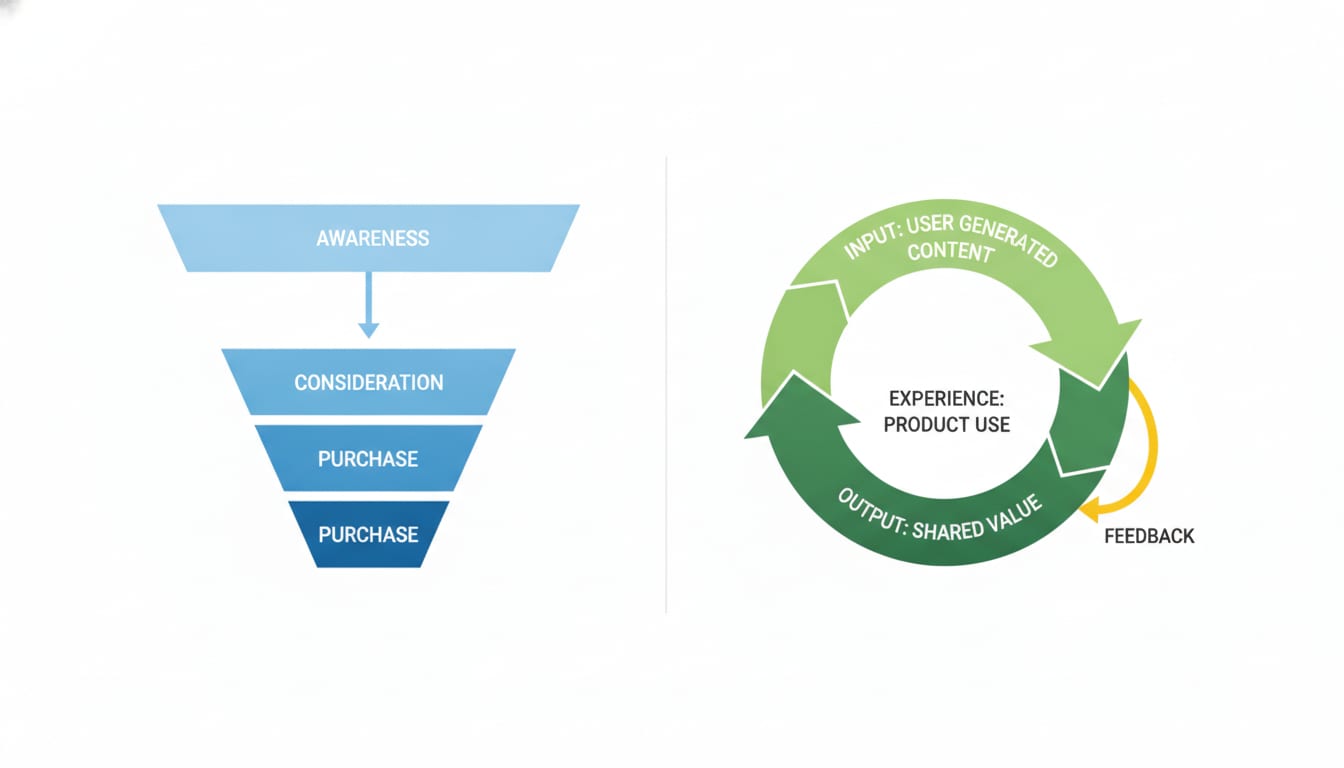
The core difference in one table
| Funnel | Growth Loop | |
|---|---|---|
| Shape | Linear: awareness → signup → activation → revenue | Circular: input → action → output → new input |
| What it answers | "Where are we leaking?" | "How does growth create more growth?" |
| Unit of work | Optimizing a step's conversion rate | Increasing loop output or reducing cycle time |
| Returns | Diminishing — each % gets harder | Compounding — each cycle seeds the next |
| Scaling lever | More spend, more traffic | More users, more content, more transactions |
| Failure mode | Channel saturation, rising CAC | Loop decay, long cycle times, weak reinvestment |
| Owner | Marketing | Product + engineering + marketing together |
| Best for | Diagnosis, forecasting, conversion work | Strategy, defensibility, CAC reduction over time |
The funnel model (AARRR — acquisition, activation, retention, referral, revenue) came from Dave McClure's "Startup Metrics for Pirates" and it's still the right way to diagnose a business. The loop framing was popularized by Brian Balfour and the Reforge team, whose central argument is that funnels encourage siloed, one-shot thinking, while loops force you to ask what the system does with each new user.
Both are true at once. Use funnels to find the leak. Use loops to decide what to build.
Why funnels stop working around Series A
A funnel has a fixed ceiling: the size of the top. You can improve signup-to-activation from 22% to 31% — a genuinely great result — but you've bought yourself one step change, not a growth rate. Then you're back to buying traffic.
Three things go wrong at once:
1. Channels decay. Andrew Chen's "Law of Shitty Clickthroughs" observes that every acquisition channel's performance degrades over time as competition and audience fatigue set in. The first banner ad in 1994 reportedly converted at 44%. Your Google Ads CTR won't.
2. Optimization returns compress. The first round of conversion work on a signup flow often yields 20–40%. The fourth round yields 2–4%. You're still spending the same engineering time.
3. CAC rises with spend. Paid channels have upward-sloping cost curves — the marginal customer is always more expensive than the average one. A funnel-only business therefore has a mathematically guaranteed growth ceiling at any fixed payback threshold.
Loops break that ceiling because the quantity of input grows with the business, not with the budget.
The math that makes loops compound
Here's the part most articles skip. A loop is defined by two numbers:
- k (loop factor / branching output): how many new inputs each completed cycle produces. For a viral loop, k = invites sent × invite acceptance rate.
- Cycle time (t): how long one full turn of the loop takes.
You do not need k > 1. That's a common misread. k > 1 means uncontrolled exponential growth (essentially never sustained for long). What you need is a k high enough to meaningfully amplify every user you acquire through other means.
The amplification multiplier on any acquired cohort is 1 / (1 − k):
| Loop factor (k) | Total users per 1,000 acquired | Effective CAC reduction |
|---|---|---|
| 0.10 | 1,111 | −10% |
| 0.25 | 1,333 | −25% |
| 0.40 | 1,667 | −40% |
| 0.60 | 2,500 | −60% |
| 0.80 | 5,000 | −80% |
Read that bottom row again. A loop with k = 0.8 means a $200 blended CAC becomes an effective $40. That's not a marketing improvement; that's a different business.
Cycle time is the underrated variable. Two loops with identical k = 0.5 behave completely differently if one cycles in 3 days and the other in 90 days. Compounding is a function of number of cycles, and number of cycles = time ÷ cycle time. Halving cycle time is usually cheaper than doubling k, and almost nobody instruments for it.
A practical rule we use in diagnostics: if you can't state your loop's k and cycle time to one decimal place, you don't have a loop — you have a hope.
The four loop types that actually work
Most companies can only realistically run one primary loop plus one or two supporting ones. Trying to run four is how growth teams end up busy and flat.
1. Viral and referral loops
User joins → gets value → invites or shares → new user joins.
Two distinct sub-types matter here. Casual contact virality happens as a byproduct of using the product (Calendly links, Loom videos, DocuSign signature requests, Figma file shares). Incentivized referral requires a deliberate ask and usually a reward — Dropbox's double-sided storage referral is the canonical example, described by Drew Houston as taking signups from 100K to 4M in roughly 15 months.
Casual contact virality beats incentivized referral almost every time because it has near-zero cycle time and doesn't decay when you turn off the reward. If your product has any collaborative or output-sharing surface, that's your first loop — not a referral program.
2. Content loops (UGC and programmatic)
User activity generates a public artifact → the artifact ranks in search or gets shared → new users arrive → they generate more artifacts.
This is Pinterest, Stack Overflow, Glassdoor, Yelp, G2, and Zillow. It's also the most underexploited loop in B2B SaaS. If your product creates structured data — job posts, salary benchmarks, invoices, templates, integrations, reviews, public profiles — you can likely build an indexable surface on top of it.
The critical constraint post-2023: content loops now compete against AI-generated volume and shrinking organic click share. The loops that still work produce artifacts that only your users could create — proprietary data, real transactions, real reviews. Generic programmatic pages are a decaying asset.
3. Paid loops
Revenue from cohort N funds acquisition of cohort N+1.
People argue paid isn't a loop. It is — a financially constrained one. The loop closes when contribution margin from acquired customers is recycled into spend. The governing variables are CAC payback period and gross margin, not virality. A paid loop with 5-month payback cycles more than twice as fast as one with 12-month payback, which is why payback period is the single most important number in a paid-led business. Reference benchmarks from OpenView and SaaS Capital put healthy SMB SaaS payback around 12 months or less, and efficient companies well under that.
Paid loops are legitimate but not defensible — anyone can buy the same auction. Use them to fund the loops that are.
4. Sales and expansion loops
Land a customer → they expand seats/usage → expansion revenue funds more sales capacity → and, in the best version, users at customer A move to company B and bring the product with them.
The "product travels with the user" version of this loop is why Slack, Notion, and Datadog compound. Net revenue retention above 120% functions as a loop in its own right: you grow without acquiring anyone. This overlaps heavily with what we cover in the product-led growth playbook around turning signups into expansion revenue.
How to diagnose which loop you already have
Almost every company has a proto-loop running unmeasured. Before you build, go find it.
Step 1 — Map the artifact. What does your product create that another human could see? A link, a file, a report, a public page, an email notification, an invoice. No artifact, no organic loop.
Step 2 — Measure the branching factor. For the last 90 days of new users, count how many were attributable to an existing user's action (share, invite, mention, indexed page). Divide by total existing active users. That's your k, uncomfortable as the number may be. Most pre-loop companies land between 0.02 and 0.15.
Step 3 — Measure cycle time. Median days from a user's activation to the moment they generate their first output that reaches a non-user. If it's over 30 days, cycle time is your bottleneck, not k.
Step 4 — Find the weakest link. Decompose k into its steps: % of users who create an artifact × average recipients per artifact × % of recipients who click × % of clickers who sign up. One of those four is usually 10x worse than the others.
This decomposition is where funnels come back in. You use funnel logic inside each loop step. Loops set strategy; funnels debug them. Anyone who tells you funnels are obsolete has never had to figure out why a share flow converts at 3%.
A worked example
A B2B analytics startup we'd characterize as typical: 4,000 monthly active users, $180 blended CAC, growth flat at 6% MoM.
Loop audit found dashboard sharing existed but was buried:
| Step | Baseline | After 6 weeks of work | Change |
|---|---|---|---|
| MAU who share a dashboard | 8% | 19% | Moved share to primary action, added share-on-create prompt |
| Avg external recipients per share | 2.1 | 2.4 | Multi-email + Slack channel share |
| Recipient click rate | 31% | 44% | Rebuilt share email + live preview instead of login wall |
| Click → signup | 9% | 17% | Public read-only view first, signup gated at edit |
| Resulting k | 0.047 | 0.171 | 3.6x |
| Median cycle time | 21 days | 9 days | Prompt at first dashboard, not first week |
Effective CAC impact: 1/(1−0.047) = 1.05x amplification → 1/(1−0.171) = 1.21x. Blended CAC drops from $172 to $149, and the loop keeps working every month without spend. Not a rocket ship — but that's the honest picture of a first loop iteration, and the compounding shows up over quarters, not weeks.
The unlock, notably, wasn't a marketing campaign. It was four product/engineering changes and one email rebuild. This is why loop work fails inside siloed teams — it requires product, engineering, lifecycle, and analytics to move on the same artifact in the same sprint. That structural point is the whole reason we run embedded pods rather than channel-specific workstreams.
Where loops fail
Being honest about this matters more than the success stories.
Loop decay. Every loop's k declines. Email deliverability tightens, social algorithms deprioritize, search results change, users get invite fatigue. Assume 10–30% annual k decay and budget maintenance work accordingly.
Retention-free loops. A loop that acquires users who churn in 30 days isn't compounding — it's a leaky bucket with extra steps. Retention is the multiplier on every loop. If your M3 retention is under 20%, fix that before touching loop design.
Loop cannibalization. Aggressive referral incentives can pull forward users you'd have acquired organically, inflating attributed loop volume while net new stays flat. Always holdout-test referral programs.
Vanity loops. Shares that generate impressions but no signups. Measure the loop at the new activated user, never at the artifact.
Too many loops. A seed-stage team running viral, content, paid, and sales loops simultaneously has four half-built systems. Pick one primary loop for the next two quarters.
A 90-day plan to build your first real loop
This maps to how we sequence our 4-phase framework — diagnostics, measurement, conversion, scale — applied specifically to loop construction.
Days 1–14: Diagnostics. Map every artifact your product produces. Interview 8–10 users about how they already share output. Identify the one loop with the shortest natural cycle time.
Days 15–30: Measurement. Instrument the four-step decomposition end to end. Build a single dashboard showing k, cycle time, and loop-attributed activated users weekly. You cannot skip this — teams that build loop features before instrumentation cannot tell whether anything worked.
Days 31–60: Conversion. Ship weekly against the weakest step. Typical high-yield moves: remove the login wall on shared artifacts, move sharing from a settings menu to a primary CTA, redesign the recipient-facing experience (usually the most neglected surface in the entire product), reduce time-to-first-artifact.
Days 61–90: Scale. Once k improves reproducibly, attack cycle time and add a second reinforcing loop. Reinvest the CAC savings into the paid loop so the two compound together.
Expect 6–12 experiments in that window. Loop work has a lower hit rate than landing page optimization — plan for roughly one in three shipping a measurable win, which is why velocity matters more than any individual test's cleverness.
The verdict
Don't choose. Use funnels to see, use loops to build.
Funnels are the diagnostic instrument — indispensable for finding where value leaks and for debugging any individual step of a loop. Loops are the architecture — the only structure that makes acquisition cheaper as you get bigger instead of more expensive.
The practical test for whether you're doing loop work or funnel work: if we tripled the company tomorrow, would this thing get better on its own? Optimizing a checkout page: no. Making shared dashboards public-by-default: yes.
If you want a second set of eyes on which loop your product can actually support — and an honest read on whether the answer is "build a loop" or "fix retention first" — book a free growth diagnostic. We'll map your artifacts, calculate your current k, and tell you where the compounding is hiding. No deck, no pitch, just the math.