The short answer: seniority isn't time served — it's the size of the decision someone can own without supervision. Once you define it that way, you can engineer it. The path from "needs a spec to start" to "owns a workstream and a client relationship" can be compressed into roughly two quarters with four mechanics: an explicit ownership ladder, forced reps on a weekly shipping cadence, player-coach pairing with real reviewed work, and a scorecard that measures judgment instead of output volume.
This is not a "we hire only 10x people" post. Most juniors start out competent, with obvious gaps: they can implement, but can't scope; they can run an A/B test, but can't tell you whether it was worth running. Closing that gap is a training problem, not a talent problem — and it's the highest-leverage thing a growth team lead can work on, because you cannot hire your way out of a capability shortage at seed-to-Series C prices.
Why "Senior" Is a Scope Definition, Not a Résumé Line
The most common mistake inside growth teams: seniority gets assigned based on years, title inflation from a previous employer, or technical depth in one narrow tool. Then the person gets handed an ambiguous problem and freezes — not because they lack skill, but because nobody ever trained them on the part of the job that senior people actually do, which is deciding what not to build.
Define five levels of ownership. Every operator should know their level and what evidence moves them up.
| Level | What they own | Supervision required | Typical evidence |
|---|---|---|---|
| L1 — Observe | Nothing end-to-end | Pairing 100% of the time | Can explain the "why" behind someone else's decision |
| L2 — Pair | Tasks inside a defined spec | Daily check-ins | Ships assigned tickets/experiments with minor rework |
| L3 — Ship with review | A full experiment or feature | Pre-launch review only | 5+ shipped units, rework rate under 15% |
| L4 — Own with checkpoint | A workstream (onboarding funnel, paid channel, data layer) | Weekly checkpoint | Sets own hypothesis backlog; defends prioritization |
| L5 — Own and teach | Outcome + another operator's growth | Peer-level | Their mentee reaches L3; client asks for them by name |
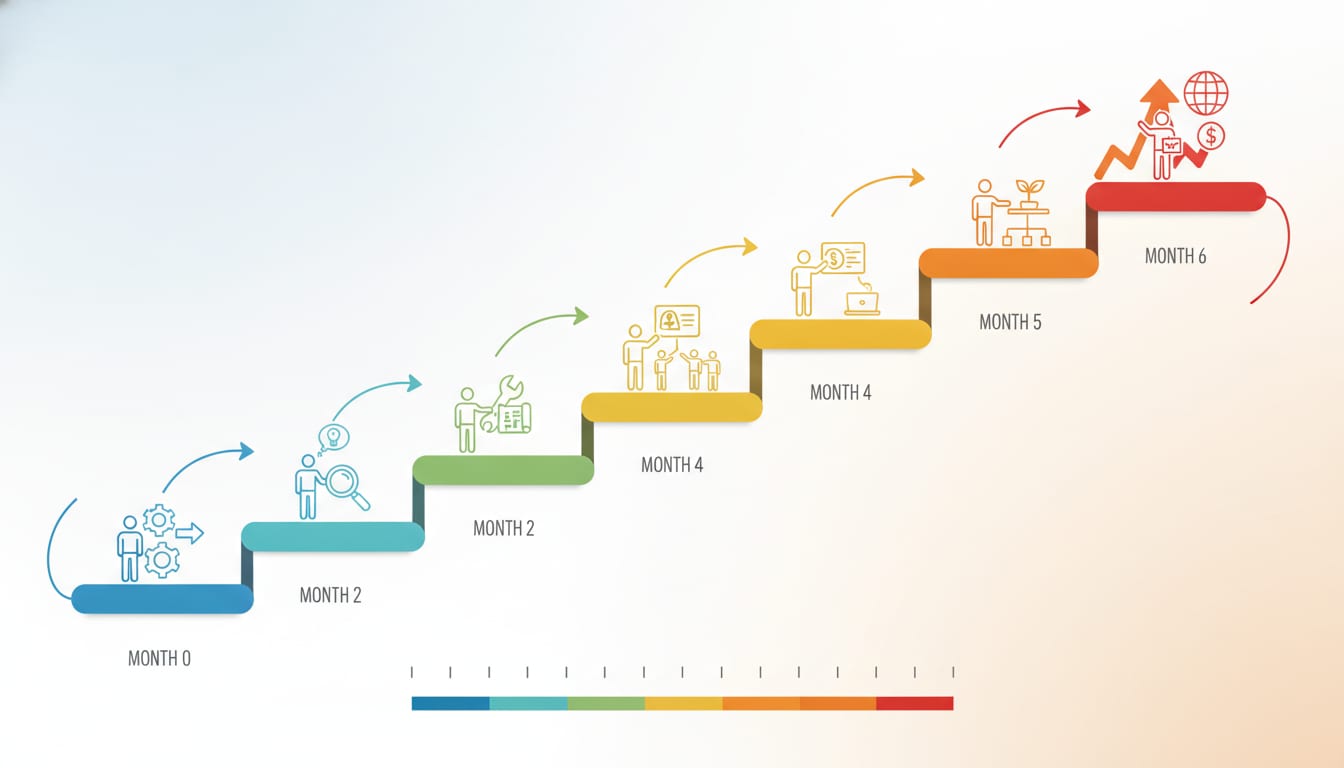
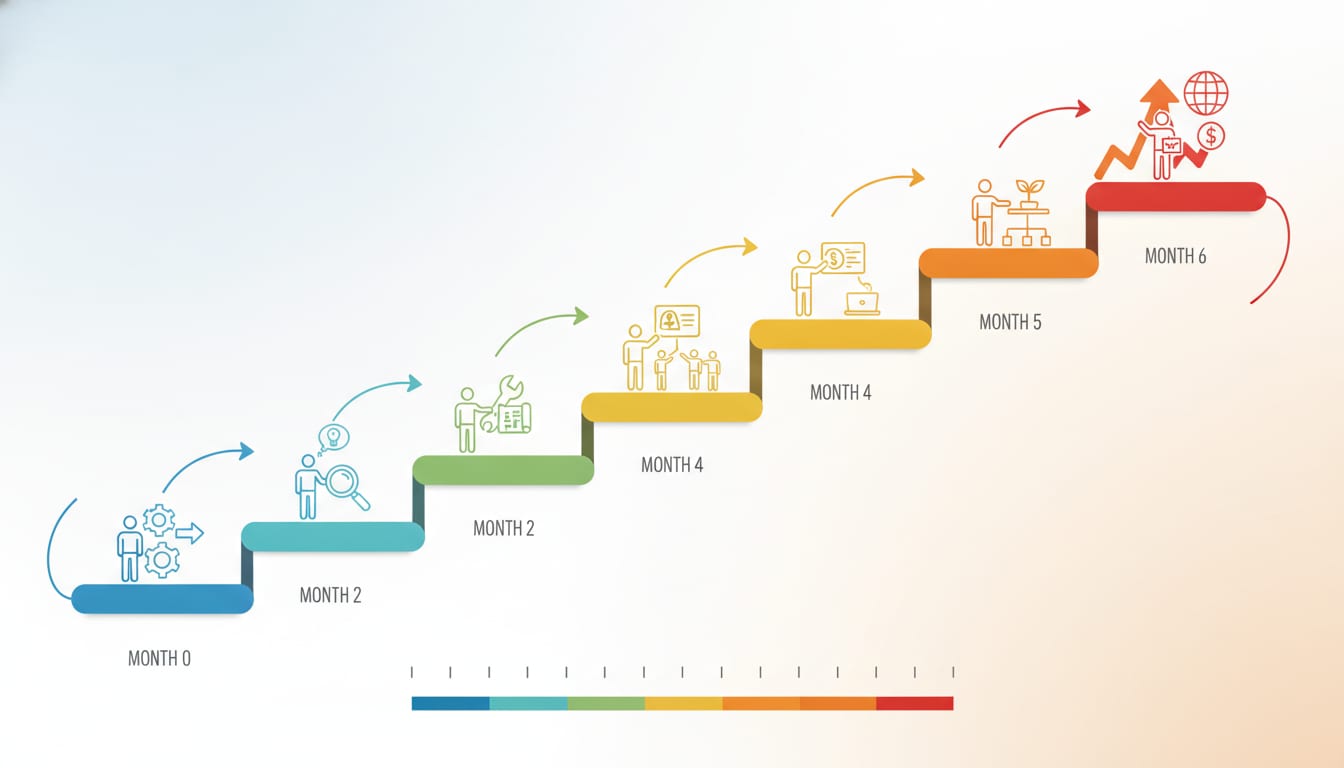
"Junior to senior in six months" means L2 to L4. That's the honest claim. L5 — the player-coach who can develop other people while carrying their own number — usually takes another 6–12 months, and not everyone wants it.
Being explicit about the ladder does something subtle but powerful: it converts a vague anxiety ("am I progressing?") into a checklist. It also gives you a defensible reason to not promote someone yet, which is far kinder than a mushy "keep it up" review.
The Six-Month Arc
Here's the shape of a six-month program. It's compressed because a weekly shipping cadence is compressed — an operator gets roughly 24 shipping cycles in six months instead of the 6–8 they'd get on a quarterly-release team. Reps are the whole game.
| Phase | Weeks | Focus | Exit criterion |
|---|---|---|---|
| Immersion | 1–3 | Context, codebase, data model, client's unit economics | Can draw the client's funnel and name the constraint metric from memory |
| Supervised reps | 4–8 | Ship small, ship often, get torn apart in review | 6+ shipped units; first solo experiment live |
| Scope stretch | 9–16 | Write their own briefs; own instrumentation and analysis | Proposes an experiment that a senior kills, and understands why |
| Front-of-room | 17–22 | Present results to the client; handle pushback | Runs a full weekly review call unassisted |
| Workstream handoff | 23–26 | Owns a funnel stage or channel end-to-end | Holds a number for a full month with weekly checkpoints only |
Two things about this table matter more than the specifics.
First, client contact starts early — week 17 at the latest, and often week 6 as a silent observer. Operators who never see the client stay junior forever, because they never internalize what the work is for. The moment someone has to explain a flat experiment result to a founder who just spent $40k on the channel, their prioritization instincts change permanently.
Second, the "gets an idea killed" milestone is deliberate. Treat a well-argued rejection as a graduation event. Learning to have your reasoning stress-tested without ego collapse is the difference between an L3 and an L4, and it only develops in an environment with high candor and high safety. Amy Edmondson's research on psychological safety — and Google's own Project Aristotle findings — landed on the same conclusion: the top predictor of effective teams was whether members felt safe taking interpersonal risks (re:Work, Google).
What Actually Produces the Change
Five mechanics, in rough order of impact:
1. Pairing on real, consequential work — not training exercises. For the first six weeks, a junior pairs with a senior on live tickets. Not tutorials. Real branches, real deploys, real consequences. The senior narrates decisions out loud, including the boring ones ("I'm not adding an event here because we'd never act on it").
2. A decision journal. Every non-obvious call gets two sentences: what was decided, and what's expected to happen. Review the journal every two weeks. This is the single cheapest intervention on this list and the one most teams skip. Reviewing predictions — not outcomes — is what builds calibration, which is the core skill you're actually buying when you hire senior people.
3. Instrumentation before implementation. No experiment gets built until the measurement plan is written: primary metric, guardrails, minimum detectable effect, and how long it will take to reach significance. Expect a good share of early proposals to die at this step because the math shows the test would need 14 weeks on the available traffic. That's the lesson. Learning to run the power calculation first is how a junior stops burning quarters on underpowered tests — a discipline built into our 4-phase framework, where measurement precedes conversion work by design.
4. Deliberate difficulty escalation. Each cycle, increase ambiguity by one notch: from "build this component" to "make onboarding step 3 convert better" to "you own activation, tell us what to do next quarter." K. Anders Ericsson's work on expert performance is unambiguous that improvement comes from practice targeted just beyond current ability, with immediate feedback — not from accumulated hours at a comfortable level (Ericsson et al., Psychological Review). Most workplaces accidentally do the opposite: they keep good juniors doing the thing they're already good at, because it's efficient this week.
5. Public credit, private correction. Juniors present their own wins to the client. Mistakes are handled inside the team. Obvious, and yet.
Where AI Fits — and Where It Lies to You
Here's the uncomfortable part of training operators in 2026: AI tools let a junior produce output that looks senior. Clean code, well-structured briefs, plausible analysis. The formatting improves faster than the judgment does, and if you review on artifacts alone, you will promote people who can't reason.
AI belongs in the workflow — it's central to AI-powered growth. But in training, two rules matter:
- Review the reasoning, not the artifact. In review, ask "why this and not the three alternatives?" An LLM-generated brief can't defend itself. The operator has to.
- Force at least one unassisted rep per new skill. Write one SQL analysis, one experiment brief, one instrumentation plan without a model. Not for purity — for diagnosis. You need to know what they actually know.
It's also worth calibrating expectations about AI's speed benefits. METR's 2025 randomized controlled trial found that experienced open-source developers were about 19% slower on real tasks in their own codebases when using AI tools, despite believing they'd been faster (METR). The self-perception gap is the finding that matters for mentoring: people are bad at judging their own velocity and their own competence. That's why the scorecard exists.
The Scorecard: Measuring Judgment, Not Volume
Output metrics make juniors optimize for busyness. Track a small set of leading indicators, reviewed monthly:
| Indicator | What it actually tells you | Healthy trajectory (6 months) |
|---|---|---|
| Rework rate | Whether they're scoping correctly, not just executing | 35–40% → under 15% |
| Senior hours per shipped unit | Real cost of supervision | Halves every 6–8 weeks |
| Hypothesis authorship % | Are they generating work or receiving it? | 0% → 50%+ |
| Kill rate on their own proposals | Are they self-editing before review? | Rises, then stabilizes ~25% |
| Escalation quality | Do they bring problems with a recommendation attached? | "What should I do?" → "I recommend X because Y" |
| Prediction calibration | From the decision journal | Directionally right on 60%+ of calls |
The last two are the real tells. When an operator stops asking open questions and starts arriving with a recommendation and a confidence level, they've crossed into senior territory — regardless of what their title says.
Three Common Failure Modes
Mentoring without protected capacity. Mentors get assigned on top of a full delivery load, and coaching quietly becomes the thing that gets dropped in week 3. Scope mentoring capacity into the plan explicitly — roughly 15% of a senior's week. If it isn't in the plan, it doesn't happen. Given that Gallup's research attributes about 70% of the variance in team engagement to the manager (Gallup), unfunded mentoring is one of the more expensive false economies in a growth org.
Rotating too fast. Cycling a junior across four workstreams in a quarter for "exposure" teaches four surface areas and ownership of none. Depth first, then breadth. One workstream for at least 8–10 weeks.
Confusing eagerness with ownership. Enthusiasm is not the same as following through when the work gets boring. Screen for it deliberately — the pattern is closer to what we describe in Hiring for Ownership: How to Spot Operators Who Give a Damn than to any skills test. Skills you can teach in six months. Whether someone gives a damn, you cannot.
Run This In Your Team Starting Monday
You don't need a program document. You need five things:
- Write the ladder. Five levels, defined by scope of unsupervised decision. One page. Share it.
- Assign one mentor per junior and fund 15% of their week. Name it in the sprint plan.
- Start the decision journal. Two sentences per non-obvious call. Review biweekly, focused on predictions.
- Escalate ambiguity every cycle. If a junior's work feels comfortable for three sprints running, you're wasting them.
- Put them in front of the customer by week 12. Silent observer first, then presenter.
Six months of that beats any course you can buy. The compounding effect at the org level is significant: LinkedIn's Workplace Learning Report has repeatedly found internal career development and learning opportunities among the strongest levers on retention (LinkedIn Learning) — and in growth teams specifically, an L4 you developed internally is worth more than an L4 you recruited, because they already have the context that takes six months to build anyway.
The underlying math is simple: a team only works if every seat can own outcomes, and there aren't enough finished senior operators on the market to staff that at scale. So you have to build them. If you're wrestling with the same math — too much growth surface area, not enough senior capacity — that's a reasonable thing to talk through. We run free diagnostic conversations that often end up being as much about team design as about funnels, and our pod engagement models are structured around senior operators who mentor as part of the job, not in spite of it.