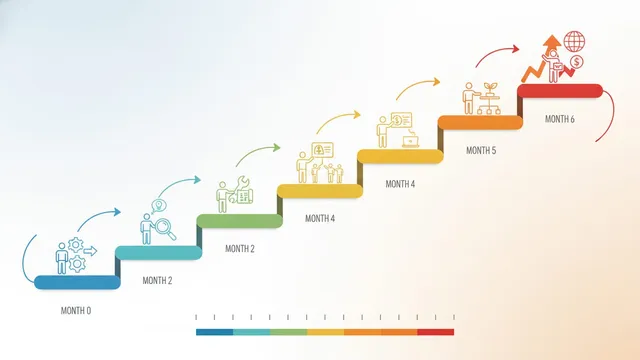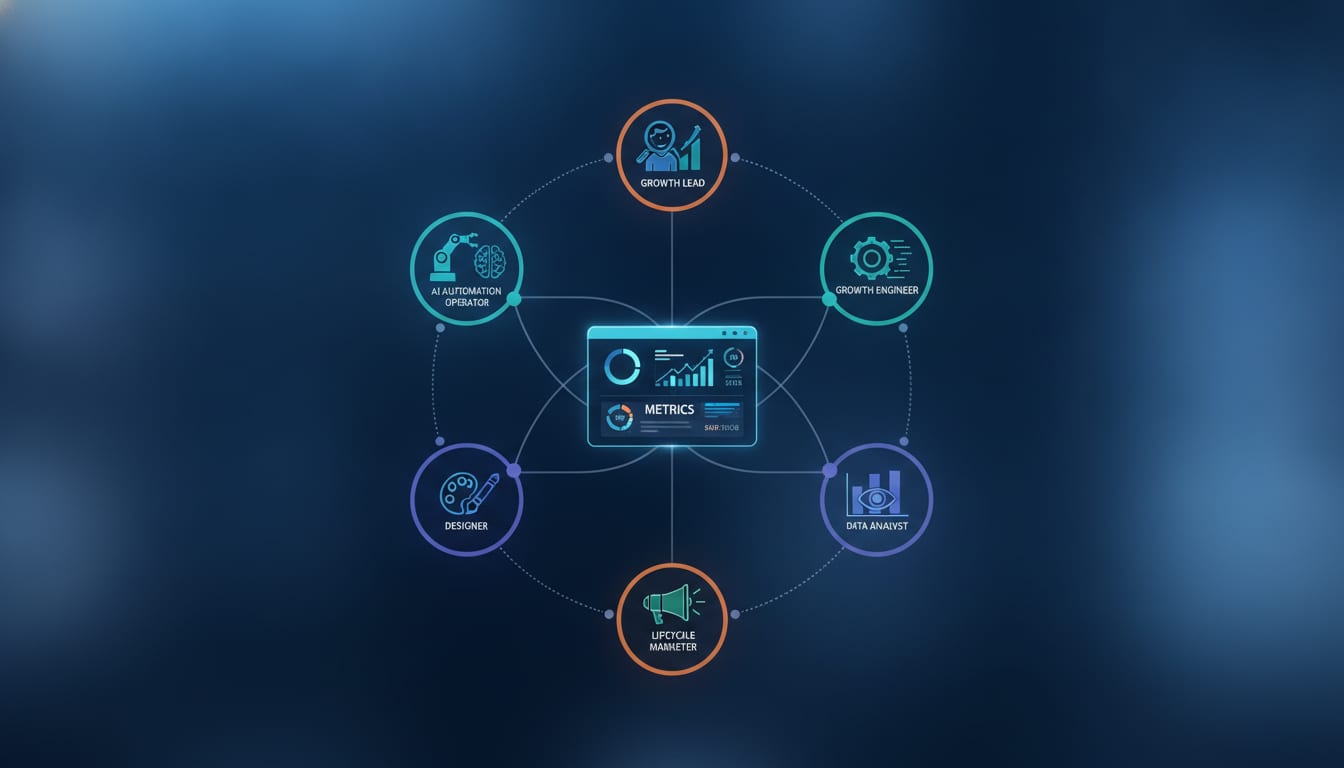
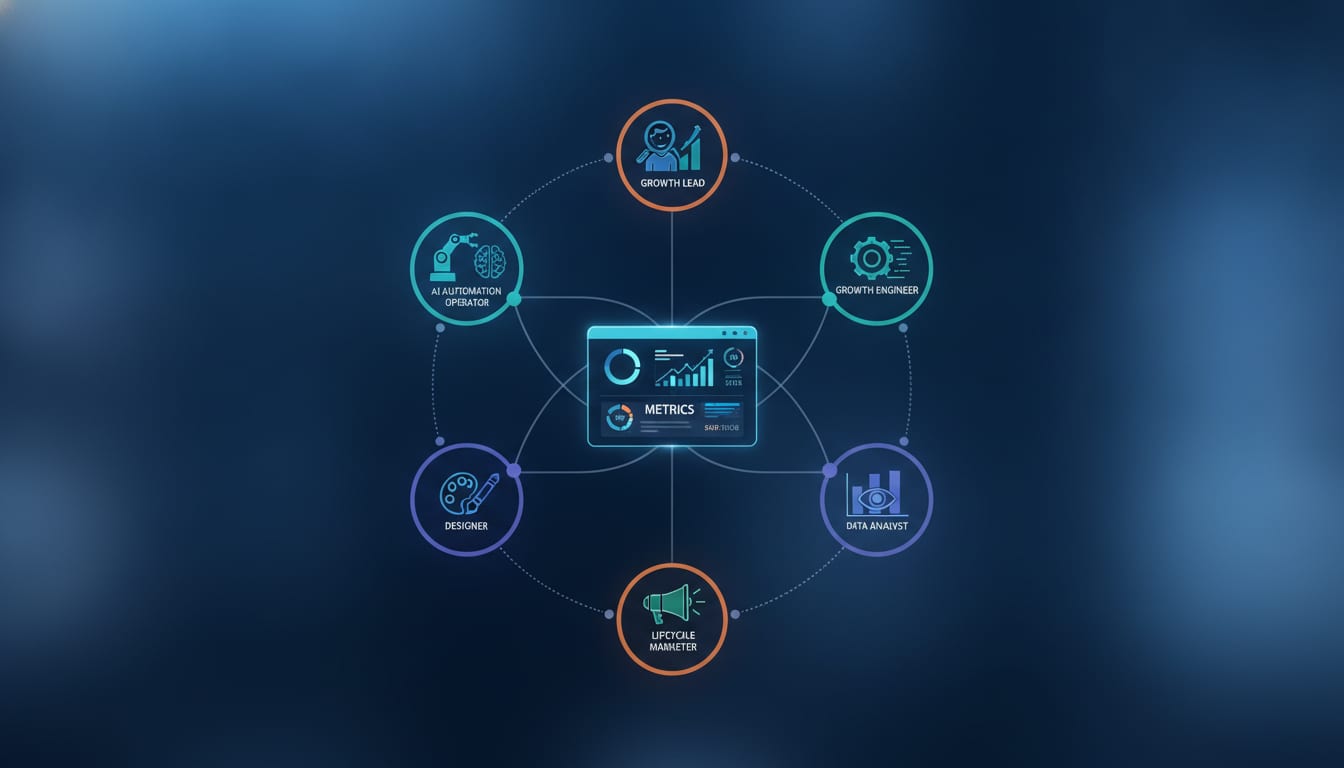
The short answer: a high-ownership growth pod is five to seven senior people — a growth lead, a growth engineer, a data/analytics owner, a lifecycle or demand marketer, a designer, and (increasingly) an AI/automation operator — who share one scoreboard, ship weekly, and own outcomes instead of deliverables. What makes it a pod rather than a team is that every role can trace a line from their work to a metric, and nobody hands work over a wall.
Most startups get this wrong in a predictable way. They hire a "growth marketer" who can't ship code, then a "growth PM" who can't run a paid channel, then an agency that can't touch the product. Each new hire adds coordination cost without adding throughput. Six months later, the experiment velocity is two tests a quarter and everyone blames the roadmap.
We at Growaton have built and run these pods for seed through Series C companies in SaaS, fintech, marketplaces, and e-commerce. This is the role-by-role breakdown of what actually works — what each person owns, what they should not own, the signals that a role is missing, and how the composition should change as you scale.
What Makes a Pod Different From a Growth Team
Before the roles, the operating model — because the same six job titles arranged badly produce a very average growth team.
A traditional growth team is organized by function: marketing reports to the CMO, engineers report to the VP Eng, analytics sits under data. Work moves through tickets and prioritization meetings. The average experiment takes three to six weeks from idea to result, most of which is waiting.
A pod is organized by outcome. It has:
- One metric that matters for the quarter (activation rate, paid CAC payback, net revenue retention — pick one primary).
- Full-stack authority — the pod can change product code, marketing site, ad spend, email, and data pipelines without cross-team approval for anything under an agreed blast radius.
- A weekly shipping cadence — something reaches real users every week. Not a status update. A shipped change.
- Shared ownership of the number — the engineer's performance review reflects activation rate, not story points.
That last point is the whole game. Research from McKinsey on agile organizations found that cross-functional, outcome-owning teams consistently outperform functionally siloed structures on speed and customer outcomes. Growth work is the most obvious application: it's inherently cross-functional and inherently measurable.
The role definitions below only make sense inside that model. Drop a "growth engineer" into a siloed org and you've hired an expensive frontend developer who's frustrated by Q3.
1. The Growth Lead (Pod Lead / Head of Growth)
Owns: the metric, the experiment backlog, the weekly cadence, and the decisions nobody else wants to make.
The growth lead is not the smartest person in the pod at any single discipline. They're the person who can hold the whole system in their head — funnel math, channel economics, product mechanics, and the team's actual capacity — and decide what gets built this week.
What they actually do
- Maintain a prioritized experiment backlog with explicit hypotheses, expected lift, and effort estimates (ICE, PIE, or whatever scoring model you can keep honest).
- Run the weekly growth meeting: what shipped, what it moved, what's next. Thirty minutes, not ninety.
- Kill experiments that are inconclusive rather than letting them run forever hunting for significance.
- Translate between the CEO's narrative ("we need to grow enterprise") and testable hypotheses ("self-serve teams over 5 seats convert to sales-assisted at 4x — let's build a seat-threshold trigger").
Signals you're missing one
Your growth work is a list of tactics, not a sequence of hypotheses. Different stakeholders each have a pet channel. Nobody can tell you what last quarter's experiments taught you, only what shipped.
What they should not own
Execution in any single lane. The moment your growth lead is writing all the ad copy or all the SQL, throughput collapses and prioritization goes stale. A player-coach model works — but the coaching has to survive contact with the calendar.
2. The Growth Engineer
Owns: shipping the experiments, the experimentation infrastructure, and the technical surface area of the funnel.
This is the role most searched for and least understood. A growth engineer is a software engineer who optimizes for learning velocity rather than code longevity. They are comfortable shipping a rough variant behind a flag on Tuesday and deleting it on Friday.
Growth engineer vs. product engineer
| Dimension | Product Engineer | Growth Engineer |
|---|---|---|
| Optimizes for | Durability, correctness, scale | Speed to validated learning |
| Typical unit of work | Feature | Experiment or funnel change |
| Code lifespan | Years | Days to months |
| Success metric | Ships spec, low defects | Experiments shipped, metric moved |
| Stack breadth | Deep in one area | Frontend, backend, analytics, martech, APIs |
| Comfortable with | Test coverage, architecture reviews | Feature flags, tracking plans, throwaway code, Segment/Rudderstack, Webflow-to-app handoffs |
What they actually do
- Build and maintain the experimentation harness: feature flags, variant assignment, holdouts, guardrail alerts.
- Implement onboarding flows, paywalls, pricing pages, referral mechanics, in-app prompts.
- Own the tracking implementation — because if the engineer doesn't own instrumentation, nobody does, and every analysis becomes an argument about the data.
- Wire up the unsexy plumbing: lead routing, CRM syncs, webhook glue between the product and the go-to-market stack.
Signals you're missing one
Your growth ideas are all things that can be done in a marketing tool. Your onboarding hasn't changed in a year. Your A/B "tests" are actually before-and-after comparisons. Marketing runs a separate landing page stack because getting into the app takes a sprint.
Salary reality check: growth engineers command a premium over generalist engineers because the skillset is rare — Levels.fyi data shows growth-focused engineering roles at US startups tracking at or above product engineering bands. Budget accordingly, or borrow the capability.
3. The Data & Analytics Owner (Growth Analyst)
Owns: the truth. Definitions, instrumentation quality, experiment readouts, and unit economics.
Most growth programs die of measurement debt, not idea shortage. Two dashboards disagree, someone loses faith, and decisions revert to opinion and seniority.
What they actually do
- Maintain the tracking plan — a single source of truth for events, properties, and definitions, versioned like code.
- Define the metric tree: north star → input metrics → experiment-level metrics. Everyone in the pod should be able to point at where their work sits.
- Run experiment analysis honestly, including calling out underpowered tests before they run rather than after.
- Own unit economics: CAC by channel, payback period, cohort retention, contribution margin. In fintech and marketplaces especially, this is where growth strategies live or die.
Signals you're missing one
Your CAC number changes depending on who you ask. Nobody can tell you the activation rate of last month's cohort versus the one before. Experiments are declared winners on 200 sessions.
A note on sequencing
Growaton's 4-Phase Framework puts Measurement immediately after Diagnostics for exactly this reason — you cannot run a conversion program on data you don't trust. Teams that skip this phase spend the next two quarters relitigating results. (More on the methodology here.)
4. The Lifecycle / Demand Marketer
Owns: getting the right people in, and getting them back.
Depending on your motion, this splits into two flavors. Sales-led B2B needs demand generation and pipeline. Product-led needs lifecycle and activation messaging. Below roughly $10M ARR, one strong operator usually covers both.
What they actually do
- Acquisition: paid channels, SEO/content, partnerships, outbound sequences — with a hard CAC-payback constraint, not a vanity traffic target.
- Lifecycle: onboarding email and in-app sequences, reactivation, expansion prompts, churn saves. This is the highest-ROI, most-neglected surface in most seed-stage companies.
- Messaging and positioning tests: headline, offer, and proof-point experiments across the site and ads.
Where the boundary sits with the growth engineer
The marketer owns the message and the mechanism; the engineer owns the surface where it renders. A lifecycle email that fires on a product event requires both — and pods handle that in one conversation instead of two backlogs.
Signals you're missing one
You have a product that activates users well and no reliable way to get more of them. Or the reverse: strong top-of-funnel and a 40% drop between signup and first value with no email sequence in sight.
5. The Product Designer (Conversion-Focused)
Owns: the user's path through the funnel, and whether it feels obvious.
A growth designer is not a brand designer. They're the person who redesigns a five-field signup form into a three-step wizard and can tell you exactly which step is bleeding users and why.
What they actually do
- Design experiment variants fast — often at low fidelity, sometimes straight into a component library the engineer can assemble.
- Run lightweight qualitative research: five user interviews, session replays, exit surveys. The
whybehind the quantitative drop. - Own the design system for growth surfaces so variants can ship without a bespoke design cycle each time.
Signals you're missing one
Your experiments are all copy and color changes, because structural changes feel too expensive. Your conversion improvements have plateaued at the margins.
The honest tradeoff
At seed stage, this is the most commonly shared or fractional role. A growth engineer with good taste plus a solid component library can cover a lot of ground. By Series A, if conversion is a priority, the pod needs dedicated design time.
6. The AI / Automation Operator
Owns: the leverage layer — the work that used to require headcount and now requires a well-built workflow.
This is the newest role and the one most likely to be missing from a 2023-era org chart. It's not "the person who uses ChatGPT." It's an operator who builds durable systems: content pipelines with human review gates, enrichment and scoring workflows, support deflection, internal agents that compress research and reporting.
What they actually do
- Build and maintain automation infrastructure (workflow tools, LLM APIs, evals) with clear cost-per-output tracking.
- Run the boring, high-yield automations: lead enrichment, meeting-notes-to-CRM, SEO content production at draft stage, competitive monitoring, QA of tracking implementations.
- Measure whether the AI investment pays back. This matters more than the tooling. A workflow that saves four hours a week and costs six hours a week to maintain is a hobby.
Signals you're missing one
Your team spends more than a day a week on repeatable manual ops. Your content output is bottlenecked on writing rather than on strategy or review. You've bought AI tools but can't say what they returned.
The honest caveat: MIT Sloan Management Review and BCG research found the majority of organizations report no significant financial return from AI initiatives. The differentiator is whether someone owns the workflow and the payback math. That's why it's a role, not a tool subscription.
7. The RevOps / Systems Owner (From Series A Onward)
Owns: the go-to-market machinery — CRM, attribution, routing, quoting, reporting hygiene.
Below roughly $3–5M ARR, the growth lead and analyst can cover this. Past that, broken GTM systems start silently costing you real revenue: leads sitting unrouted, attribution that credits the wrong channel, a pipeline report the board doesn't believe.
What they actually do: own the CRM data model, build attribution that survives scrutiny, automate handoffs between marketing/sales/CS, and maintain the forecast inputs.
Signal you're missing one: your sales team maintains a private spreadsheet because they don't trust Salesforce.
How Pod Composition Changes by Stage
There's no universal pod. Here's how we typically staff by stage and motion:
| Stage / ARR | Core Roles | Usually Shared or Fractional | Primary Focus |
|---|---|---|---|
| Seed (<$2M ARR) | Growth lead (often the founder), growth engineer, analyst | Design, AI/automation, RevOps | Activation + one repeatable channel |
| Series A ($2–10M) | Growth lead, 1–2 growth engineers, analyst, lifecycle/demand marketer | Design, AI/automation | Conversion depth + channel diversification |
| Series B ($10–30M) | Everything above + dedicated designer, AI/automation operator, RevOps | — | Growth loops, expansion revenue, CAC efficiency |
| Series C ($30M+) | Multiple pods, each on its own metric (acquisition pod, activation pod, monetization pod) | — | Parallel compounding loops |
Two rules we hold to regardless of stage:
- Never more than seven people in a pod. Past that, coordination overhead eats the velocity advantage and you've rebuilt the thing you were trying to escape. Split into two pods with separate metrics instead.
- Every pod has an engineer. A growth pod without engineering capacity is a marketing team with a better name. It will optimize the surfaces it can reach — ads, emails, landing pages — and quietly ignore the product, which is where most of the compounding lives.
The Titles Problem: What These Roles Are Actually Called
Growth marketing titles are a mess, which makes hiring and org design harder than it needs to be. A quick translation guide:
| Common Title | Usually Means | Watch Out For |
|---|---|---|
| Head of Growth | Growth lead (pod lead) | Sometimes just "senior performance marketer" |
| Growth Product Manager | Growth lead, product-side | May have no channel or paid experience |
| Growth Engineer | Full-stack eng on funnel surfaces | Sometimes a marketing-ops person who can edit HTML |
| Growth Marketer | Demand gen or lifecycle | Enormously variable — probe on ownership of a number |
| Growth Analyst | Data/analytics owner | May be dashboard-maintaining, not decision-driving |
| Full-Stack Marketer | Generalist, seed-stage fit | Rarely deep enough in any lane past Series A |
| Growth Ops / RevOps | Systems owner | Sometimes purely CRM admin |
Hiring advice: ignore the title on the résumé. Ask for the metric they owned, the number it started at, the number it ended at, and what they'd do differently. Operators who give a damn answer that in specifics. Everyone else answers in projects.
The Ownership Layer That Makes It Work
You can hire all seven roles and still get a mediocre growth function. The composition is necessary, not sufficient. What separates a real pod is a set of operating rituals:
- A single scoreboard, visible to everyone. One dashboard, one primary metric, updated automatically. Not a deck someone builds Thursday night.
- Weekly ship review. What went live, what it moved, what we learned. Learnings get written down — an experiment archive is a compounding asset, and most teams throw it away.
- Named owners, not committees. Every experiment has one person's name on it. That person writes the readout, win or lose.
- Blameless post-mortems on losses. Roughly 70–80% of well-designed experiments fail to produce a win — that's normal at Microsoft and Booking.com and it's normal at your company. If losing an experiment is career-risky, your team will only propose safe ones, and safe ones don't move metrics.
- A blast-radius agreement. Define upfront what the pod can ship without approval (anything reversible affecting <20% of traffic, say) and what needs a conversation. Ambiguity here is the number one velocity killer.
This is the difference between a pod that runs 40 experiments a quarter and one that runs six. The people are often equally talented.
Building vs. Borrowing the Pod
Hiring six senior, cross-functional operators takes most startups nine to fifteen months and considerable risk — and the first two hires typically arrive before you know which metric matters most. That's a real cost.
The alternative is to borrow a formed pod that's already worked together, run the diagnostic and measurement phases fast, then either keep it embedded or use it to define the roles you eventually hire in-house. Both paths work. The mistake is the middle path: hiring one generalist "growth person" and expecting them to be the whole pod. That's how you burn eighteen months and a good operator.
If you want a concrete read on which roles your growth function is actually missing, that's exactly what our free growth diagnostic covers — we map your funnel, your instrumentation, and your current coverage gaps, and tell you what to fix first. No obligation to work with us afterward. You can also see how staffed pods have played out for other companies or read more on the 4-Phase Framework that governs how our pods sequence work.