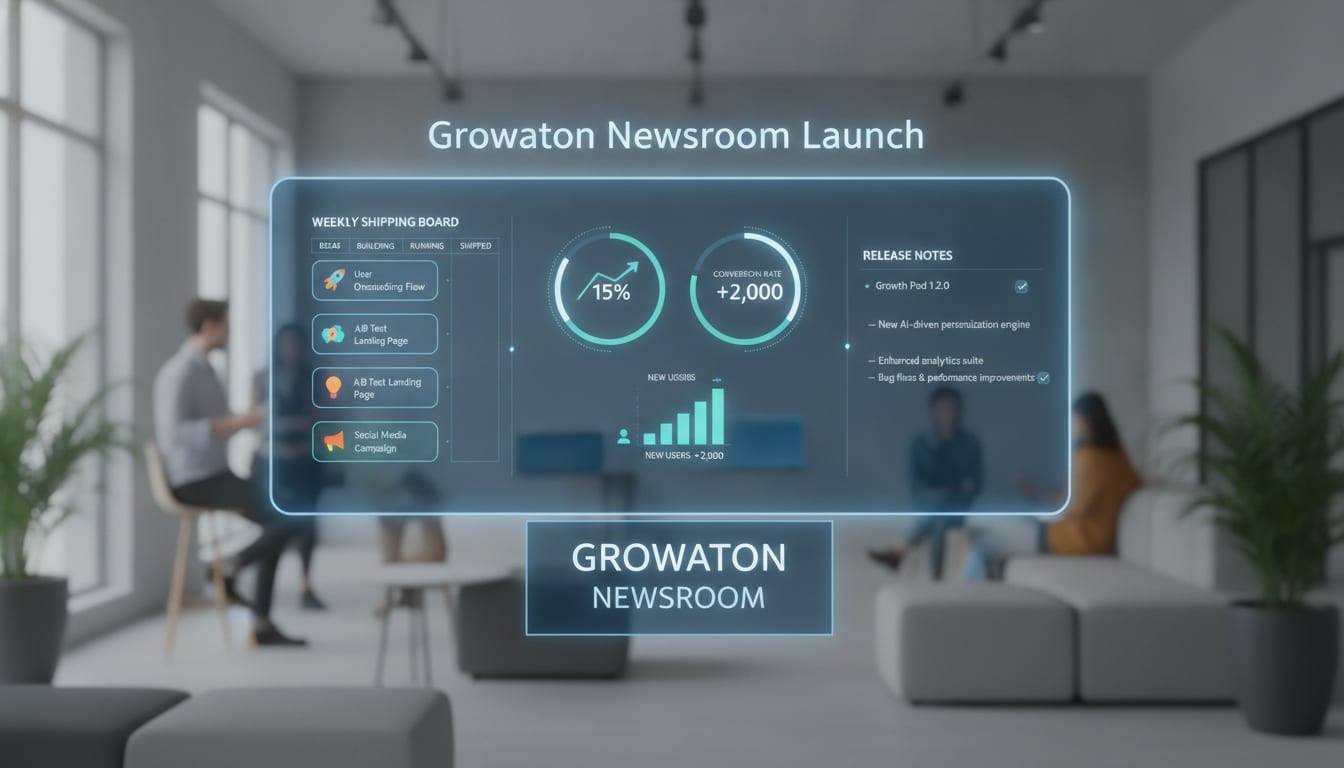
This is the home for Growaton news and Growaton updates — company initiatives, vendor and tooling adoptions, team hires, certifications, methodology changes, and the occasional "we tried this and it didn't work" post. It publishes as needed rather than on a fixed calendar, and every entry is written for the same three audiences we serve every day: founders and CEOs, growth and marketing leads, product and engineering leaders, and ops/RevOps.
If you're a client, this is where you'll find out what changed in how we work before it shows up in your weekly ship log. If you're evaluating us, this is where you can watch us operate in public and decide whether our operating rhythm matches yours.
What the Newsroom is (and what it isn't)
Most company blogs bury their actual news under thought leadership. We're separating the two on purpose.
| Stream | What it covers | Cadence | Primary reader |
|---|---|---|---|
| Newsroom | Company initiatives, new hires, vendor/tool adoptions, certifications, pricing and process changes, partnership announcements | As needed | Clients, prospects evaluating us |
| AI Signal | Biweekly roundup of what actually matters in AI for growth teams, with a Growaton point of view and what we're changing because of it | Biweekly | Growth, product, ops leaders |
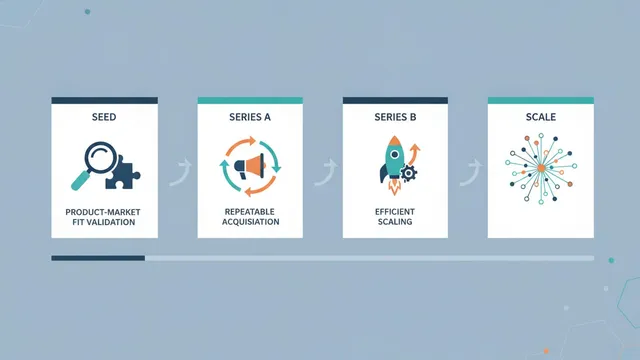
| Playbooks & frameworks | Evergreen guides — growth engineering, PLG, unit economics, [[link:plan_1787248465364_imbvomx | scaling stages]], prioritization | Ongoing |
| Experiment breakdowns & case studies | Real client outcomes with the numbers, the losing variants, and the mechanics | Ongoing | Founders, RevOps, growth leads |
What the Newsroom isn't: a press-release generator. We're not going to announce that we're "excited to announce" a badge we bought. If a post lands here, it should change something for a reader — a decision they make, a tool they evaluate, a process they copy, or an expectation they hold us to.
Why we're publishing company updates at all
Because the alternative is worse. In the embedded-partner model, the client is buying an operating system, not a deliverable. When we change our stack, our prioritization criteria, or our staffing model, that change propagates into every engagement. Publishing it in the open does three useful things:
- It creates an audit trail. If we say we ship weekly, you should be able to check.
- It forces intellectual honesty. Writing down why we adopted a vendor makes it much harder to keep paying for it out of inertia.
- It makes the sales conversation shorter and more honest. Founders vetting a growth partner shouldn't have to reverse-engineer how a team works from a capabilities deck. Read six months of updates instead.
That last one matters more than it sounds. Google's own guidance on creating helpful, reliable, people-first content is essentially a description of good disclosure: show your expertise, be specific about who made this and why, and answer the question the reader actually has. We'd rather be judged on our operating record than our adjectives.
Our bar for a Newsroom post
Every entry in this stream has to clear four gates before it publishes:
- A named change. Something concrete happened — a tool went live, a role got filled, a framework got revised, a policy changed.
- The reasoning, including the tradeoff. What we gave up. What the alternative was. Roughly what it cost.
- A reader implication. What a founder, growth lead, or RevOps operator should do — or stop doing — because of it.
- A number where a number exists. If we can't quantify it yet, we say so and commit to a follow-up.
No gate, no post. This is the same standard we hold in client work, where a "win" that can't be traced to a metric movement is treated as an anecdote, not a result.
The launch slate: what's shipping first
We're opening the Newsroom alongside the first wave of substantive content. Rather than drip it out to look busy, here's the roadmap and who each piece is for, so you can ignore the 80% that isn't aimed at your job.
| Piece | Pillar | Written for |
|---|---|---|
| Growth Engineering in 2026: Building an Experiment-Driven Growth Machine | Growth Engineering & Experimentation | Growth, product, and engineering leads |
| ICE vs PIE vs RICE vs Growaton's 4-Phase Prioritization | Growth Engineering & Experimentation | Growth and product leads |
| The ROI of AI: How to Prove Your LLM Spend Actually Pays Back | AI-Powered Growth & Automation | All roles, especially founders signing the invoices |
| Manual Growth Ops vs AI-Augmented Growth: The Real Numbers | AI-Powered Growth & Automation | Growth and ops leaders |
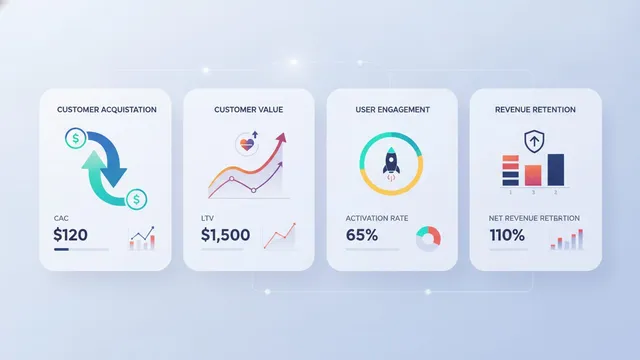
| The 2026 SaaS Unit Economics Guide: CAC, LTV, and Payback Period Explained | Data, Analytics & Unit Economics | Founders and RevOps |
| The Product-Led Growth Playbook: Turning Signups into Expansion Revenue | Conversion & Product-Led Growth | Product and growth leaders |
| SaaS Freemium vs Free Trial vs Reverse Trial: Which Converts Best? | Conversion & Product-Led Growth | Founders and product leads |
| [[link:plan_1786573424769_elozi87 | The Startup Scaling Playbook]]: From Seed to Series B in 2026 | Startup Scaling Playbooks |
| Growth Agency vs. Embedded Growth Pod vs. In-House Team: Which Model Wins in 2026? | Choosing a Growth Partner | Founders and CEOs |
| The 27-Question Checklist for Vetting a Growth Partner Before You Sign | Choosing a Growth Partner | Founders and CEOs |
| How a Series A SaaS 3x'd ARR in 9 Months with an Embedded Growth Pod | Case study | Founders and CEOs |
| How We Cut CAC by 47% by Rebuilding a Series A SaaS Company's Attribution Model | Case study | RevOps and founders |
| AI Signal: What Actually Matters in AI for Growth Teams (Launch Edition) | AI Signal | Growth teams |
The through-line is our 4-Phase Growth Framework — Diagnostics → Measurement → Conversion → Scale. Nearly every playbook above is a deeper cut of one phase. If you only read one thing, read the framework, because it's the thing that determines what we work on in week one versus week twelve.
What we're committing to publish going forward
Specific categories you can expect in this stream:
Vendor and tooling adoptions
When we standardize on an experimentation platform, warehouse, CDP, attribution tool, or LLM provider across pods, we'll post what we chose, what we tested it against, and the cost-per-outcome math. AI tooling gets extra scrutiny here — the honest state of the market is that a lot of AI spend is unmeasured. Our position is that if you can't attribute a model's cost to a cycle-time reduction, a conversion lift, or a headcount avoided, it isn't ROI; it's a subscription.
Team and capability updates
New senior builders, new disciplines added to the pod, new certifications. We'll say what capability it unlocks for clients rather than just posting a headshot. Our staffing thesis is "senior builders at AI speed" — small pods of people who have shipped before, augmented by automation, instead of large teams of juniors billing hours. Hiring notes here should show whether we're living up to that.
Methodology revisions
Frameworks that don't change are frameworks nobody is testing. When we revise prioritization scoring, diagnostic scope, or reporting formats, it goes in the Newsroom with a before/after. Existing clients get the change in their weekly review first; the public post follows.
Post-mortems
Experiments we ran on ourselves that lost. Channels we killed. Pricing we walked back. This is the least fun category and the most useful one. The research on online controlled experiments is blunt about the base rate: in Kohavi and Thomke's analysis of experimentation at Microsoft, only about a third of tested ideas improved the target metric. Any growth team claiming a higher hit rate is either not measuring or not testing anything interesting.
For current clients: what changes
Nothing about your engagement changes because of this launch. Weekly shipping cadence, transparent reporting, and the same pod continue as-is. Two additions:
- Advance notice. Process, tooling, or staffing changes land in your weekly review before they publish here. No client should learn about a change to how we work from a blog post.
- A shared reference library. When a pod recommends expanding into a new workstream — say, layering RevOps and attribution work onto an existing paid and SEO scope — you'll get the relevant playbook link instead of a verbal explanation. Fewer "trust us," more "here's the mechanism, here's the math."
If a topic keeps coming up in your weekly calls and there's no post for it yet, tell your pod lead. That's how most of the roadmap above got prioritized in the first place.
How to follow Growaton news and updates
- Newsroom + playbooks: the Growaton blog carries every stream, including AI Signal.
- Newsletter: experiment learnings, framework updates, and the biweekly AI Signal digest, sent to founders and growth operators. Sign up from the blog.
- Case studies: detailed outcome breakdowns with the numbers live in the case study library.
- Engagement models and scope: plans and pod structures.
And if you'd rather skip the reading and get a direct read on your funnel, book a free growth diagnostic. It's a conversation, not a pitch deck: we look at your acquisition, activation, and retention data, name the two or three constraints actually capping growth, and tell you whether an embedded pod is the right fix — including when it isn't.