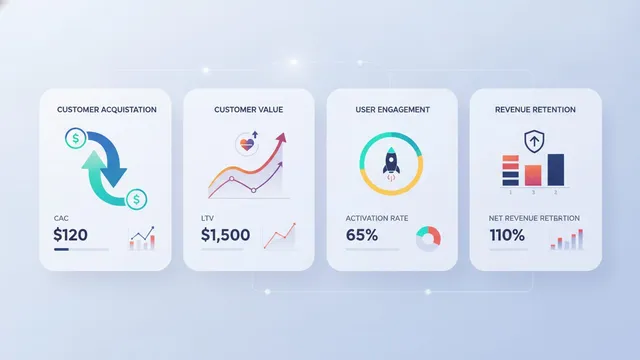
The short answer: scaling from seed to Series B in 2026 is no longer about hiring ahead of revenue. It's about proving a repeatable acquisition motion, instrumenting your data before you spend, and compounding conversion gains through disciplined experimentation. The companies that raise Series B next year will be the ones that can show a specific number: how much capital they put in, and how much recurring revenue came out — with a payback period under 18 months.
That's the whole game. Everything below is the mechanics.
We at Growaton work as an embedded pod inside seed-to-Series C startups — product, engineering, data, experimentation, and marketing in one team — so this playbook is written from the inside of roughly the same problem repeated across SaaS, fintech, marketplace, and e-commerce companies. The failure patterns rhyme. So do the fixes.
Why the 2026 Scaling Environment Is Different
The 2021 playbook — raise, hire 20 people, buy growth, raise again in 12 months — is dead, and the data says so plainly.
Carta's data on venture rounds shows the gap between rounds has stretched significantly, with the median time from Series A to Series B now sitting well north of two years for companies that get there at all — and roughly half of Series A companies never raise a Series B. Bessemer's research on cloud businesses has consistently pointed to the same shift: investors moved from rewarding growth at any cost to rewarding efficient growth, measured through frameworks like the "Rule of 40" and net revenue retention.
Three practical consequences for founders:
- You need to survive longer on each round. Plan 24–30 months of runway, not 18.
- Efficiency metrics are now diligence gates, not nice-to-haves. CAC payback, net dollar retention, and gross margin get interrogated at Series A, not Series B.
- Headcount is the most expensive way to test a hypothesis. A senior team that ships weekly beats a junior team that ships quarterly, and AI-augmented workflows have widened that gap further.
The startup growth stages haven't changed. The bar for each one has moved up.
The Four Startup Growth Stages (And What Actually Matters in Each)
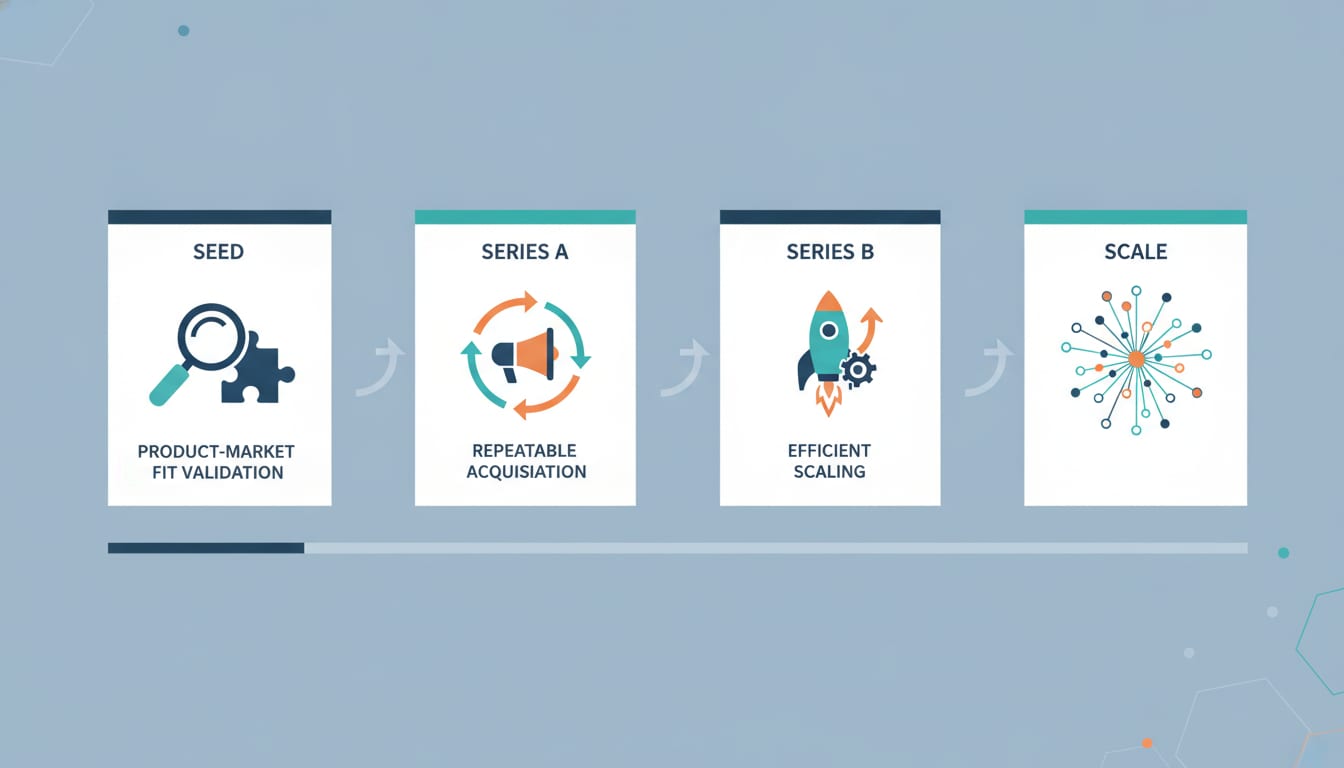
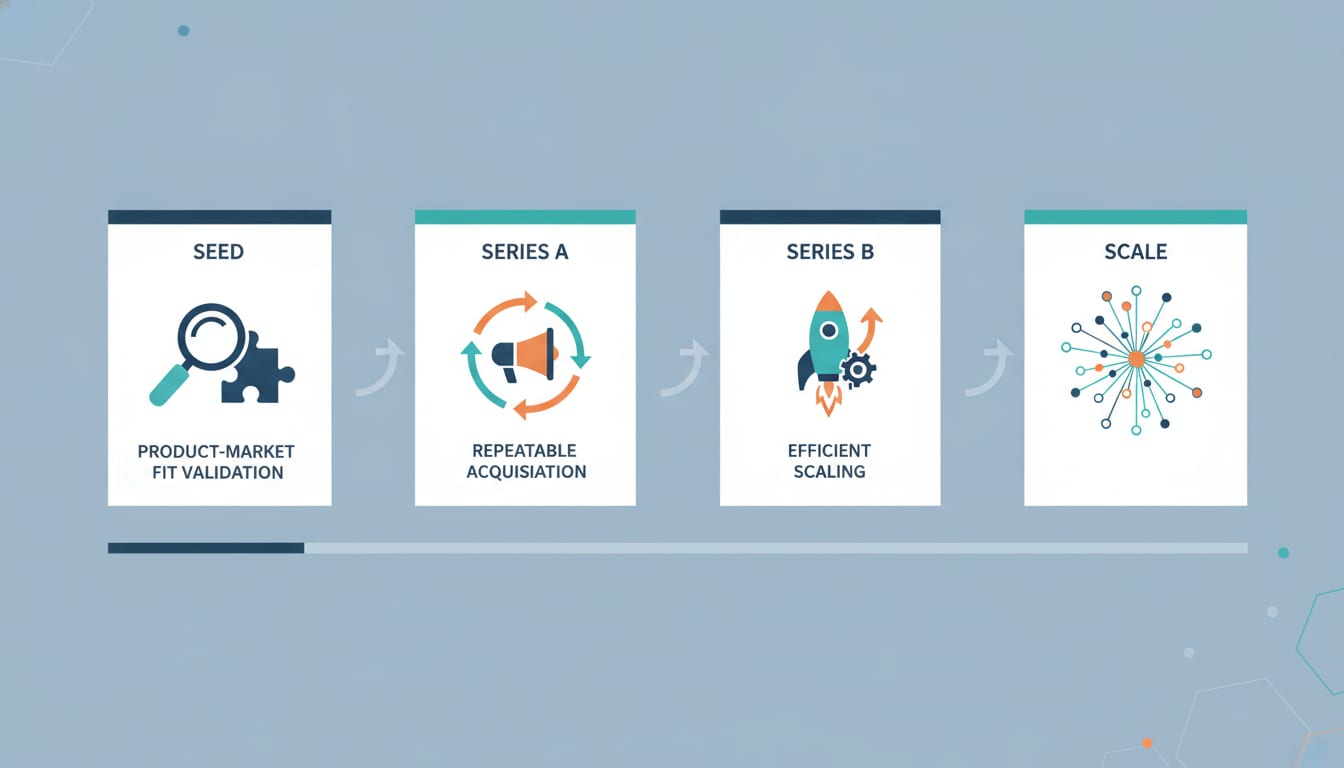
Most scaling advice fails because it prescribes tactics without stage. Paid social is brilliant at one stage and a capital incinerator at another. Here's the stage map we use, framed by the single question each stage has to answer.
| Stage | Typical ARR | The one question | Primary risk | What to ignore |
|---|---|---|---|---|
| Seed | $0–$1M | Do people want this enough to pay and stay? | Building for a market that doesn't exist | Brand, SEO scale, org design |
| Seed → Series A | $1M–$3M | Can we acquire customers repeatably and predictably? | One-channel dependency, founder-led sales that don't transfer | Multi-channel expansion, enterprise motion |
| Series A | $3M–$10M | Can we grow efficiently as we add channels and headcount? | Rising CAC, flat conversion, data chaos | New market entry, premature international |
| Series A → B | $10M–$25M+ | Is this a system that compounds without the founders? | Retention cliffs, unit economics that break at scale | Anything that isn't the core motion |
The mistake we see most often: companies running Series A tactics at seed stage. Hiring a paid media agency at $600K ARR before anyone can articulate the ideal customer profile in a sentence. It burns cash and, worse, generates data so noisy that the next 12 months of decisions are made on garbage.
Stage 1: Seed — Earn the Right to Scale
At seed, your job is not growth. It's evidence.
Concretely, before you're allowed to spend money on scale, you should be able to produce:
- A named ICP with a quantified pain. Not "mid-market ops teams." Something like: "revenue ops leads at 50–300 person B2B SaaS companies who manually reconcile CRM and billing data every month and lose 12+ hours doing it."
- Retention evidence. For SaaS, logo retention and early cohort behaviour. Sean Ellis's classic PMF survey threshold — 40% of users saying they'd be "very disappointed" without your product — remains a useful crude signal, and Superhuman's operationalisation of it is still the best public write-up.
- One channel that works with founder effort. Cold outbound, a community, a founder's audience, a partnership. Manual is fine. Unscalable is fine. Nonexistent is not.
- Instrumentation. This is the one founders skip and regret. Product analytics with defined events, a source of truth for revenue, and identity resolution between marketing touch and paying account.
Do this at seed: talk to customers weekly, ship narrow, instrument everything, keep burn brutally low.
Don't do this at seed: hire a VP of anything, build a brand campaign, chase press, or expand into a second segment because the first one is hard.
Stage 2: Seed to Series A — Build One Repeatable Motion
Seed to Series B growth is won or lost here, because this is where "we have customers" has to become "we have a machine."
Repeatability has a specific definition: you can predict, within a reasonable band, how many customers you'll acquire next month for a given spend and effort. That requires three things.
Channel concentration, not diversification. Pick one primary acquisition channel and one secondary. Go deep. A channel isn't "working" until you understand its unit economics at three different spend levels — because channels break as they scale, and you want to find the ceiling before you've built a plan on top of it.
A transferable sales or self-serve motion. If the founder closes every deal, you don't have a motion — you have a founder. The test: can a new hire, with your enablement material, close a deal in their first 60 days? For product-led companies, the equivalent test is whether signups convert to paid without human intervention. (If you're deciding between models here, the trade-offs between freemium, free trial, and reverse trial deserve their own analysis — they produce very different conversion and expansion curves.)
Baseline unit economics. You need CAC, gross margin, and a payback estimate. It'll be rough. That's fine. Directional truth beats precise fiction.
A concrete benchmark set for Series A readiness in 2026, based on what we see in diligence conversations:
| Metric | Weak | Fundable | Strong |
|---|---|---|---|
| ARR | <$1M | $1.5M–$2.5M | $3M+ |
| YoY growth | <100% | 150–200% | 250%+ |
| Gross margin (SaaS) | <65% | 70–78% | 80%+ |
| CAC payback | >24 mo | 12–18 mo | <12 mo |
| Net revenue retention | <95% | 100–110% | 120%+ |
| Logo churn (monthly, SMB) | >4% | 2–3% | <1.5% |
These aren't rules. They're the conversation you'll be having with a partner at a fund, so it's better to know your numbers before they ask.
Stage 3: Series A — Scale Without Breaking the Economics
You've raised. Now the pressure inverts: you have money and a mandate, and the temptation is to spend both quickly. This is where most of the value is destroyed.
Three things go wrong at Series A, in this order.
Data fragmentation. You add a CRM, a CDP, three ad platforms, a product analytics tool, and a warehouse. Nobody agrees on what a "qualified lead" means. Every dashboard reports a different revenue number. Decisions slow to a crawl because arguing about the data is easier than arguing about the strategy. We rebuilt attribution for one Series A SaaS client and cut blended CAC by 47% — not by finding a new channel, but by discovering that two of their five channels were being credited for demand the other three had generated. They were scaling the wrong spend.
Conversion neglect. Teams at this stage default to top-of-funnel: more traffic, more leads, more spend. But a 20% improvement in trial-to-paid conversion has the same revenue effect as a 20% increase in traffic — at roughly a tenth of the cost, and it compounds because it improves every future acquisition dollar too. Conversion work is the highest-ROI growth activity at Series A and the most consistently underinvested.
Org sprawl before process. Hiring specialists into a company with no operating rhythm produces coordinated inactivity. Marketing runs campaigns engineering can't instrument. Engineering ships features marketing doesn't know about. Everyone's busy; the funnel doesn't move.
The antidote to all three is the same: an experimentation system with a shared measurement layer. Which brings us to the framework.
The 4-Phase Growth Framework
We run every engagement — and recommend every internal growth team run — on the same four-phase loop: Diagnostics → Measurement → Conversion → Scale. The order is not negotiable, and it's where most in-house teams go wrong: they start at Scale.
Phase 1: Diagnostics
Before you change anything, find the constraint. One or two weeks of work, maximum, and it should produce a ranked list of leaks with estimated revenue impact.
What to examine: funnel step-by-step conversion, cohort retention curves, channel-level CAC and payback, activation-to-value time, expansion and contraction revenue, and the gap between what your data says and what your customers say.
The output is not a report. It's a prioritised hypothesis list. In our experience, 70% of the available growth in a Series A company sits in two or three specific leaks — and almost nobody has correctly identified which ones before doing the work.
Phase 2: Measurement
You cannot improve what you can't attribute. Phase 2 builds the infrastructure: event taxonomy, identity resolution across anonymous and known users, a warehouse as the single source of truth, and dashboards that a founder can read in 90 seconds.
This is the phase teams want to skip because it doesn't feel like growth. It is the phase that makes every subsequent decision correct instead of plausible. A useful rule: if you can't tell me the conversion rate between any two adjacent funnel steps, segmented by acquisition source, you're not ready to spend money on acquisition.
Phase 3: Conversion
Now you run experiments — on onboarding, pricing, packaging, landing pages, activation flows, lifecycle messaging, checkout. The metric that matters here isn't win rate; it's experiment velocity. Ten shipped tests a month with a 20% win rate beats two tests a month with a 50% win rate, and it produces vastly more learning.
This is where growth engineering earns its name: most meaningful conversion experiments require code, not just copy changes. That's precisely why siloed marketing agencies stall out at this phase — they can't ship the test, so they recommend it and wait.
Phase 4: Scale
Only once conversion is compounding do you pour fuel on acquisition. Now increased spend produces increased revenue at a known, defensible ratio — because the funnel behind it converts, the data behind it is trustworthy, and you know your payback period.
Scale means: increasing spend on proven channels, adding channels one at a time with the same measurement discipline, expanding into adjacent segments, and building the content and SEO assets that compound over 12–24 months.
Skip to Phase 4 and you're buying traffic for a funnel that leaks. That's the single most common way Series A capital disappears.
The Team Model: What to Build, Buy, and Borrow
Headcount decisions determine your burn multiple more than any other choice. The 2026 reality is that you can access senior capability without permanent senior payroll — but only if you're honest about which capabilities you need permanently.
Build in-house (always): the roles that own customer relationships and product direction. Founders on sales at seed. A product owner. A first engineer who understands the domain.
Borrow (stage-dependent): cross-functional growth execution — the combination of engineering, data, experimentation, and demand generation that has to work as one unit. Hiring this in-house at Series A means four to six senior hires, six months of recruiting, and a 12-month ramp before compounding output. Most companies at $3–8M ARR don't have that time or that budget.
Buy (specific and bounded): tooling, and specialist point work like brand design or a compliance audit.
The failure mode we see most is hiring a single generalist "Head of Growth" at Series A and expecting them to be a marketer, analyst, and engineer simultaneously. It's an unfair job. They usually leave in 11 months, and the company has lost a year.
Whether an embedded pod, a traditional agency, or in-house building is right for you depends on stage and constraint — that comparison deserves a full analysis rather than a paragraph, and if you're evaluating partners, the vetting questions matter more than the pitch deck.
AI-Augmented Execution: Where It Genuinely Changes the Math
The honest version: AI has meaningfully compressed the cost of certain growth work and barely touched others. Knowing which is which is the difference between real leverage and expensive theatre.
Where the ROI is real and measurable:
- Engineering throughput on well-specified work. GitHub's research on Copilot found developers completing tasks roughly 55% faster in controlled studies. Real-world gains are lower and vary by task type, but the direction holds for boilerplate, tests, and integration work — which is a large share of growth engineering.
- Content and SEO production at volume, when a senior editor owns quality and the strategy is human-designed. AI drafts, humans decide.
- Data analysis and internal ops automation — lead enrichment, routing, reporting, QA, support triage. This is the most under-exploited category and usually the fastest payback.
- Experiment variant generation. Producing 15 landing page variants instead of 3 is now trivially cheap; the constraint moved to traffic and measurement.
Where it doesn't help yet: strategic prioritisation, customer discovery, positioning, and anything requiring judgement about what matters. AI accelerates execution once you know what to build. It won't tell you what to build.
The discipline that matters is measuring it. If you're spending on LLM tooling, you should be able to attribute the spend to hours saved or revenue produced — the same standard you'd apply to a paid channel. Most teams can't, which is why AI budgets are the first thing cut in a tight quarter.
The Operating Rhythm That Makes Scaling Repeatable
Frameworks fail without cadence. Here's the rhythm we've found holds up from $1M to $25M ARR.
Weekly: ship something. A test, a feature, a fix, a campaign. One meeting, 45 minutes: what shipped, what we learned, what ships next. No status theatre.
Bi-weekly: review the experiment log. Wins, losses, and — most valuable — inconclusive tests, because those usually indicate a measurement problem rather than a bad idea.
Monthly: unit economics review. CAC by channel, payback, retention cohorts, burn multiple. Founders present these numbers themselves. It changes how they think.
Quarterly: re-run diagnostics. The constraint moves. The thing that limited you last quarter is rarely the thing limiting you now, and teams routinely spend a full quarter optimising a bottleneck they already fixed.
Two cultural conditions make this work, and they're not optional. First, someone owns each number — not a team, a person. Second, losing experiments are reported as loudly as winning ones. A growth team that only reports wins is a growth team that's lying to itself, and the lie compounds faster than the growth does.
Stage-Specific Warning Signs
A quick diagnostic. If you recognise more than two in your current stage, your constraint is probably not where you think it is.
Seed: you can't name your ICP in one sentence. Retention conversations happen less often than pipeline conversations. Your product roadmap comes from the loudest customer.
Seed → A: growth is entirely founder-dependent. One channel is 90% of acquisition. You don't know your CAC. Sales cycles vary by 4x with no explanation.
Series A: three dashboards report three different revenue figures. Paid spend is up 3x and revenue is up 1.5x. Nobody can tell you last quarter's experiment win rate. New hires take four months to become productive.
Series A → B: net revenue retention is below 100%. Growth requires proportional headcount growth. Expansion revenue is under 15% of new ARR. Your best customers came from a channel you've stopped investing in.
The Compounding Argument
Here's the reason this sequence matters, in numbers.
A company improving funnel conversion 8% per quarter — a modest, very achievable rate with a functioning experiment loop — is 36% more efficient after a year and 85% more efficient after two. Every acquisition dollar spent thereafter works harder. That's the difference between a Series B raised from strength and a bridge round raised from necessity.
A company that spends the same two years buying traffic into an unimproved funnel has bought two years of revenue and zero years of leverage.
Scaling from seed to Series B isn't a fundraising problem. It's a compounding problem. The playbook is: find the constraint, instrument the truth, fix conversion, then scale — in that order, on a weekly cadence, with senior people who own the outcome.
If you want an outside read on which phase you're actually in and where your biggest leak sits, that's exactly what a free growth diagnostic conversation is for. You can also see the 4-Phase Framework in practice or read through detailed case studies of how it's played out in Series A SaaS, fintech, and marketplace companies.