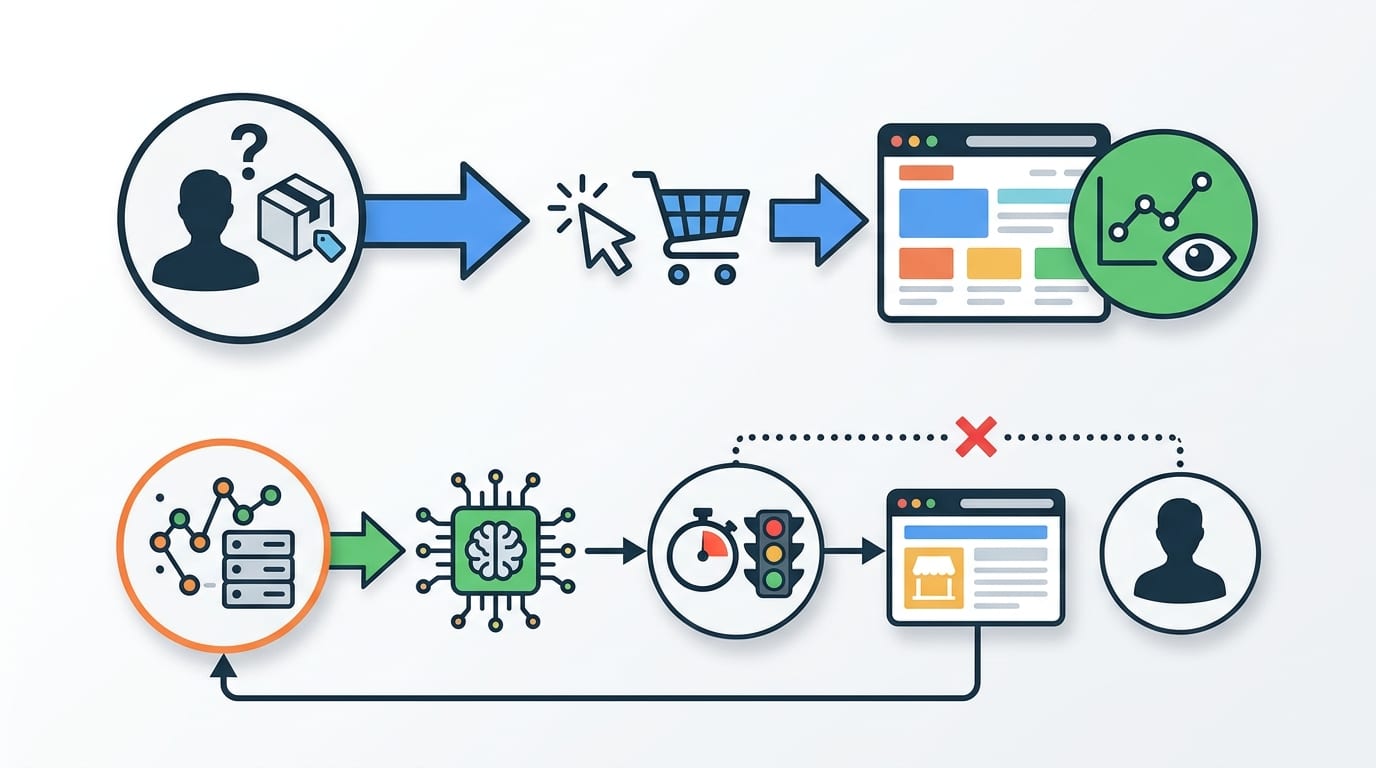
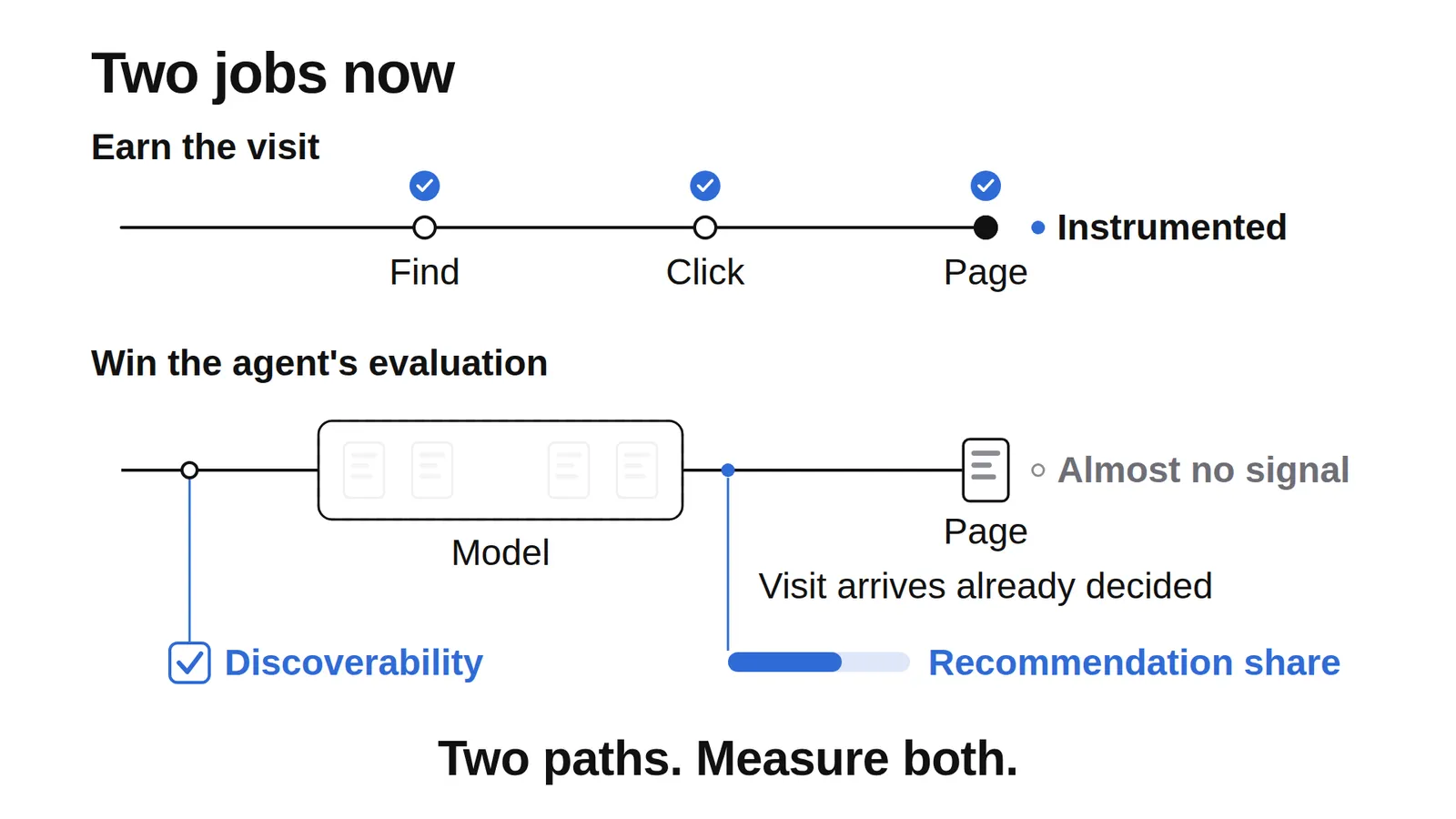
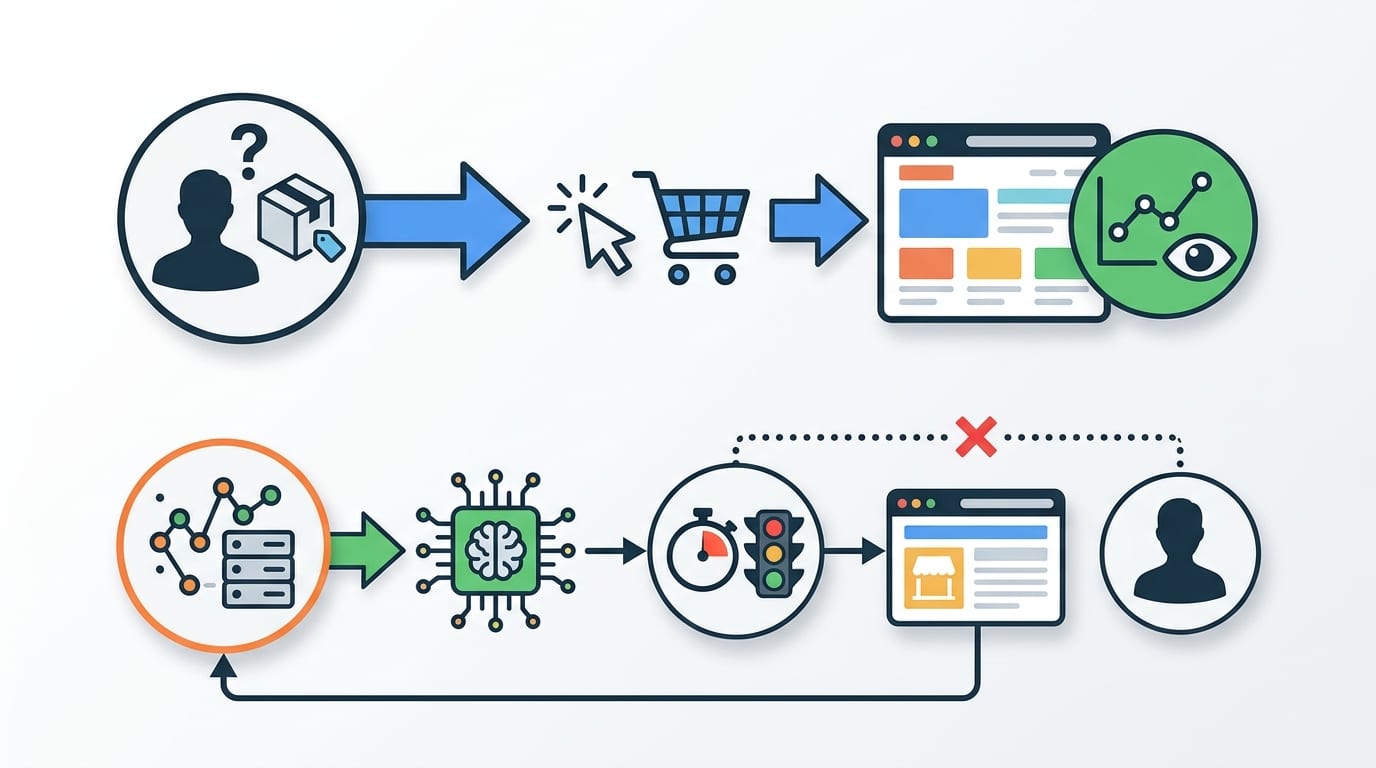
A shopper used to find you, click, and land on your page. You could see all three steps. Now a model reads your product data, compares it against four competitors, and hands the customer one recommendation. The visit either never happens or happens at the end, already decided.
That splits your acquisition work into two separate jobs with two separate measurement systems. Boston Consulting Group draws the same line in How Retailers Can Win With AI Shopping Agents in 2026: a merchant is now selling into two very different patterns of buying behavior, and performance in one is no guide at all to performance in the other. Where the person is still weighing options themselves, you have to be visible before they ever start typing. Where the choice has been delegated to a model, all that matters is whether you appear on the short list it hands back. The split is real, and it leaves you somewhere uncomfortable: the first job already has instrumentation built around it. The second has almost none, and the signal worth watching there moves earlier than revenue does.
This piece is about building that second measurement layer. What you can actually instrument today, what the numbers mean, and which parts are still too thin to run decisions on.
The short answer
Track two new things alongside your existing funnel:
- Discoverability: can agents fetch, parse and correctly interpret your product and policy data? This is a technical pass/fail you control entirely.
- Recommendation share: when an agent is asked a buying question in your category, how often does your product appear in the answer, and in what position?
Neither of these is in your analytics tool. Both are buildable this quarter with a scraper, a prompt harness and a database table. Neither will give you clean revenue attribution, and you should stop expecting them to.
Why the usual referral signal won't save you
The instinct is to wait for the platforms to ship a clean referrer and then just read it in GA4. That wait is going to be long, and the data you get at the end of it will not be comparable across sources.
Analytics Agent, in their agentic commerce attribution model for Shopify, are blunt about where things stand: what lands in the referrer field varies by assistant, several hand over nothing usable at all, and ChatGPT identifies itself consistently enough that a detection rule holds up, while Perplexity rotates its strings often enough to break the same rule. Their conclusion is that the vendors have yet to converge on anything resembling a shared convention. That matches what I see in server logs. You can build per-platform detection rules, and you should, but you are maintaining a fingerprint library, not reading a channel dimension. Each rule is a guess that a vendor can invalidate on a Tuesday with no changelog.
The affiliate side has the same hole in a sharper form. Siren's write-up on affiliate attribution in the age of AI agents points out that the emerging agentic commerce specs account for each mechanical step of a sale: assembling the cart, moving product data between systems, confirming the shopper's identity, and settling payment. On credit, they are silent. Nothing in that sequence records what sent the shopper your way in the first place. So the protocols are being written for transactions, not for marketing accounting. Nobody designing them has a reason to prioritize your channel report.
Treat referrer detection as best-effort telemetry with a known decay rate. Build the leading indicators separately, where you own the measurement.
Layer one: discoverability as a pass/fail test
Discoverability is the least glamorous and most tractable part of this. Before an agent can recommend you, it has to retrieve and understand you. That is a set of binary conditions, and most merchants fail several without knowing it.
What to check, per product, on a schedule:
| Check | What failure looks like | How to test |
|---|---|---|
| Fetchability | Agent user-agents blocked by WAF, bot rules or rate limits | Replay requests with known agent UA strings from an external IP, log status codes |
| Render dependency | Price, stock and specs only exist after JS execution | Fetch raw HTML, assert the key fields appear in the source |
| Structured product data | Price, availability, GTIN, shipping, returns missing or stale | Parse your own markup nightly, diff against the source of truth in your ERP |
| Policy legibility | Returns window, warranty, shipping cutoffs buried in images or PDFs | Extract text from policy pages, assert the key terms are machine-readable |
| Feed parity | Marketplace feed and site disagree on price or stock | Scheduled diff, alert on mismatch above a threshold |
| Variant resolution | Agent cannot tell which SKU matches "size 10, blue" | Fetch a variant URL, check the right attributes resolve |
None of this is new engineering. It is the same discipline you already apply to a payment webhook: assert the contract, alert when it breaks. The difference is that nobody owns it yet, so it breaks silently for months.
One concrete pattern worth stealing: run the discoverability suite against your top 200 SKUs by margin, not by traffic. Agents compress a category into a handful of options. A failure on a long-tail SKU costs you a sliver. A failure on the product that carries your contribution margin costs you the quarter.
Layer two: recommendation share, measured not vibed
This is the part teams describe as a feeling. "We seem to show up in ChatGPT." That is not a number and you cannot put it in a board deck.
Recommendation share is a sampling problem, and sampling problems have known methods. Here is the build.
Define the prompt set
Write 60 to 150 buying prompts that represent how people actually ask in your category. Not keywords. Full questions, with the constraints real buyers carry: budget ceilings, use cases, compatibility, delivery timing, returns anxiety. Group them:
- Category prompts: "best waterproof hiking boots under $180"
- Comparison prompts: "X versus Y for wide feet"
- Constraint prompts: "boots that ship to Spain and accept returns within 60 days"
- Branded prompts: "is X any good"
Freeze the set. The moment you edit prompts, your time series breaks. Version it like schema, add new prompts in a v2 block that you track separately for a month before merging.
Run it on a fixed cadence
Weekly, same day, same hour, from the same region, with the same account state. Capture the full response text, not a boolean. You want the position in the answer, the adjectives used, the price the model quoted, and which competitors appeared alongside you.
Score it
Four metrics are enough to start:
| Metric | Definition | What it tells you |
|---|---|---|
| Presence rate | % of prompts where your brand appears at all | Baseline retrievability in the category |
| Share of mentions | Your mentions ÷ all brand mentions in the response set | Competitive position, not just presence |
| Primary recommendation rate | % where you are the lead suggestion | The one that correlates with orders |
| Fact accuracy rate | % of mentions where quoted price, stock and policy are correct | Direct feedback on layer one |
That last one is the sleeper. I have seen a model recommend a merchant enthusiastically and quote a price from a cached page that was 22% below live. Every one of those conversions arrives angry or doesn't arrive at all. Fact accuracy is a discoverability bug surfacing as a conversion problem, and you will misdiagnose it as a CRO issue if you aren't measuring both layers.
Store it like a real dataset
One row per prompt, per platform, per run. Columns for response text, extracted brands, positions, quoted facts, and a run ID. Put it next to your orders table. In six months you will want to regress primary recommendation rate against new-customer orders with a lag, and you cannot do that if the data lives in a spreadsheet someone updates when they remember.
This is the point where it stops being a marketing task. Analytics Agent make the same argument from the other direction, recommending you "track the discoverability signals that determine whether agents recommend you tomorrow." Correct, and worth being explicit about the implication: the output is a pipeline with alerting, not a dashboard toggle. Someone has to own the schema.
Where the data is still too thin to decide on
I want to be precise about the limits, because the failure mode here is treating a noisy sample as a KPI and then reorganizing a team around it.
Single runs mean nothing. Model responses vary run to run with no input change. A week-over-week move of five points on a 100-prompt set is inside the noise band for most categories. Compute your own variance before you set a threshold. Run the same prompt set twice on the same day for four weeks and look at the spread. That spread is your minimum detectable effect.
Personalization is invisible to you. Your prompt harness runs from a clean state. Real users have history, memory, location and sometimes a payment method on file. Your measured recommendation share is a proxy for a distribution you cannot observe. Use it for direction, not for absolute levels.
You cannot yet attribute revenue to it. There is no reliable join between "we were recommended" and "this order happened." Anyone selling you that join today is selling you a model fit, not a measurement. Treat recommendation share the way you'd treat branded search volume: a leading indicator with a plausible mechanism and no clean causal line.
Platform coverage is uneven. You can harness the major assistants through APIs or automation. Agents embedded inside retail apps and service flows are mostly closed to you. Salesforce's own pitch for launching an agentic contact center describes agents moving into service conversations at speed, which means a growing share of recommendation moments happens inside systems that will never expose a measurement surface to a third-party merchant. Accept the blind spot and size it, rather than pretending the measured portion is the whole.
Two years is the planning horizon, not two quarters. BCG reports that "68% of retailers expect agentic commerce to have a significant or transformational effect within two years." Expectation is not adoption. I'd read that number as permission to fund a measurement build now, not as a mandate to restructure the acquisition budget this quarter.
How to sequence the work
If you are starting from zero, this is roughly 10 to 14 weeks of real engineering time, not a sprint.
Weeks 1-3: discoverability suite. Automated checks against your top SKUs, running nightly, alerting into the channel where someone actually responds. Exit criteria: three consecutive clean nights and a documented runbook for each failure type.
Weeks 3-6: prompt harness. Frozen prompt set, scheduled runs across the platforms you can reach, raw responses stored. Exit criteria: four weeks of data and a computed variance band per metric.
Weeks 6-9: agent traffic fingerprinting. Server-side user-agent and behavioral rules, written as a maintained library with a review date, feeding a separate traffic segment. Exit criteria: segmented sessions reconcilable against raw logs within a stated tolerance.
Weeks 9-14: joins and holdouts. Put recommendation share next to orders, new-customer rate and branded search. Then run the only thing that actually settles the question: geo or time-based holdouts on the inputs you control, so you can see whether fixing discoverability on a SKU set moves anything downstream. Incrementality testing is the honest answer to a world without clean referrers, and it is engineering work, not a reporting setting.
A note on who does this. The build spans product data, server infrastructure, analytics and marketing judgment, which in most companies is four teams and three handoffs. IDC's definition of forward-deployed engineering describes engineers working inside the customer's environment on the customer's actual problem rather than shipping a spec over the wall, and that shape fits this work better than a quarterly agency deliverable does. The failure mode I see most often is a beautiful measurement spec that nobody owns the implementation of. If getting a trustworthy set of numbers in place is the blocker rather than the strategy, that is typically where the reporting and KPI work lands first.
What this changes about the first job
Earning the direct visit does not get easier because of any of this, but it does get more valuable. A customer who chooses you directly is a customer whose next purchase an agent does not get to re-evaluate from scratch. Loyalty, subscription, account balances and saved carts are now defensive measurement assets as much as revenue ones, because they move purchases back into a path you can observe end to end.
So the allocation question becomes concrete rather than philosophical: what share of this quarter's budget buys direct preference, and what share buys agent legibility? You cannot answer that without both measurement layers running. Most teams currently have one.
Start with the pass/fail layer. It's cheap, it's fully in your control, and it is the input to everything else. If you want to talk through where your own instrumentation breaks before you commit engineering time to it, start a conversation.
Get one trusted set of numbers
Reports, analytics and KPI dashboards usually ship during the diagnostic, covering unit economics, tracking and whether the numbers can be trusted.
KPI dashboards