The short version: a16z's argument that implementation-heavy software out-builds the self-serve darlings is correct, and I've watched it play out. The part I disagree with is in the job title. The person you deploy into a customer's operation should be chosen for product judgment, not for a git commit history. Send an engineer by default and you pay the margin cost of services-led growth without getting the defensibility it's supposed to buy.
That's the whole disagreement. Everything below is why.

What a16z actually claimed, and where they're right
In "Trading Margin for Moat: Why the Forward Deployed Engineer Is the Hottest Job in Startups", a16z makes a case that would have gotten you laughed out of a 2021 board meeting: accept lower gross margins, do the hands-on deployment work, and you end up harder to rip out. Procurement Tidbits summarizes the position cleanly in "Your vendor's forward-deployed engineer is moving in... Plan the move-out!": "a16z argued in 2025 that AI startups optimizing for 80% gross margins were being shortsighted, and that hands-on deployment work is what makes software hard to displace."
I agree with the mechanism. When your software is wired into someone's actual process, including the ugly parts, the CSV that one analyst maintains by hand, the approval step that exists because of a 2019 audit finding, you are not a line item anymore. You're infrastructure. Switching costs stop being about data export and start being about rebuilding institutional knowledge.
Thomas Otter names the reversal with the right amount of eye-roll in "on the forward deployed engineer": "Two years ago or so, much of venture capital and the associated punditry insisted that all B2B products embrace product led growth, PLG." The same institutions that told you self-serve was the only defensible motion now tell you services are. Both can be partly true. What bothers me is the certainty in each direction, and the implicit promise that if you copy the structure you get the outcome.
Where I partly disagree: margin for moat is a trade, not an upgrade
Trading margin for moat only works if the margin buys learning that compounds back into the product. If the deployment work stays in the deployment, you haven't built a moat. You've built a consultancy with a software license attached, and you'll find out when you try to raise on it.
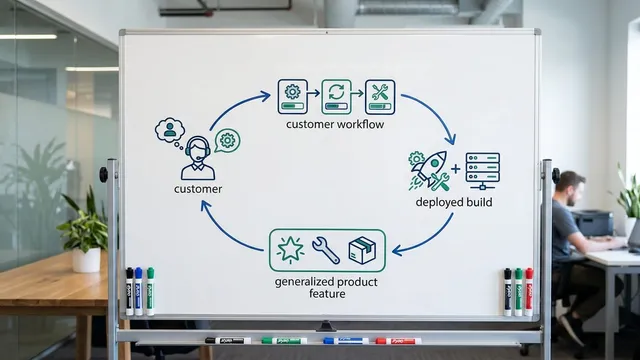
The test is simple and most companies fail it: in the last quarter, what shipped into the core product because of what the deployed person saw in the field? Not a config flag. Not a customer-specific script. A feature or a model change that every other customer now gets. If the answer is nothing, you're running billable hours with a product logo on the invoice.
| What you're actually running | Signal | What happens at 20 customers |
|---|---|---|
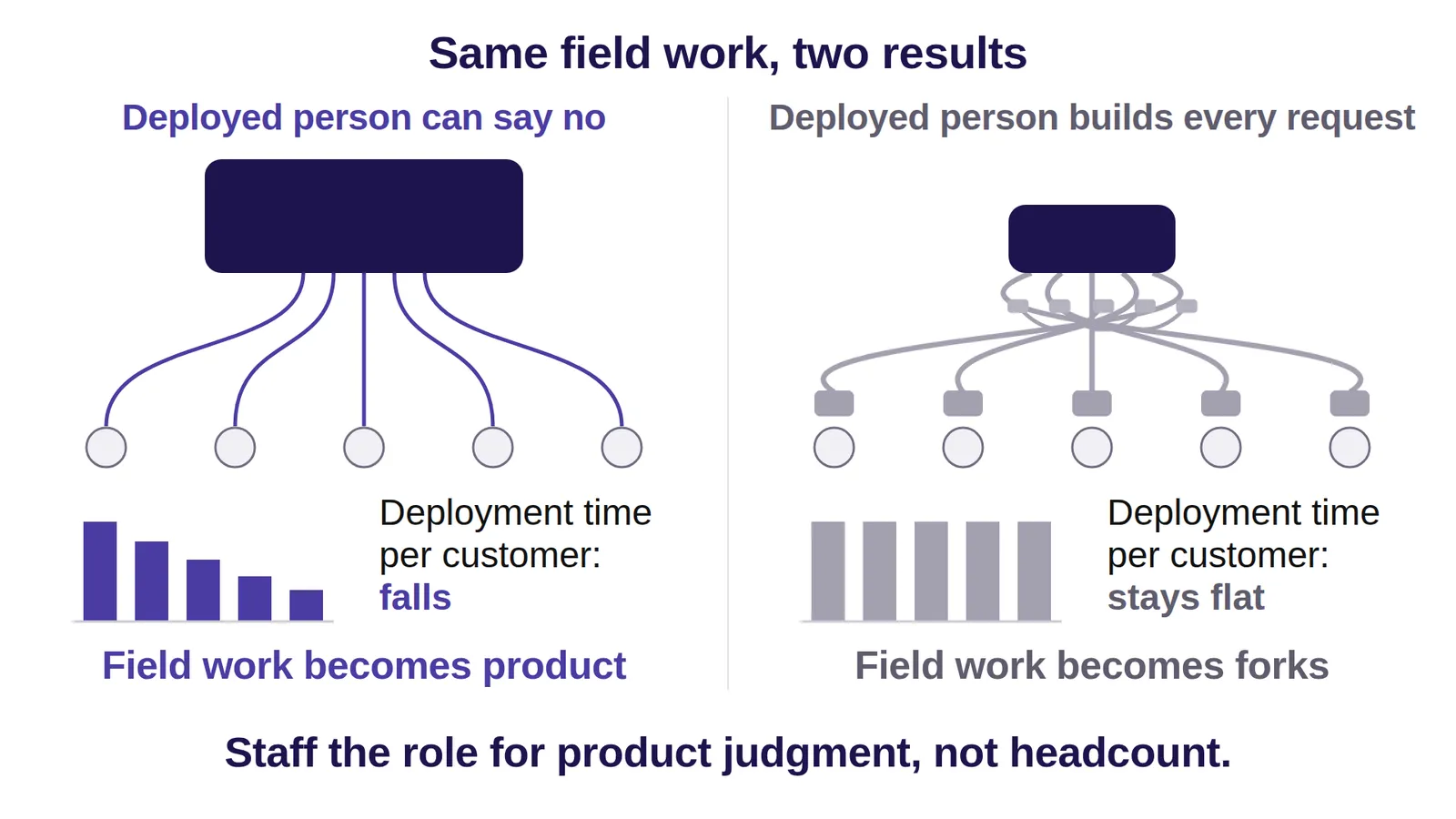
| Services-led growth | Field work produces product commits; the deployed person owns backlog input | Deployment time per customer falls, product gets sharper |
| Implementation consulting with a product skin | Field work produces per-customer forks and custom scripts | Deployment time per customer stays flat, engineering drowns in forks |
| Title arbitrage | Field work produces slide decks and change orders | You hire more FDEs to service the FDEs |
The role is older than the title, and we should say so
Wikipedia's entry on the Forward Deployed Engineer includes a line that a16z said about itself, that the title is "title arbitrage." I'd take it further. Procurement Tidbits puts it bluntly: "Vendor engineers sitting at the customer, configuring, integrating and fixing things until the system works? We used to call them implementation consultants."
Close, but not quite the whole lineage. The role I recognize isn't the implementation consultant. It's the operations-minded product person with an engineering background who embedded with a customer, learned the process well enough to argue with it, and then came back and changed the roadmap. I spent a decade watching those people, hiring those people, and occasionally being that person badly before being that person adequately. They had no title that traveled. They were "the PM who actually understands the warehouse," or "the one we send when the deal is technical."
So I'll grant the rebrand its value. Naming the role does two useful things. It makes the job legible to recruiters and budgets, which matters more than purists admit. And it shortens the rite of passage. You used to need fifteen years to be trusted in a customer's operation. Now you need clear thinking and a working model of systems and operations, and you can be genuinely dangerous at year four.
That's the good news and the rant in one sentence. The shortcut is real, and shortcuts attract people who want the title without the judgment.
The actual differentiator: the mandate to say no
Here's the line from LeadDev's "The rise of the forward-deployed engineer (FDE)" that I'd put on the job description: "If a client says X is the solution, an FDE will really interrogate whether that's really the case and vocally propose alternatives backed with data and evidence."
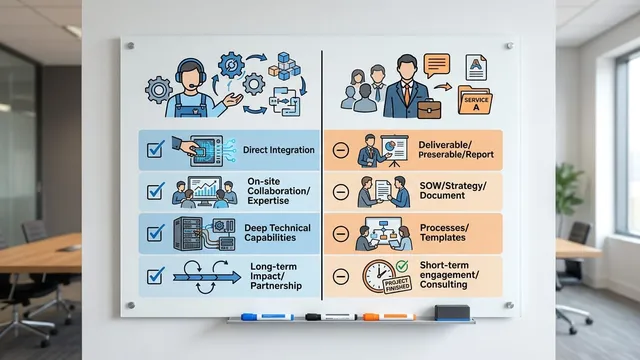
Read that again and notice what it describes. Interrogating a stated solution. Proposing alternatives. Backing them with evidence. That is product management. It is specifically the hardest part of product management, the part where you tell a paying customer that the thing they asked for will not fix the thing they're upset about.
Igor at Productics says it more sharply in "Forward Deployed Engineer NO, Product Manager YES": "Every company racing to copy Palantir sent the engineer. Almost none of them sent the person with the mandate to say no." He also identifies who actually got sent: "disproportionately, engineers early in their careers who have never had to tell a client no."
I agree with both, and I'd add the structural reason it happens. Saying no requires three things that are organizational, not personal:
- Standing. The deployed person needs the authority to decline a request without escalating to someone who will say yes to protect the renewal.
- A roadmap they influence. If they can't trade "not this" for "this instead, next sprint," no is just obstruction.
- A comp structure that doesn't punish it. If the deployed person's variable comp is tied to utilization or to customer satisfaction scores collected the week after a refusal, they will build the bad thing.
An engineer with no product mandate, no backlog influence, and a utilization target will build whatever the customer asks for. Beautifully. On time. And it will be the wrong thing, and the wrong thing becomes a fork, and the fork becomes the reason your deployment time per customer never drops.
Judgment is the scarce input, not headcount
The failure mode I keep seeing at seed-to-Series C is staffing this role by headcount math. Pipeline says eight enterprise deals, deployment takes one person per deal, hire eight. That's a capacity plan, not an operating model. You get the margin hit immediately and the moat never arrives, because eight people with no product authority produce eight bespoke implementations.
The honest claim about what we do at Growaton: we staff embedded pods around product judgment first and then wrap engineering, data and experimentation capacity around it. Not because judgment is mystical, but because it's the input that determines whether the field work turns into product. One person who can interrogate a stated solution, supported by senior build capacity, out-delivers four who can only implement one. That's not a guarantee of outcomes, it's an argument about where the constraint sits.
How to staff forward deployment so it builds product
If you're adopting this model, here's the arrangement I'd defend.
Pick for product judgment, then check the systems floor. You want someone who can read a process map, find the step where the real cost lives, and articulate a different solution than the one they were handed. Then verify they understand systems and operations well enough to be credible: APIs, data flows, where state lives, what breaks at scale. Engineering depth is a strong plus. It is not the entry requirement. The entry requirement is judgment plus a working model of systems.
Give them backlog input in writing. Not "they talk to product." A named, recurring slot where field findings enter the roadmap, with a decision made and recorded. If the deployed person's observations have no defined path into the product, you've built a complaints inbox.
Define what they're allowed to refuse. Write down the categories: customer-specific data models, workflows that only this account needs, integrations with systems the customer is already replacing. Make refusal the default for those, with an explicit escalation path for exceptions. Track the exceptions.
Measure the two numbers that matter. Deployment time per customer should trend down as you add customers. Product commits sourced from field work should be non-zero every cycle. If the first is flat and the second is zero, stop hiring and fix the model.
Protect the person. This role eats people: travel, somebody else's fires, a resolution clock set by a quarter you don't control. Running it at 100% utilization because it bills is how you lose the person who had the judgment. We split field weeks and build weeks explicitly, and yes, that costs capacity. We accept the cost because replacing this profile takes a quarter and the knowledge leaves with them.
Plan the move-out. Procurement Tidbits is writing to buyers, but the advice reads just as well for sellers. If you cannot describe what the account looks like after your person leaves, including who owns which runbook, you have built a dependency rather than a deployment. Buyers are getting better at asking this question. Have the answer ready.
What this means for the next two years
A lot of the current enthusiasm rests on a temporary condition: enterprises can't self-serve adaptive systems yet, so humans do the grounding. I think that's accurate and I think it's temporary in shape, not in substance. The humans don't disappear. The work moves from building the integration to defining what good looks like, which is, again, product judgment rather than implementation labor.
Which means the companies that staff this role as "engineer who travels" are optimizing for the part of the job most likely to compress. The ones who staff it as "product person with a systems brain and a mandate" are optimizing for the part that doesn't.
a16z got the economics right. Services-led growth can out-build pure self-serve in implementation-heavy categories, and the gross margin purists were being short-sighted. Igor and Thomas Otter got the staffing right. The differentiating skill is the willingness and authority to refuse the bad request, and that skill has a name that predates the rebrand.
Call the role whatever helps you hire. Just make sure the person you deploy holds the pen on what gets built, and is allowed to put it down.
If you're building this motion now and you're not sure whether your deployment work is compounding into product or just accumulating forks, that's a thirty-minute conversation. Book a free diagnostic and bring your last two deployments. We'll look at where the field work went.