If you hire Forward Deployed Engineers because enterprises can't configure your product themselves, you have built an org chart around a temporary condition. That's fine. Temporary conditions are worth staffing. What's not fine is treating the structure as permanent, because the gap you're filling is the one your product team should be closing.
Here is the honest version of the claim: the humans don't go away. The work changes shape. Today an FDE builds the integration. In two or three years, the same person defines what good looks like and arbitrates when the system gets it wrong. Those are different jobs with different skill profiles, and most companies hiring FDEs right now are hiring for the first one and planning for neither.
The strongest version of the argument for FDEs
Thomas Otter put it cleanly in on the forward deployed engineer: the FDE surge is "in part a reflection of the current immaturity of AI solutions, but also of the flexible potential of these solutions."
Two causes, not one. That second clause is the part people skip. Immaturity is temporary. Flexibility isn't. A system that can be pointed at eighty different workflows will always need someone to decide which eighty, in what order, with what definition of correct. That decision is product judgment, and no amount of model improvement removes it.
The Forbes Technology Council made the narrower argument in The Rise Of The Forward Deployed Engineer: "Today's FDE exists because generative AI systems don't behave like traditional software." Partly true. Non-deterministic output means you can't hand a customer a configuration guide and walk away. But that framing dates the role to 2023, which is wrong. Palantir ran this playbook for twenty years before anyone shipped an LLM, and Wikipedia's entry on the Forward Deployed Engineer traces the title to exactly that lineage. Operations-minded product people with an engineering background have been doing this work under other names the entire time. The generative AI wave didn't invent the role. It expanded the market for it and shortened the rite of passage, which is the genuinely new thing.
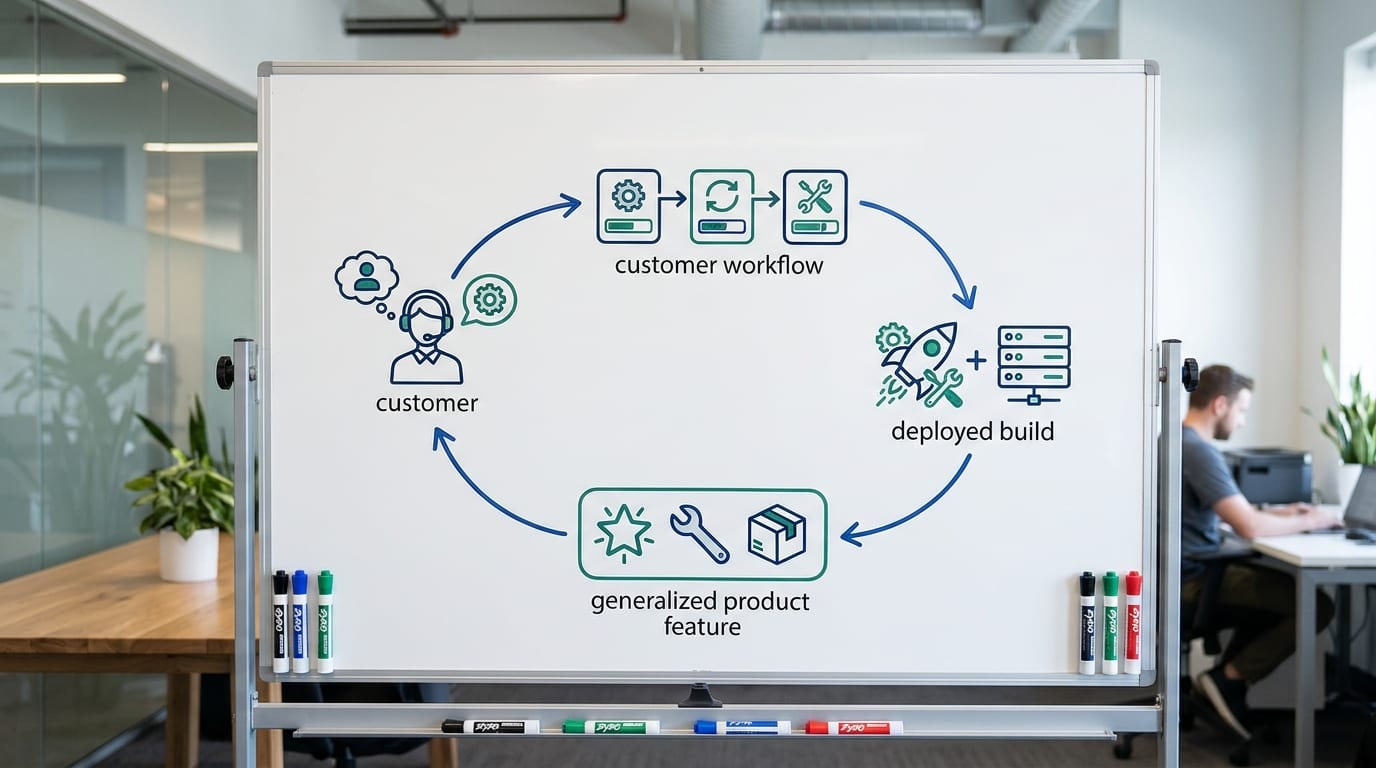
The feedback loop is the model. Everything else is professional services.
This is the part we agree with without qualification.
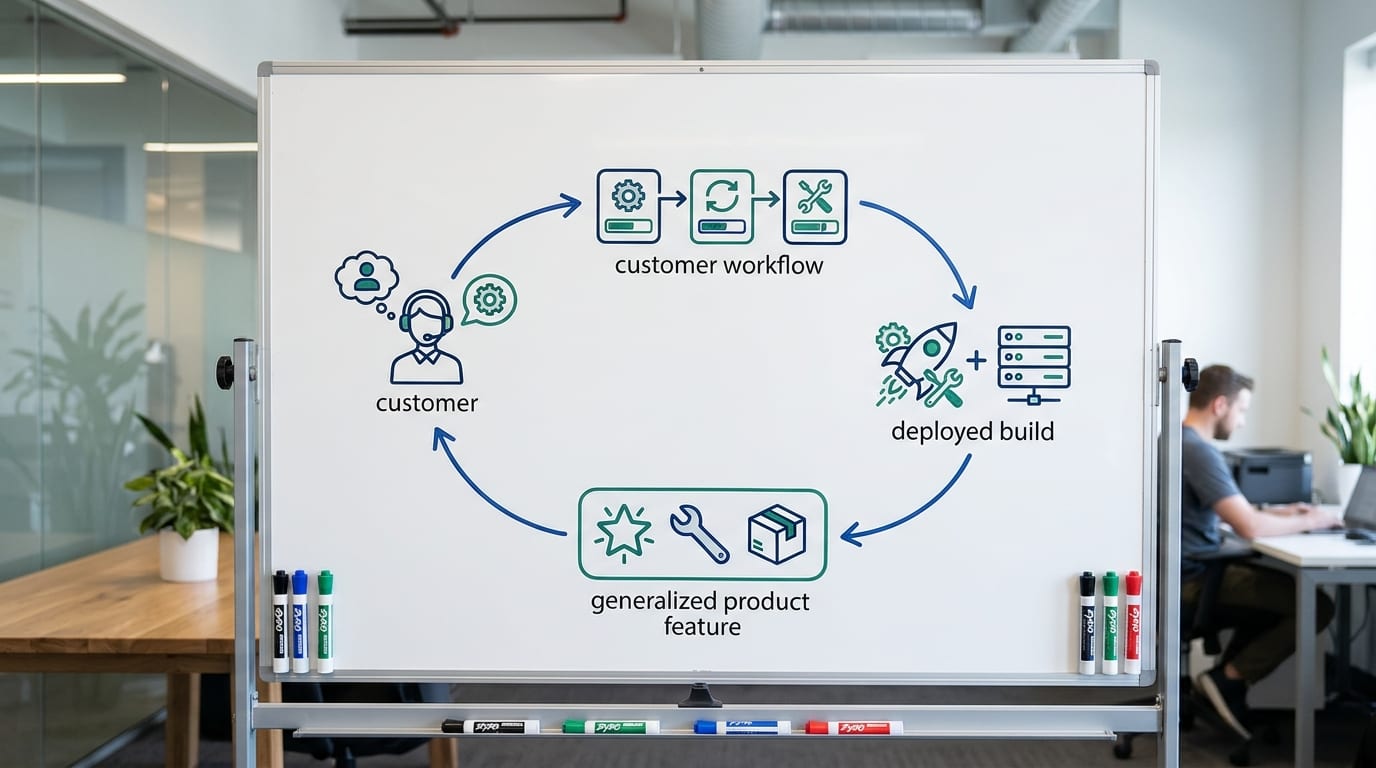
PostHog's engineering team described it in WTF is a forward deployed engineer?: "Those learnings then get used by core product teams, who generalize them for other customers." One sentence, and it contains the entire difference between an FDE function and a staffing line item.
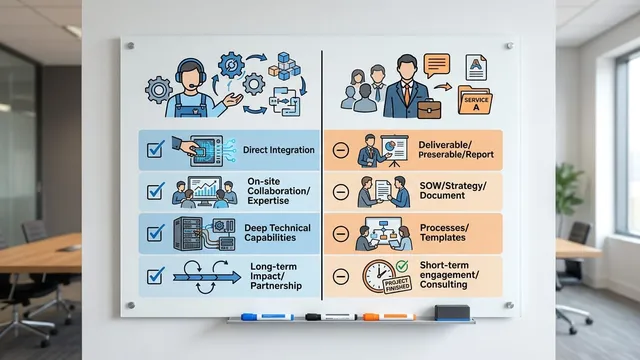
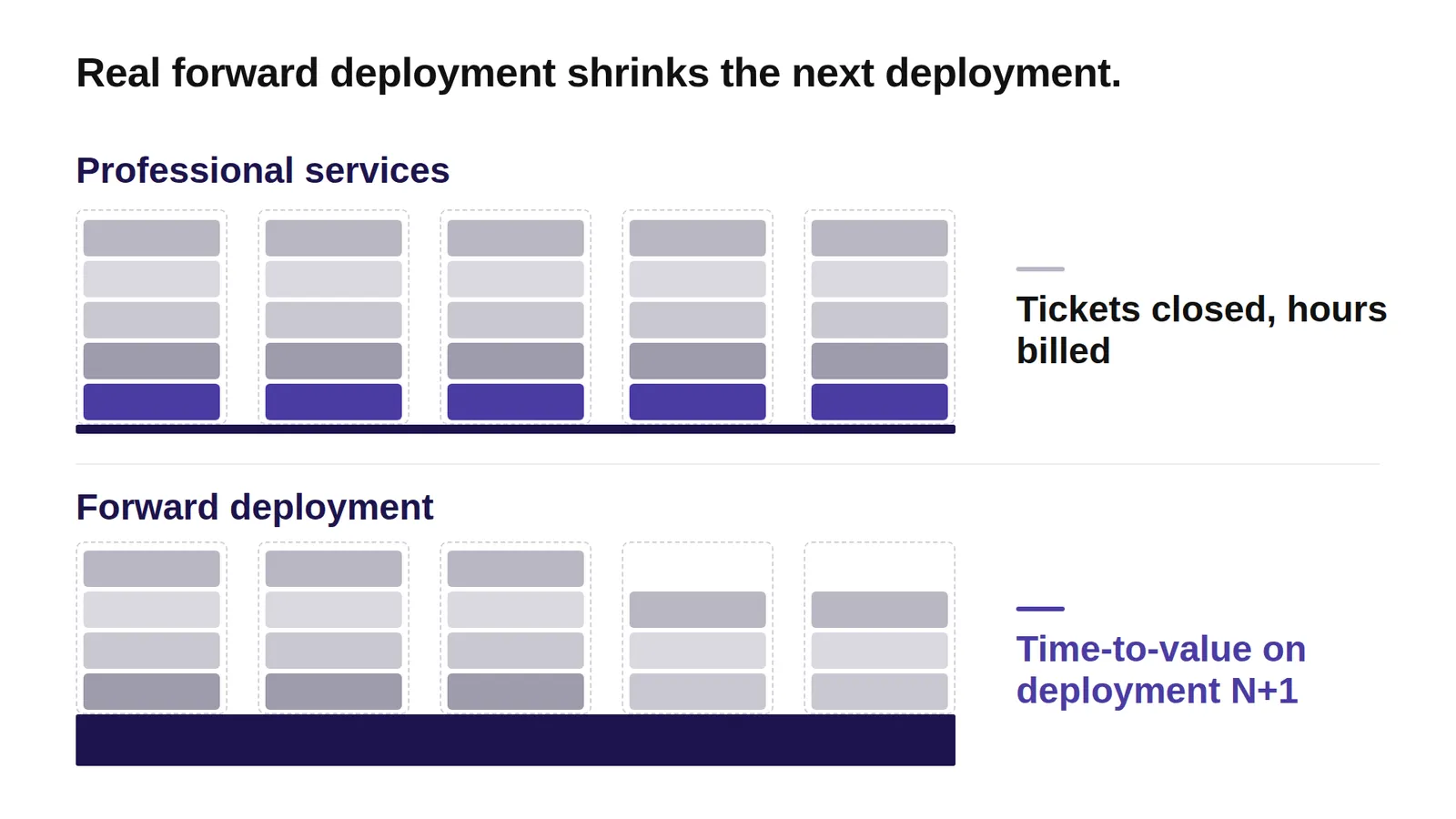
Jision said the harsher version in Forward Deployed Engineering Is Real. Most of What Companies Are Building Is Not.: "Sitting with the customer was never the point. Plenty of companies embed engineers with customers. That is called professional services." Agreed, and we'd add the operational tell. Professional services bills hours and closes tickets. An FDE function closes tickets and reduces the number of tickets the next customer generates. If your deployed engineers aren't shrinking the next deployment, you don't have a model. You have a cost center with a prestigious title.
The test is boring and measurable:
| Signal | Professional services | Real forward deployment |
|---|---|---|
| Where the work lands | Customer's instance only | Customer's instance, then the core product |
| Backlog owner | Account manager or CS | Shared with product, with a named owner |
| Success metric | Tickets closed, hours billed | Time-to-value on deployment N+1 |
| What gets refused | Nothing the customer pays for | Requests that don't generalize |
| Deployment count per person | High, because volume is the business | Low, because depth is the input |
That last row is where FDE washing shows up fastest. Ask how many customers one deployed engineer carries. If the answer is eight, they're a solutions engineer with a new business card.
a16z is right about the moat and partly wrong about the shape
a16z made the loudest case in Trading Margin for Moat, with the line everyone quotes: "Enterprises buying AI are like your grandma getting an iPhone: they want to use it, but they need you to set it up."
Funny and basically correct about the current moment. Procurement Tidbits summarized the thesis fairly in Your vendor's forward-deployed engineer is moving in... Plan the move-out!: "a16z argued in 2025 that AI startups optimizing for 80% gross margins were being shortsighted, and that hands-on deployment work is what makes software hard to displace."
We partly agree. Trading margin for moat does reverse the orthodoxy Otter described, where "two years ago or so, much of venture capital and the associated punditry insisted that all B2B products embrace product led growth, PLG." The reversal is real and the margin hit is real.
But a16z also named the failure mode themselves, in The Palantirization of everything: "thousands of bespoke deployments that are impossible to maintain or upgrade." That's not a footnote. That's what happens when you run the margin trade without the generalization discipline. You end up with a moat made of technical debt, which is a moat that keeps you in as effectively as it keeps competitors out.
The grandma analogy also has a shelf life, and that's the whole point of this article. Grandma learned the iPhone. Setup is now a five-minute onboarding flow. Nobody built a durable business on iPhone setup services.
Where we disagree on staffing
a16z defaults the deployed person to an engineer. We don't. The differentiating skill is product judgment: interrogating the customer's stated solution, finding the workflow underneath it, and refusing the request that won't generalize. Siding with Otter here, the engineering is the price of entry, not the edge.
This is the rant and the good news at once. The role used to require fifteen years to do well, because you needed scar tissue in operations, product, and engineering simultaneously. AI tooling collapsed part of that. A sharp person with clear thinking and a working model of systems and operations can be genuinely dangerous in this role at four or five years in. That's good for careers and good for staffing. It's bad when companies read "shorter rite of passage" as "no rite of passage" and staff the function by headcount instead of judgment. Then you get the margin hit without the moat.
What to build now so you're not stranded
Assume self-serve catches up on the easy 60% of what your FDEs do today. Build for that.
1. Instrument the deployment, not just the product. Log every custom thing you build in the field, tagged by workflow and customer. Review it monthly. If the same custom build shows up three times, it's a product requirement and you've been charging yourself for it. We at Growaton treat a recurring field build as a failed product decision, not a win.
2. Give product a standing claim on field learnings. Not a Slack channel. A named person on the product team who owns the generalization backlog, with exit criteria per item. PostHog's loop only works if someone is paid to close it.
3. Write down what you refuse to build. A public-ish list of out-of-scope requests with the reason attached. This is the single best artifact for distinguishing a real forward-deployed model from dressed-up services work, and it compounds, because the reasons become your product thesis.
4. Split field weeks from build weeks. Hard split, on the calendar. The role burns people because travel, other people's fires, and someone else's resolution clock stack up with no recovery window, and most companies run it at 100% utilization because it bills. Rotation costs capacity. We accept the cost, and we say so out loud rather than pretending the math is free.
5. Set a self-serve target per deployment category. Pick the top three things FDEs do manually and put a date on each for when a customer does it alone. If no date exists, the structure is permanent by default, which is the thing you said it wasn't.
6. Hire for the second job, not the first. The 2028 version of this role is defining correctness, building evaluation sets, and arbitrating edge cases. Judgment and taste, written down, enforced. Hire people who can do that now, let them build integrations today.
The move-out clause, from both sides
Procurement Tidbits wrote that piece for buyers, telling them to plan the move-out before the vendor's FDE moves in. Good advice. Vendors should read it as a product spec.
If your customer can write a credible exit plan for your deployed engineer, you have built something generalizable. If they can't, you've built dependency, and dependency gets renegotiated the moment a competitor ships self-serve for the same workflow. That's the uncomfortable test, and it's the right one.
The humans stay. The integration work doesn't. Plan accordingly.
If you're staffing forward-deployed work right now and can't tell whether it's building product or billable hours, that's a measurable question, not a philosophical one. Book a free diagnostic conversation and we'll look at where your field learnings are actually landing. More on how we run embedded pods is on the Growaton blog.
Ship the product improvements your business needs
Growaton builds custom software, servers and infrastructure, e-commerce platforms, process automation with AI and roadmaps, deploying inside your systems every week with senior review.
product and engineering execution