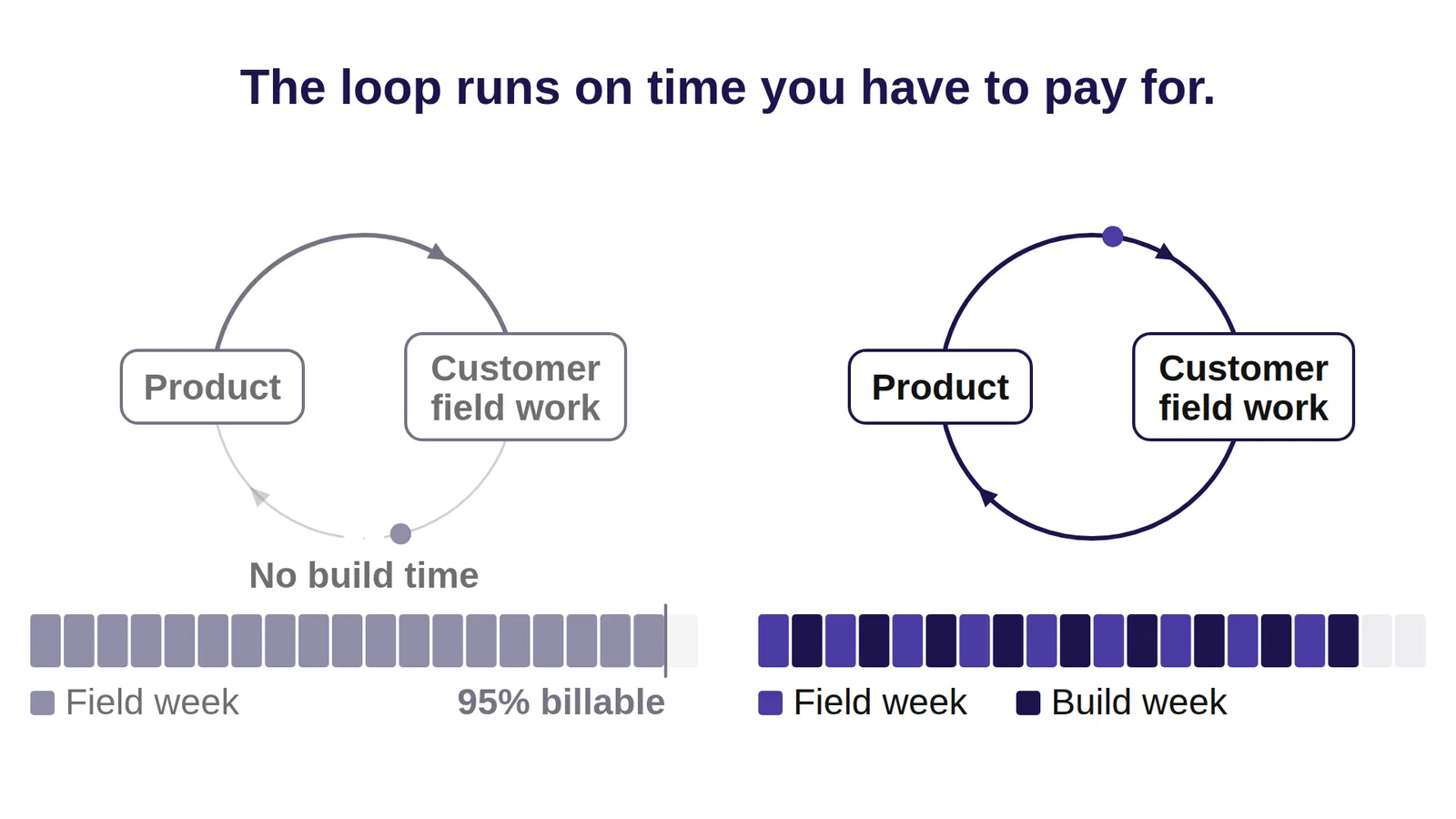
The Forward Deployed Engineer model works. The feedback loop from a customer's messy reality back into the product is the best mechanism most companies have for building something people actually use. That part I agree with.
What I disagree with is how it's being staffed. Most companies hiring FDEs right now are running the role at something close to 100% utilization, because the role bills. Travel, someone else's fires, a resolution clock set by a quarter you don't control, and a skill combination that's genuinely rare. Then a line item that says the person is 95% billable. That math works for two quarters and then the person leaves, and you've lost the one human who understood why the client's ingestion pipeline was built the way it was.
The answer isn't to stop deploying people forward. It's to price the burn honestly and build the calendar around it. At Growaton we do it with rotation windows and a hard split between field weeks and build weeks. It costs capacity. We accept the cost, and we say so out loud when we scope work, because the alternative is pretending a person is a resource with a 100% uptime SLA.
What the role actually costs, in units people recognize
Start with what the people writing about this have already said, because they're not hiding it.
LeadDev puts it plainly: "Sustainability is shaky: rare skills, heavy travel, and real burnout risk." That's the open question, and I partly agree. I agree that it's shaky when run the way most companies run it. I don't think it's inherent to the work.
PostHog is more specific about the load: FDEs "do a ton of meetings and customer-facing work and are often required to travel 20-50% of the time." Fifty percent travel is not a perk. It's a 50% reduction in deep work capacity, plus recovery time that nobody schedules.
Even Wikipedia's entry on the role, which is about as neutral a source as exists, notes that "some software engineers consider the role to be undesirable because of the travel requirements and pressure to solve customer problems within relatively short amounts of time." When the encyclopedia version of a job description contains a warning, the warning is load-bearing.
Here's the piece nobody lines up next to the others. The pressure is not just "solve it fast." It's solve it fast against a clock you did not set. The client's quarter-end, the client's board deck, the client's integration freeze. A product engineer working a roadmap can negotiate scope. A deployed engineer inside someone else's operation mostly cannot. They inherit a deadline, inherit a system they didn't design, and inherit the political context of why the previous attempt failed.
| Load factor | What it looks like on a calendar | What most staffing plans assume |
|---|---|---|
| Travel | 20-50% of weeks, per PostHog | Billable hours, no recovery |
| Meetings and customer-facing work | Most of the field week | "Engineering time" |
| Resolution clock | Set by the client's quarter | Negotiable scope |
| Context switching | 2-4 client systems in a head | One codebase |
| Rare skill combo | Product + ops + eng in one person | Replaceable headcount |
Four of those five columns are mispriced. That's the whole problem.
The feedback loop is the model, and the loop is what breaks first
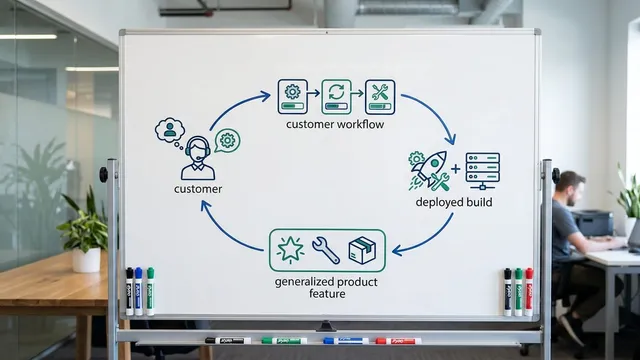
PostHog describes the payoff well: learnings from the field "get used by core product teams, who generalize them for other customers." I agree completely. That generalization step is the entire reason the role exists instead of just being a services line.
a16z names the failure mode on the other side, "thousands of bespoke deployments that are impossible to maintain or upgrade." I think a16z is right that this is the risk and right that implementation-heavy software can out-build self-serve competitors. Where I'd push back is on who holds the pen, but that's a different argument. Here the point is narrower: the thing that prevents bespoke sprawl is the generalization step, and the generalization step requires the deployed person to have time that is not in front of a customer.
Which is exactly the time that gets cut first.
When you run someone at full field utilization, you don't lose the shipping. Shipping is what's visible, so it survives. What you lose is the write-up, the refactor, the conversation with the core product team about which three of eight client hacks should become a feature. You lose the loop. And then you have a services business with an engineering cost structure, which is the worst of both.
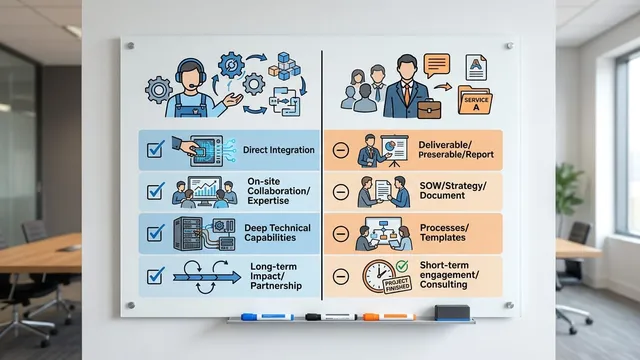
Jision put the distinction sharply on Medium: "Sitting with the customer was never the point. Plenty of companies embed engineers with customers. That is called professional services." Agreed, and I'd add the mechanical version: the difference between FDE and professional services is a calendar artifact. If there is no protected block where field learning becomes product, you are running professional services and calling it something newer.
What we do instead
Three practices. None of them are clever. All of them cost money, which is why they're rare.
1. A hard split between field weeks and build weeks
Not a soft split. Not "80/20 as capacity allows." A pod member in a field week is in the client's reality: their systems, their standups, their incidents. A pod member in a build week is unreachable for client escalation and is doing one of three things: generalizing what they learned into reusable product or internal tooling, paying down the shortcuts they took in the field, or writing the thing down so the next person doesn't rediscover it.
We run these in alternating blocks rather than splitting days inside a week, because a half-day of build time next to a client Slack channel is not build time. It's interrupted field time with a different label.
The honest cost: you need coverage for the client during build weeks. That means a second named person on the account, which means you are paying for redundancy. We price it in. Clients who want a single heroic individual at a lower rate are better served by someone else, and we tell them that in the diagnostic call rather than nine weeks in.
2. Rotation windows
Nobody sits on the same client operation indefinitely. We set an explicit window, and at the end of it the person either rotates to a different account or rotates into a build-heavy stretch.
Two reasons. The first is burnout, which is the one everybody names. The second matters more to the business: a person who has been in one client's system for a year stops seeing it. They've absorbed the client's assumptions, including the wrong ones. Rotation is how you keep the ability to say this request is the symptom, not the problem. That refusal is the highest-value thing a deployed person does, and it decays with tenure on a single account.
Rotation also means handover has to be real, which forces documentation to exist. A system that only one person can operate is a liability you're calling a specialty.
3. Capacity planned under 100%, deliberately
We don't scope pods to full utilization. The buffer absorbs client fires, travel recovery, and the generalization work that has no client to bill it to.
Someone will do this arithmetic and conclude we're leaving margin on the table. Correct. We're trading margin for retention and for the product loop. The counter-trade is a team that bills 95% for two quarters and then hands you two resignations and a deployment nobody can upgrade, which is the a16z failure mode arriving through the people door instead of the code door.
Why this role burns people faster than regular product engineering
The rare skill combination is the part that gets undersold. A forward deployed person needs a working model of systems, a working model of operations, and enough product judgment to interrogate a stated request. That's three muscles.
My broader read on the role, which I've written about across this series, is that it's largely a rebrand of what unusually operational product people have done for years, usually product folks with an engineering background. The useful part of the rebrand is that it shortens the rite of passage: you no longer need fifteen years to be dangerous in a client's systems, you need clear thinking plus a real model of how systems and operations behave. That's genuinely good news, and I'd rather have the shortcut than not.
But the shortcut has a tax. Someone operating at the edge of their experience, inside someone else's production environment, on someone else's clock, carries a cognitive load that a principal engineer doing the same work does not. They're pattern-matching with fewer patterns. That is survivable and often the right trade, and it is not free. If you've hired the role precisely because it lets you staff sharp mid-level operators instead of fifteen-year veterans, the support structure around them is not optional overhead. It is the thing that makes the shortcut work.
In our model that means five levels of ownership with written exit criteria, so it's explicit which decisions a person can make alone and which escalate. Enterprise security review, multi-year platform bets, and architectural calls with a long blast radius go to someone senior. Not because the mid-level person can't reason about them, but because being wrong on those is expensive in a way that compounds, and carrying that weight alone is a large part of what burns people out.
Four questions to ask before you staff this role
If you're building an FDE function, or buying one, these separate a sustainable model from a billable one.
- How many customers does one deployed person carry? More than two or three and the generalization work is already gone. They're triaging.
- What's on the calendar that isn't client-facing? If the answer is "they write things up when they have time," there is no loop. Ask to see the block.
- What has this person refused to build? A deployed engineer who has never pushed back on a client's stated solution is an order-taker with travel expenses. Refusal is evidence of product judgment.
- Who covers the account when this person is off? If the answer is a name, good. If the answer is "the client waits," you've built a single point of failure and the person knows it, which is why they can't actually take the time off.
That fourth one is where most plans fall apart. Rotation and build weeks only exist if someone else can hold the account. Everything else is intention.
The part I'll admit I'm unsure about
I don't know whether this shape of the role is durable. Several writers frame forward deployment as temporary human grounding for systems that can't yet self-serve into an enterprise, and I think that's partly right. The humans don't go away, but the work moves: less building the integration, more defining what good looks like and verifying that it happened.
If that's where it's heading, the sustainability problem changes shape rather than disappearing. Less travel, maybe. Same resolution clock, same ownership of other people's fires, same requirement to hold product judgment under pressure. I wouldn't bet on the current org design lasting, and I'd bet heavily that the people who can interrogate a client's stated solution stay valuable regardless of what the title becomes.
What I'm confident about: if you run this role at full utilization because it bills, you will get the margin hit without the moat. The moat is the loop from field to product, and the loop runs on time you have to pay for.
If you're standing up an embedded team and trying to figure out what the real capacity math looks like, that's a reasonable thing to pressure-test with someone who's made the trade. Book a free diagnostic conversation and bring your current staffing plan. We'll tell you where it breaks.
Ship the product improvements your business needs
Growaton builds custom software, servers and infrastructure, e-commerce platforms, process automation with AI and roadmaps, deploying inside your systems every week with senior review.
product and engineering execution